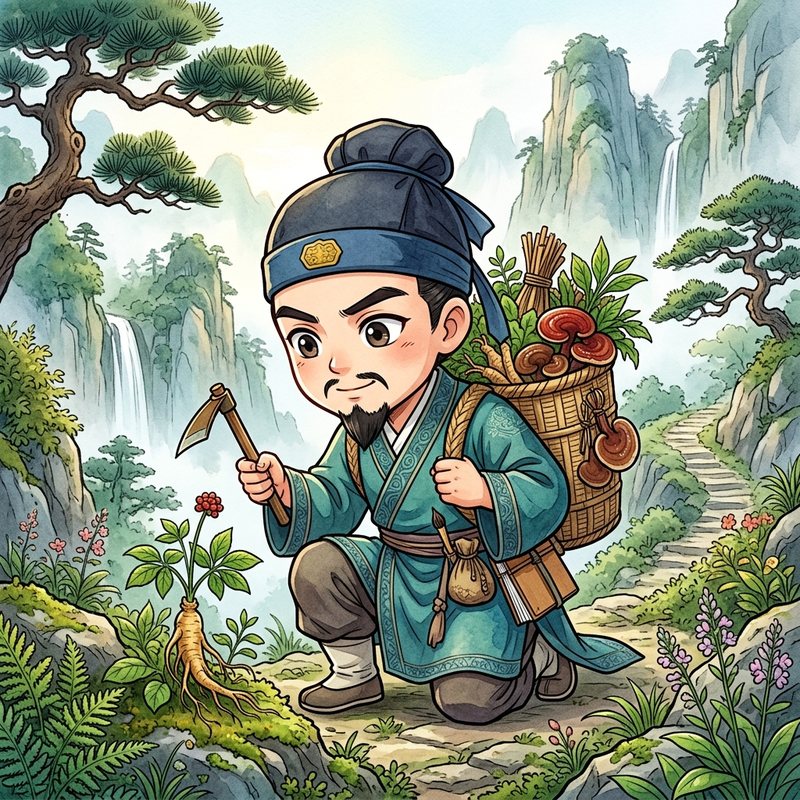
The Master Herbalist & Author of Materia MedicaMing Dynasty (1518-1593)字东璧 · 号濒湖山人 · 医圣Audio Journey · 8 Stops
Trekked thousands of miles tasting toxic herbs to author the ancient encyclopedia praised by Darwin.
The Prince of Eastern Pharmacists· Carl Linnaeus & ParacelsusThe Pioneer of Empirical Biology· Charles Darwin & Pliny the Elder
Unfolding the Historical Landscape…
印
Daily Wisdom & Resilience Oracle
The Master Botanist
“身如逆流船,心比铁石坚。望父全儿志,至死不怕难。”
My body is like a boat against fierce currents; my heart is firmer than iron and stone. I pray my father fulfills my quest, for I shall fear no hardship until death.
💡 Renouncing imperial civil examinations to master medical natural history, Li Shizhen commits his life to saving others.
— Li Shizhen(The Master Herbalist & Author of Materia Medica)
Historical Footprints & Narration Archive
8 Stations
1
Qizhou, Qichun (Hubei)
1538 CE · Age 20
Herbal medicine cradle along the Yangtze where Li Shizhen was born, Qichun, Hubei
Renouncing the Imperial Exams to Heal Human Suffering
Cut away the redundant, supply what is missing, and correct what is false.
Station Narration Script
Born in 1518 to physicians in Qichun, Li Shizhen abandoned the exams after three failures. He vowed to practice medicine by the creed: cut redundancy, supply omissions, correct falsehoods.
Departure Transition Script
His skill won fame across Chu; he was invited to the Prince of Chu's medical bureau in Wuchang.
2
Prince of Chu Estate, Wuchang (Wuhan, Hubei)
1551 CE · Age 34
Ducal palace medical office on the middle Yangtze, Wuhan, Hubei
Curing Incurable Royalty: Gaining Access to Secret Imperial Medical Texts
Medicine is the art of deep comprehension; its divine mastery connects harmoniously with the cosmos.
Station Narration Script
As head of the Chu palace clinic he cured the prince's heir. Night study of rare texts taught him: 'The physician works through insight—sacred skill that communes with Heaven and Earth.'
Departure Transition Script
Recommended for excellence, he entered the Imperial Medical Academy in Beijing.
3
Imperial Medical Academy, Beijing
1556 CE · Age 39
Ming imperial academy of medicine where Li Shizhen accessed the imperial library, Beijing
Walking Away from the Capital: 'Ancient Medical Books Are Killing People'
Ancient books contain confused classifications and inherited errors passed down for centuries—they must be corrected!
Station Narration Script
At the Imperial Academy he found materia medica riddled with deadly errors—even mercury sold as elixir. 'Categories are confused, commentaries perpetuate falsehoods—they must be corrected!' He resigned to rewrite the truth.
Departure Transition Script
Back among the people, he shouldered a medicine basket into the Wudang mountains to test herbs himself.
4
Mount Wudang (Shiyan, Hubei)
1560 CE · Age 43
Misty Daoist mountain sanctuary where Li Shizhen collected rare medicinal herbs, Hubei
Testing Deadly Toxins on Himself: The Discovery of Herbal Anesthesia
Mandala flower, taken with warm wine, causes intoxicating numbness in moments; surgery and cauterization may proceed without pain.
Station Narration Script
On Wudang cliffs he not only collected specimens but tasted datura in measured doses: 'Taken in warm wine, it soon brings a drunken haze—cutting sores or moxa, one feels no pain.' Empirical anesthesia was born.
Departure Transition Script
He then crossed south to Jiujiang and climbed misty Mount Lu to verify cliff herbs in situ.
5
Mount Lushan (Jiujiang, Jiangxi)
1565 CE · Age 48
Misty sacred peaks where Li Shizhen collected rare alpine herbs, Jiujiang, Jiangxi
Distinguishing Look-Alike Herbs on Misty Mountain Precipices
Observe its form with your eyes, taste its essence with your mouth, immerse yourself in its habitat—only then is true knowledge gained.
Station Narration Script
On Lu's cliffs he distinguished look-alike herbs and interviewed gatherers, correcting hundreds of deadly misidentifications. 'See the form, taste the flavor, walk the ground—only then is knowledge true.'
Departure Transition Script
From Lu he entered Poyang Lake country to learn from fishers and woodcutters.
6
Poyang Lake (Jiangxi)
1570 CE · Age 53
Expansive freshwater wetland surveyed for aquatic fauna and flora, Jiangxi
Learning from Fishermen: Transforming Folk Wisdom into Universal Science
Farmers and fishermen are all my teachers; mountains, rivers, and flora are all my living library.
Station Narration Script
By Poyang Lake he studied aquatic remedies with fishers and snake venom with hunters: 'Farmers and fishers are all my teachers; mountains and plants are all my books.'
Departure Transition Script
After twenty-seven years, at sixty-one, he carried the finished manuscript to Nanjing for printing.
7
Jinling / Nanjing (Jiangsu)
1578 CE · Age 61
Famed printing center of the Ming Dynasty where the Compendium was engraved, Nanjing
Twenty-Seven Years, 1.9 Million Words: The Magnum Opus Completed
Like entering a grand garden of golden flowers—diverse in hues yet distinct in orders; each displaying divine radiance and unmatched marvel.
Station Narration Script
Three revisions later, Nanjing saw the Compendium of Materia Medica—fifty-two juan, nearly two million characters, 1,892 drugs. Wang Shizhen praised it as entering the Golden Valley garden where every species stands distinct.
Departure Transition Script
In old age he returned to Qichun to await the finished printing—a life given to human health.
8
Qichun (Hubei)
1593 CE · Age 75
Herbal medicine cradle along the Yangtze where Li Shizhen completed the Compendium, Hubei
Darwin's Tribute: The Ancient Chinese Encyclopedia for All Humankind
From Shennong's ancient herbal until now, herbal medicine reaches its ultimate completion. Blessing the nation, longevity to people, enriching all humanity.
Station Narration Script
In 1593, as printing neared completion, Li Shizhen died at seventy-five in Qichun. 'The Divine Farmer's materia medica is at last complete—prolonging the life of state and people.' Darwin later called it an ancient Chinese encyclopedia.
Key Historical Inquiries & Context
· 核心史实公案与速览
Revered by Charles Darwin as 'the ancient Chinese encyclopedia', Li Shizhen's Compendium of Materia Medica is a monumental landmark in global botanical and medical science. Spending 27 years trekking through high mountains, tasting toxic herbs, and consulting fishermen and woodcutters, he corrected centuries of errors.
Revered by Charles Darwin as 'the ancient Chinese encyclopedia', Li Shizhen's Compendium of Materia Medica is a monumental landmark in global botanical and medical science. Spending 27 years trekking through high mountains, tasting toxic herbs, and consulting fishermen and woodcutters, he corrected centuries of errors.
QWhat was Li Shizhen (Dongbi)'s primary cultural and historical legacy?
Li Shizhen (Dongbi) is celebrated across world history as a pioneer of The Prince of Eastern Pharmacists, The Pioneer of Empirical Biology, leaving enduring philosophical insights, literature, and art.
QWhere does Li Shizhen (Dongbi)'s historical life journey map lead?
This interactive GIS map retraces 8 chronological stops across Ming Dynasty China, originating from Qizhou, Qichun (Hubei) and spanning through Qichun (Hubei).
The Complete Life Journey & Biography of Li Shizhen (Bencao Gangmu) (李时珍)
Chronological travel & exile routes mapped to modern Chinese cities across Ming Dynasty (1518-1593) China — featuring bilingual scholar audio, classical poetry recitations, and historical cross-paths.
Qizhou, Qichun (Hubei) (湖北蕲春 (瓦硝坝医药世家启蒙立志))
Age 20
Modern-day analog: Herbal medicine cradle along the Yangtze where Li Shizhen was born, Qichun, Hubei
Renouncing the Imperial Exams to Heal Human Suffering
Born in 1518 to physicians in Qichun, Li Shizhen abandoned the exams after three failures. He vowed to practice medicine by the creed: cut redundancy, supply omissions, correct falsehoods.
His skill won fame across Chu; he was invited to the Prince of Chu's medical bureau in Wuchang.
“Cut away the redundant, supply what is missing, and correct what is false.”
Prince of Chu Estate, Wuchang (Wuhan, Hubei) (湖北武汉 (楚王府良医所医术名震荆楚))
Age 34
Modern-day analog: Ducal palace medical office on the middle Yangtze, Wuhan, Hubei
Curing Incurable Royalty: Gaining Access to Secret Imperial Medical Texts
As head of the Chu palace clinic he cured the prince's heir. Night study of rare texts taught him: 'The physician works through insight—sacred skill that communes with Heaven and Earth.'
Recommended for excellence, he entered the Imperial Medical Academy in Beijing.
“Medicine is the art of deep comprehension; its divine mastery connects harmoniously with the cosmos.”
Imperial Medical Academy, Beijing (北京 (太医院任职目睹古籍纰漏立志重修本草))
Age 39
Modern-day analog: Ming imperial academy of medicine where Li Shizhen accessed the imperial library, Beijing
Walking Away from the Capital: 'Ancient Medical Books Are Killing People'
At the Imperial Academy he found materia medica riddled with deadly errors—even mercury sold as elixir. 'Categories are confused, commentaries perpetuate falsehoods—they must be corrected!' He resigned to rewrite the truth.
Back among the people, he shouldered a medicine basket into the Wudang mountains to test herbs himself.
“Ancient books contain confused classifications and inherited errors passed down for centuries—they must be corrected!”
Mount Wudang (Shiyan, Hubei) (湖北十堰 (攀武当悬崖亲尝曼陀罗毒草))
Age 43
Modern-day analog: Misty Daoist mountain sanctuary where Li Shizhen collected rare medicinal herbs, Hubei
Testing Deadly Toxins on Himself: The Discovery of Herbal Anesthesia
On Wudang cliffs he not only collected specimens but tasted datura in measured doses: 'Taken in warm wine, it soon brings a drunken haze—cutting sores or moxa, one feels no pain.' Empirical anesthesia was born.
He then crossed south to Jiujiang and climbed misty Mount Lu to verify cliff herbs in situ.
“Mandala flower, taken with warm wine, causes intoxicating numbness in moments; surgery and cauterization may proceed without pain.”
Mount Lushan (Jiujiang, Jiangxi) (江西九江 (攀登庐山绝壁纠正历代医书错谬))
Age 48
Modern-day analog: Misty sacred peaks where Li Shizhen collected rare alpine herbs, Jiujiang, Jiangxi
Distinguishing Look-Alike Herbs on Misty Mountain Precipices
On Lu's cliffs he distinguished look-alike herbs and interviewed gatherers, correcting hundreds of deadly misidentifications. 'See the form, taste the flavor, walk the ground—only then is knowledge true.'
From Lu he entered Poyang Lake country to learn from fishers and woodcutters.
“Observe its form with your eyes, taste its essence with your mouth, immerse yourself in its habitat—only then is true knowledge gained.”
Modern-day analog: Expansive freshwater wetland surveyed for aquatic fauna and flora, Jiangxi
Learning from Fishermen: Transforming Folk Wisdom into Universal Science
By Poyang Lake he studied aquatic remedies with fishers and snake venom with hunters: 'Farmers and fishers are all my teachers; mountains and plants are all my books.'
After twenty-seven years, at sixty-one, he carried the finished manuscript to Nanjing for printing.
“Farmers and fishermen are all my teachers; mountains, rivers, and flora are all my living library.”
Modern-day analog: Famed printing center of the Ming Dynasty where the Compendium was engraved, Nanjing
Twenty-Seven Years, 1.9 Million Words: The Magnum Opus Completed
Three revisions later, Nanjing saw the Compendium of Materia Medica—fifty-two juan, nearly two million characters, 1,892 drugs. Wang Shizhen praised it as entering the Golden Valley garden where every species stands distinct.
In old age he returned to Qichun to await the finished printing—a life given to human health.
“Like entering a grand garden of golden flowers—diverse in hues yet distinct in orders; each displaying divine radiance and unmatched marvel.”
Modern-day analog: Herbal medicine cradle along the Yangtze where Li Shizhen completed the Compendium, Hubei
Darwin's Tribute: The Ancient Chinese Encyclopedia for All Humankind
In 1593, as printing neared completion, Li Shizhen died at seventy-five in Qichun. 'The Divine Farmer's materia medica is at last complete—prolonging the life of state and people.' Darwin later called it an ancient Chinese encyclopedia.
“From Shennong's ancient herbal until now, herbal medicine reaches its ultimate completion. Blessing the nation, longevity to people, enriching all humanity.”