Chronological travel & exile routes mapped to modern Chinese cities across Late Qing & Modern Republic China — featuring bilingual scholar audio, classical poetry recitations, and historical cross-paths.
Shaoxing (Ancestral Home & Sanwei Study) (浙江绍兴(百草园与三味书屋))
Age 1Modern-day analog: Shaoxing Old City, Zhejiang Province
Born into a scholar-gentry family in Shaoxing, the sudden fall of his household forced him to shuttle between pawnshops and pharmacies, tasting early sorrow.
In the Baicao Garden of Shaoxing's old town, young Zhou Shuren found his freest hours—listening to crickets, pulling wild herbs, and carving the character 'Early' into his desk at Sanwei Study to spur himself on. His father's illness drained the family fortune, and he spent his boyhood standing on tiptoe at pawnshop counters, reading the cold contempt in neighbors' eyes. These early tastes of a callous world gave him an unshakable clarity about the devouring nature of feudal ritual. Years later he would write that hope is like a path across the earth—originally there is none, but as more people walk, one comes into being. It was the path he meant to tread all his life.
But the fallen household could no longer shelter a boy's dreams of learning. To break free of the feudal family's grip, seventeen-year-old Zhou Shuren said farewell to his hometown and boarded a train for Nanjing's new academies, eager to breathe a different air.
“For hope is like a path across the earth: originally there is no path, but as more people walk, a path comes into being.”
从百草园到三味书屋,其实地上本没有路,走的人多了,也便成了路。 (Qí shí dì shàng běn méi yǒu lù, zǒu de rén duō le, yě biàn chéng le lù.)
Nanjing (School of Mines and Railways) (南京(矿路学堂,呼吸新思想))
Age 17Modern-day analog: Modern Nanjing, Jiangsu Province
Enrolling in tuition-free modern technical academies in Nanjing, he avidly read Huxley's 'Evolution and Ethics', discovering Western scientific thought.
Amid the coal smoke and machinery of Nanjing's School of Mines and Railways, Zhou Shuren devoured Yan Fu's translation of Huxley's 'Evolution and Ethics'. The words 'survival of the fittest' struck like a bolt of lightning through his old world. Resolved to 'walk strange paths and seek different people', he cast aside archaic scholasticism and threw himself wholeheartedly into modern science. Graduating first in his class, he won a state scholarship to study in Japan. The boy who had grown up at pawnshop counters had finally seized the key to changing his own fate.
Carrying the sharp edge of evolutionary thought and a burning wish to save his country, he crossed the sea to Japan. At the medical academy in Sendai he hoped to heal his people's bodies—until a magic-lantern slide show would rewrite the course of his life.
“To walk strange paths, to flee to other lands, and to seek different kinds of people.”
走异路,逃异地,去寻求别样的人们。 (Zǒu yì lù, táo yì dì, qù xún qiú bié yàng de rén men.)
Sendai Medical Academy (Japan) (日本仙台(幻灯片事件,弃医从文))
Age 23Modern-day analog: Tohoku University, Sendai, Miyagi Prefecture, Japan
Watching slide projections of fellow Chinese standing numb as a spy was executed during the Russo-Japanese War, he realized curing souls mattered more than physical medicine.
In the anatomy hall at Sendai, Dr. Fujino patiently corrected his lecture notes in red ink, offering warmth amid the prejudice of a foreign land. But a magic-lantern slide in one class shattered everything: images of the Russo-Japanese War showed Chinese onlookers watching numbly as a compatriot was executed. It struck him to the heart—a weak and foolish people, however sound their bodies, could only serve as meaningless spectacles and idle spectators. He realized that medicine could heal bodies but never souls; only literature could awaken a sleeping nation. He abandoned medicine for writing, vowing to pledge his blood to China.
Carrying his vow to pledge his blood to China, he returned to Beijing, copying ancient inscriptions under the locust trees of the Shaoxing Guild Hall in brooding silence. For over a decade he lay dormant—until Qian Xuantong's knock roused the sleeping pen to life.
“I send my thoughts to cold stars, though the Fragrant One heeds them not; with my own blood I pledge myself to the Yellow Emperor!”
寄意寒星荃不察,我以我血荐轩辕。 (Jì yì hán xīng quán bù chá, wǒ yǐ wǒ xuè jiàn Xuān Yuán.)
Beijing (New Culture Movement & Shaonshan) (北京(新青年,《狂人日记》与《呐喊》))
Age 37Modern-day analog: Shaoxing Guild Hall, Xuanwumen, Beijing
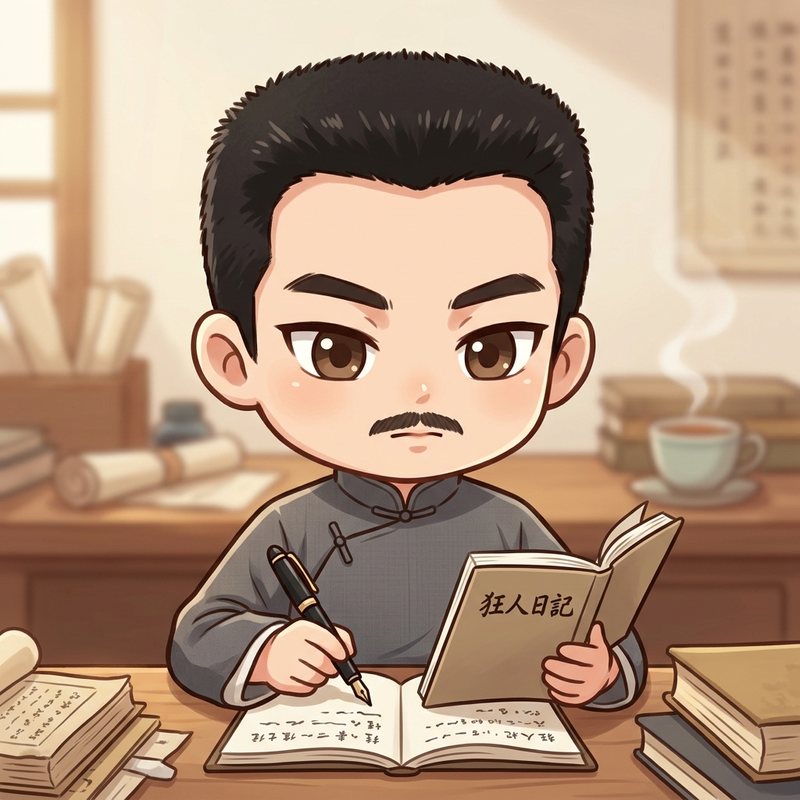
Living in the Shaoxing Guild Hall, he published China's first modern vernacular short story 'Diary of a Madman' in New Youth magazine, piercing the silent 'iron house'.
On a summer night in Beijing's Shaoxing Guild Hall, Zhou Shuren copied ancient inscriptions under the locust trees. His friend Qian Xuantong urged him to write. Lu Xun asked: if people sleep inside an airtight iron house and are about to die, and one shouts aloud to wake the sensitive few—can one truly say there is no hope of breaking free? So, under the pen name Lu Xun, he published China's first modern vernacular story, 'Diary of a Madman'. Opening history, he read between the lines and found two words scrawled across every page—'Eat People!' Then 'The True Story of Ah Q' dissected the national character, shaking the whole country. At last, a crack of light split the iron house.
From 'Diary of a Madman' to 'The True Story of Ah Q', Lu Xun wielded his pen like a scalpel, laying bare the sickness of old China. As the northern wind grew harsher, he decided to head south, carrying the flame into the storm of Xiamen and Guangzhou.
“I opened the history books; there were no dates, but on each page were scrawled the words 'Benevolence and Morality'. I could not sleep, and scrutinizing between the lines until midnight, I finally deciphered the words written across every volume: Eat People!”
我翻开历史一查,这历史没有年代,歪歪斜斜的每页上都写着‘仁义道德’几个字。我横竖睡不着,仔细看了半夜,才从字缝里看出字来,满本都写着两个字是‘吃人’! (Wǒ fān kāi lì shǐ yī chá...)
Xiamen & Guangzhou Universities (厦门与广州(南下播火,直面风暴))
Age 45Modern-day analog: Xiamen University, Fujian & Sun Yat-sen University, Guangzhou
Journeying south to lecture at Xiamen and Sun Yat-sen Universities, he witnessed the volcanic upheaval of the Great Revolution and defended progressive youth.
In the sea breeze of Xiamen University, Lu Xun wrote the lyrical memoir 'Dawn Blossoms Plucked at Dusk'. Then he journeyed south to Guangzhou, becoming Dean of Sun Yat-sen University. But in 1927 the bloody storm broke—soldiers arrested and killed young students by the hundreds. Lu Xun rushed to ransom imprisoned activists and, in fury, resigned every academic post in protest. 'Games of blood cannot endure,' he declared, while reflecting bitterly on how powerless words were before guns. Carrying this clarity and grief, he resolved to go to Shanghai and fight on with his pen as a dagger.
Carrying his denunciation of 'games of blood' and his faith in the light, Lu Xun arrived in Hongkou, Shanghai. In the darkness of that glittering metropolis, he would spend his final decade honing his essays into the sharpest of daggers.
“Games of blood cannot endure; their effectiveness lasts only so long as deceit prevails.”
血的游戏是不能长久的,有效也只是在欺瞒的时期。 (Xuè de yóu xì shì bù néng cháng jiǔ de.)
Shanghai (The Dagger and Shield of Essays) (上海(鲁迅存故里,韧性战斗))
Age 55Modern-day analog: Hongkou District, Shanghai
Residing in Shanghai for his final decade, he led the League of Left-Wing Writers, wielding thousands of essays as surgical blades until his final breath.
In a cramped room on Dalu Xincun in Hongkou, watched by spies and under bounty warrants, Lu Xun wrote over a thousand razor-sharp essays under dozens of pseudonyms, striking at darkness and shielding young left-wing writers like Rou Shi and Hu Yepin. He led the League of Left-Wing Writers until his strength gave out. On the morning of October 19, 1936, he died in Shanghai. Tens of thousands of ordinary people poured into the streets to escort his coffin, which was draped with a banner reading 'Soul of the Nation'. 'Fierce-browed, I coolly defy a thousand pointing fingers; head-bowed, like a willing ox I serve the children'—with his whole life, he wrote out that iron backbone and that boundless devotion.
“Fierce-browed, I coolly defy a thousand pointing fingers; head-bowed, like a willing ox I serve the children.”
运交华盖欲何求,未敢翻身已碰头。横眉冷对千夫指,俯首甘为孺子牛。 (Yùn jiāo huá gài yù hé qiú, wèi gǎn fān shēn yǐ pèng tóu. Héng méi lěng duì qiān fū zhǐ, fǔ shǒu gān wéi rǔ zǐ niú.)