Chronological travel & exile routes mapped to modern Chinese cities across Yuan Dynasty / Venice (1254-1324) China — featuring bilingual scholar audio, classical poetry recitations, and historical cross-paths.
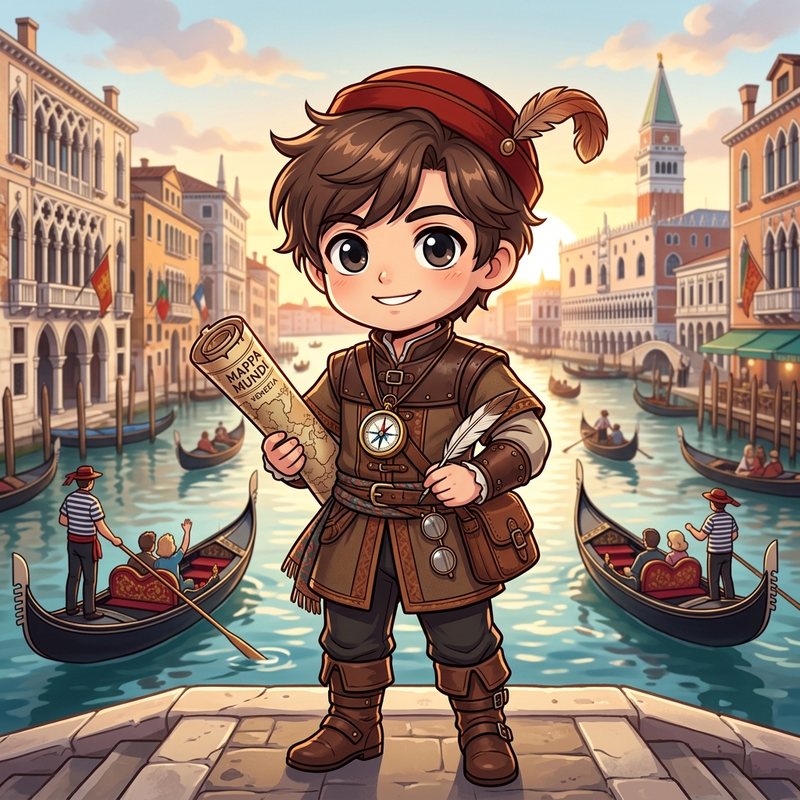
Venice, Republic of Venice (意大利威尼斯共和国 (水城启程))
Age 17Modern-day analog: Queen of the Adriatic and maritime merchant republic, Venice, Italy
A Seventeen-Year-Old Bidding Farewell to the Grand Canal
In 1271, seventeen-year-old Marco Polo bid farewell to the canals of Venice. Accompanying his father and uncle, he set sail toward the mysterious horizons of Asia, embarking on a twenty-four-year global odyssey.
Sailing across the Mediterranean to Acre, the newly elected Pope blessed the Polos with credentials and sacred oil for the Great Khan, after which the caravan pushed deep into Persia.
“The world is wide and rich in wonders for those who dare to cross its borders.”
世界辽阔无垠,等待着无畏者去亲眼见证它的奇迹。 (Shìjiè liáokuò wúyín, děngdài zhe wúwèi zhě qù qīnyǎn jiànzhèng tā de qíjì.)
Acre & Jerusalem, Levant (地中海阿卡与耶路撒冷 (受赐圣油))
Age 17Modern-day analog: Crusader seaport and holy crossroads of the Levant, modern Acre, Israel
Holy Oil and Papal Letters for the Great Khan
At the Crusader port of Acre and Jerusalem, Marco secured papal letters and holy oil from the Holy Sepulchre—the earliest diplomatic bridge between the Vatican and the Mongol Empire.
Blessed with papal protection, the caravan rode camels across Mesopotamian plains toward the Strait of Hormuz on the Persian Gulf.
“May these two mighty realms encounter one another in peace and understanding.”
愿这两座相隔万里的伟大帝国,在和平与智慧中相向而行。 (Yuàn zhè liǎng zuò xiānggé wàn lǐ de wěidà dìguó, zài hépíng yǔ zhìhuì zhōng xiāngxiàng ér xíng.)
Strait of Hormuz, Persian Gulf (波斯霍尔木兹海峡 (转行陆路))
Age 18Modern-day analog: Strategic Persian Gulf trading emporium, modern Hormuz, Iran
Ships Tied with Cords: Turning Away from a Watery Grave
At Hormuz, seeing fragile ships stitched with coconut cord without iron nails, the Polos wisely abandoned the sea route to brave the harsh overland mountain trails of Persia instead.
Turning north away from treacherous waters, they marched across Persian deserts for months until the icy jagged peaks of the Pamir Mountains rose before them.
“Their ships are wretched affairs, stitched together with cords made of coconut husk.”
那些船只脆弱得经不起风暴一击,稍有巨浪便将解体沉沦海底。 (Nàxiē chuánzhī cuìruò de jīngbuqǐ fēngbào yījī, shāoyǒu jùlàng biàn jiāng jiětǐ chénlún hǎidǐ.)
Pamir Mountains & Wakhan Corridor (帕米尔高原与瓦罕走廊 (世界屋脊))
Age 20Modern-day analog: Rugged Roof of the World mountain gateway between Central and East Asia
Across the Roof of the World: Wild Sheep with Five-Foot Horns
Across the frozen 'Roof of the World' at fifteen thousand feet, where the intense cold weakened campfire heat, Marco documented giant wild sheep later named after him, and while resting in Badakhshan heard of fireproof mineral cloth cleansed in open flames.
After resting in the Badakhshan region, the expedition descended the Wakhan Corridor and faced the scorching sands of the Taklamakan Desert.
“On this high plain no birds fly because of the cold, and fire does not give the same heat.”
在这高寒的原野上,甚至连鸟儿都不飞,火焰也失去了原本的温度。 (Zài zhè gāohán de yuányě shàng, shènzhì lián niǎor dōu bù fēi, huǒyàn yě shīqù le yuánběn de wēndù.)
Dunhuang, Hexi Corridor, China (中国甘肃敦煌 (莫高窟与鸣沙山))
Age 20Modern-day analog: Ancient Silk Road trading oasis and Buddhist grottoes, Gansu, China
Emerging into Cathay: Shazhou Temples and Silk Road Caravans
Emerging from desert sands, Marco reached Shazhou (Dunhuang) on the Silk Road, recording Buddhist temples, pilgrim rites, and the bustling oasis caravan life that marked the gateway into Cathay.
Leaving Shazhou, the caravan rode eastward through the Hexi Corridor toward Xanadu, the splendid summer capital of Emperor Kublai Khan.
“Shazhou abounds in Buddhist temples; caravans come and go without cease—an oasis gateway into Cathay.”
沙州多佛寺,商旅往来不绝,绿洲为入华西陲之门户。 (Shāzhōu duō fó sì, shānglǚ wǎnglái bù jué, lǜzhōu wéi rù Huá xīchuí zhī ménhù.)
Shangdu (Xanadu), Inner Mongolia, China (中国内蒙古上都开平 (觐见忽必烈))
Age 21Modern-day analog: Summer palace and grasslands capital of Kublai Khan, Inner Mongolia, China
Standing in Marble Palaces before the Master of the World
In 1275, twenty-one-year-old Marco presented papal letters to Kublai Khan at the marble palace of Xanadu. Speaking fluent Mongolian, he charmed the Emperor and was appointed an imperial envoy.
Enjoying the Khan's deepest favor, Marco accompanied the court southward along the imperial highway into the grand capital of Khanbaliq, modern Beijing.
“The Great Khan received them with honor and took young Marco into his personal service.”
大汗待客以最高礼节,称赞马可年轻机敏,胜过诸国寻常使者。 (Dàhàn dàikè yǐ zuìgāo lǐjié, chēngzàn Mǎkě niánqīng jīmǐn, shèngguò zhūguó xúncháng shǐzhě.)
Khanbaliq / Dadu (Beijing), China (中国北京元大都 (帝国中枢盛景))
Age 22Modern-day analog: Winter imperial metropolis of the Great Khan, modern Beijing, China
Paper Money and Stone Fuel: Inside the Grandest Capital on Earth
Living in Beijing for over a decade, Marco was awed by tree-bark paper currency, lightning-fast postal courier networks, and coal fuel, witnessing an urban civilization grander than medieval Europe.
Commissioned by the Khan to oversee rich southern provinces, Marco sailed down the Grand Canal to take administrative charge of the wealthy city of Yangzhou.
“All merchants and everyone in the empire accept this paper money as if it were pure gold and silver.”
全帝国的所有商人和臣民都乐意接受这种纸币,一如它是纯金与纯银。 (Quán dìguó de suǒyǒu shāngrén hé chénmín dōu lèyì jiēshòu zhè zhǒng zhǐbì, yī rú tā shì chúnjīn yǔ chúnyín.)
Yangzhou, Jiangsu, China (中国江苏扬州府 (总管三年运河))
Age 28Modern-day analog: Flourishing canal metropolis where Marco Polo claimed administrative tenure, Jiangsu
Governing the Salt Capital: A Venetian Rules the Grand Canal
Governing Yangzhou for three years, Marco managed vital salt revenues and Grand Canal commerce, admiring the flourishing waterways and silk workshops that surpassed Mediterranean ports.
In 1291, tasked with escorting a Mongol princess to Persia, the Polos received permission to return home, sailing from the world-famous maritime hub of Quanzhou.
“The city lives by trade and crafts, producing silk and armor, sending countless vessels down the river.”
此城制造极为精巧的各类武器与丝织品,运河商船如织,岁税不可胜计。 (Cǐ chéng zhìzào jíwéi jīngqiǎo de gèlèi wǔqì yǔ sīzhīpǐn, yùnhé shāngchuán rú zhī, suìshuì bùkě shèngjì.)
Quanzhou (Zaiton), Fujian, China (中国福建泉州刺桐港 (刺桐拔锚远航))
Age 37Modern-day analog: World's preeminent medieval maritime trading port, Fujian, China
Fourteen Colossal Treasure Ships Departing Zaiton
Departing from Quanzhou, then the busiest seaport on Earth, Marco sailed with fourteen colossal treasure junks laden with spices across the Indian Ocean to begin his two-year voyage home.
Surviving ferocious typhoons and tropical fevers that claimed over six hundred shipmates, Marco finally sailed into Venice after twenty-four years of legendary wandering.
“For one shipload of pepper that goes to Alexandria, a hundred ships come to this port of Zaiton.”
运往亚历山大港的一艘胡椒船,对应运往这刺桐港的足有一百艘之多! (Yùnwǎng Yàlìshāndà gǎng de yī sōu hújiāo chuán, duìyìng yùnwǎng zhè Cìtóng gǎng de zú yǒu yībǎi sōu zhī duō!)
Genoa Prison & Venice, Italy (意大利热那亚监狱与威尼斯 (百万传奇))
Age 44Modern-day analog: Historic maritime prison where The Travels of Marco Polo was dictated, Italy
I Have Not Told Half of What I Saw
In 1298, imprisoned in Genoa after a sea battle, Marco dictated his adventures to Rustichello, creating the immortal book that inspired the Age of Exploration. On his deathbed in 1324 he declared: 'I have not told half of what I saw!'
“I have not told half of what I saw, because no one would have believed me.”
我连我亲眼所见的一半都未曾说出,因为说了也不会有人肯信! (Wǒ lián wǒ qīnyǎn suǒ jiàn de yībàn dōu wèicéng shuōchū, yīnwèi shuō le yě bù huì yǒurén kěn xìn!)