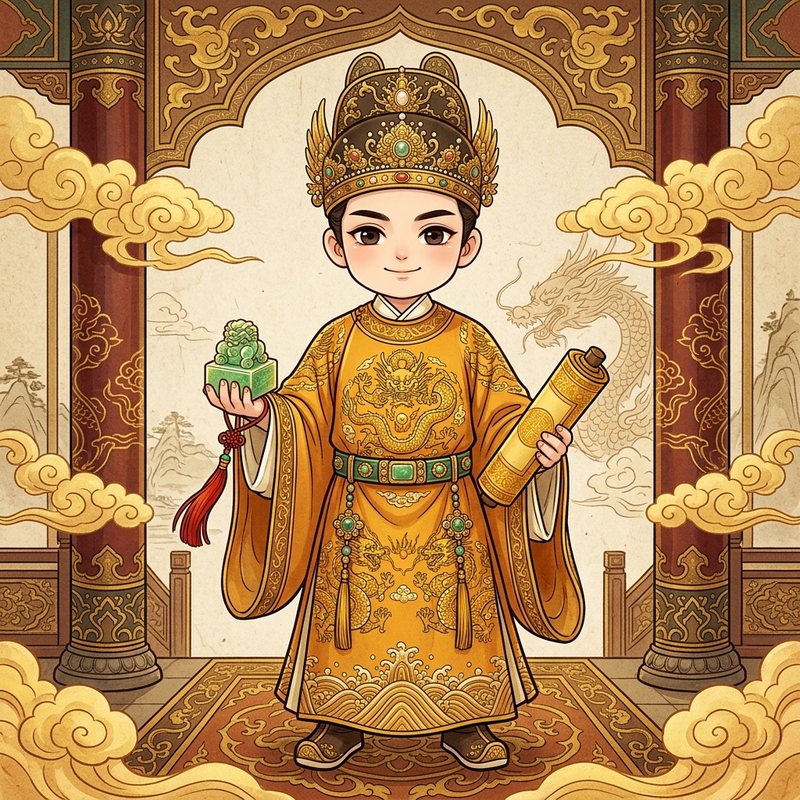
The eighth emperor of the Song Dynasty and an unprecedented artistic genius: creator of Slender Gold calligraphy and the Xuanhe Academy, who lost an empire in the Jingkang Incident.
The Tragic Imperial MaestroNorthern Song Dynasty(1082—1135)讳佶 · 端王 · 宣和教主道君皇帝Audio Journey · 10 Stops
The eighth emperor of the Song Dynasty and an unprecedented artistic genius: creator of Slender Gold calligraphy and the Xuanhe Academy, who lost an empire in the Jingkang Incident.
The Slender Gold Calligrapher & Aesthetic Sovereign· Emperor Rudolf II of HabsburgThe Grand Patron of the Imperial Academy· King Louis XIV & The Royal AcademiesThe Tragic Paradox of Imperial Sovereignty· King Charles I of England
Unfolding the Historical Landscape…
印
Daily Wisdom & Resilience Oracle
The Resilient Optimist
“竹杖芒鞋轻胜马,谁怕?一蓑烟雨任平生。”
Holding a bamboo cane and wearing straw sandals, I stride faster than a horse. Who is afraid? A straw cloak in the mist and rain — I live my life with equanimity.
💡 In the 3rd year of exile in Huangzhou, caught in a sudden downpour, Su Shi embraced the storm with supreme resilience.
— Su Shi (Dongpo)(The Renaissance Foodie & Optimist)
Historical Footprints & Narration Archive
10 Stations
1
Prince of Duan's Residence, Kaifeng
1082 CE · Age 0
Imperial princely residence in the Northern Song capital, modern Kaifeng, Henan
Born in the imperial palace of Kaifeng, untouched by factional politics, displaying prodigal genius in painting and calligraphy.
“天下一人”
Tiān xià yī rén
The One Man Under Heaven.
Station Narration Script
In 1082, Zhao Ji was born in the Song imperial palace of Bianjing. As a prince far removed from succession rivalries, he spent his youth indulging in calligraphy, painting, and the arts in his residence. He styled himself 'The One Man Under Heaven' with his unique signature, pouring his soul into artistic pursuits, unaware that imperial destiny and political storms would soon overtake him.
Departure Transition Script
In 1100, Emperor Zhezong died without an heir, and the eighteen-year-old Prince of Duan was unexpectedly called to the throne.
2
Imperial Palace of Bianjing
1100 CE · Age 18
Imperial palace complex of Northern Song, modern Kaifeng, Henan
Ascended the Dragon Throne at eighteen, establishing the 'Jianzhong Jingguo' era to heal bitter court factionalism.
“建中靖国”
Jiàn zhōng jìng guó
Establishing the Golden Mean and Pacifying the Realm.
Station Narration Script
In 1100, eighteen-year-old Zhao Ji ascended the throne as the eighth emperor of the Song Dynasty. In the great halls of Bianjing, the youthful sovereign proclaimed the 'Jianzhong Jingguo' era, seeking to bridge the venomous factional chasm that had paralyzed imperial governance for decades. He solicited honest advice and appointed upright ministers, but the treacherous currents of court power would prove far more turbulent than poetry and brushwork.
Departure Transition Script
In 1104, Huizong channeled his imperial vision into institutional culture, creating the Imperial Painting Academy.
3
Imperial Painting Academy, Kaifeng
1104 CE · Age 22
The Imperial Painting Academy in the Northern Song capital, modern Kaifeng, Henan
Established imperial civil exams for fine arts and created the razor-sharp 'Slender Gold' script.
“夫画者,成教化,助人伦,穷神变,测幽微,与六籍同功,四时并运。”
Fú huà zhě, chéng jiào huà, zhù rén lún, qióng shén biàn, cè yōu wēi, yǔ liù jí tóng gōng, sì shí bìng yùn.
Painting serves to perfect moral transformation, support human relations, exhaust divine mutations, and probe hidden mysteries—sharing the same merit as the Six Classics.
Station Narration Script
Within the Imperial Painting Academy in Kaifeng, twenty-two-year-old Huizong presided over a golden epoch of fine art. Elevating court painters to official ranks and testing their metaphysical genius through poetic riddles, he pushed Song realism and atmospheric lyricism to new heights. Concurrently, he forged his immortal 'Slender Gold' script—sharp as carved jade and elegant as standing cranes—defining an aesthetic zenith for imperial China.
Departure Transition Script
In 1112, auspicious cranes circled the palace gate, ushering in the construction of the Gengyue Garden.
4
Xuande Gate & Gengyue Garden, Kaifeng
1112 CE · Age 30
The mystical imperial garden of Gengyue in the Northern Song capital, modern Kaifeng, Henan
Painted 'Auspicious Cranes' above Xuande Gate and built the mythical Gengyue mountain garden.
At clear dawn palace eaves brush against radiant rainbow mist, as immortal cranes suddenly arrive bearing signs of divine auspiciousness. Floating gracefully, they hail from the three fairy mountains, soaring in pairs to reveal their millennium-old grace.
Station Narration Script
In early 1112, as cranes circled through multicolored clouds above Xuande Gate, thirty-year-old Huizong painted 'Auspicious Cranes', convinced his reign was blessed with cosmic peace. Outside Kaifeng, the celestial peaks of Gengyue rose skyward, adorned with massive limestone crags and exotic wildlife shipped from across the empire. It was an imperial paradise of supreme refinement, yet the immense burden upon commoners was already fracturing the empire's foundation.
Departure Transition Script
In late 1125, Jurchen forces crossed the Yellow River; Huizong abdicated and fled south to Zhenjiang.
5
Jinshan Temple, Zhenjiang
1126 CE · Age 44
Ancient Runzhou on the Yangtze River, modern Zhenjiang, Jiangsu
Abdicated hastily as Jurchen cavalry advanced, fleeing south down the Grand Canal to Zhenjiang.
“委以重器,付之宸极。”
Wěi yǐ zhòng qì, fù zhī chén jí.
Entrusting the paramount vessels of state and yielding the cosmic pole of imperial rule.
Station Narration Script
In early 1126, amidst the river mists of Jinshan Temple in Zhenjiang, the sound of temple bells could not calm the terror of the forty-four-year-old Retired Emperor. As Jurchen cavalry stormed south, the aesthetic sovereign who had built mountains of stone panicked and surrendered his crown, fleeing down the Yangtze. Standing by the temple balustrade gazing across the river, he watched northern skies fill with smoke, his gilded dreams shattered by brutal military reality.
Departure Transition Script
Hearing that Kaifeng held, Huizong returned in April, only to face a catastrophic second siege.
6
The Besieged Capital of Bianjing
1126 CE · Age 44
The besieged imperial capital of Northern Song, modern Kaifeng, Henan
Kaifeng breached in the second Jin siege; royal treasures plundered and imperial family captured.
The city of flowers is deserted now, cold and desolate, while spring dreams wander over barbarian sands. Where is my ancestral home? How can I bear the Nomad flute blowing 'Plum Blossoms Falling' through the freezing night.
Station Narration Script
Under heavy snow, war engulfed the magnificent capital of Bianjing. In February 1127, the city walls breached, and both Huizong and Qinzong were seized as prisoners of war. The Xuanhe imperial collections—tens of thousands of irreplaceable scrolls, bronzes, and ceramics—were looted into baggage wagons. The exotic trees of Gengyue were felled for firewood, and its sculpted stones crushed. Standing amid the ashes, forty-five-year-old Huizong watched his artistic empire vanish in tears.
Departure Transition Script
In April 1127, Jurchen armies marched three thousand captive royals north into exile.
7
Minzhong Temple, Yanjing
1127 CE · Age 45
Ancient Yanjing garrison, modern Beijing
Held captive in Yanjing's temples, weeping over withered apricot blossoms in his lyric 'Yanshan Ting'.
“天遥地远,万水千山,知他故宫何处。怎不思量,除梦里、有时曾去。”
Tiān yáo dì yuǎn, wàn shuǐ qiān shān, zhī tā gù gōng hé chù. Zěn bù sī liang, chú mèng lǐ, yǒu shí céng qù.
The sky is distant and the earth vast across ten thousand waters and mountains; who knows where my former palace now stands? How could I not yearn for it—except that only in dreams can I sometimes return.
Station Narration Script
In May 1127, sandstorms whipped through the courtyard of Minzhong Temple in Yanjing. Clad in tattered cotton robes, forty-five-year-old Zhao Ji stood staring at a lone wild apricot tree, its delicate pink petals torn away by the northern gale. The sovereign who had painted divine cranes was now reduced to recording his heartbreak in words: 'Who knows where my former palace now stands?' His empire was gone, and only in haunting dreams could he wander back to Kaifeng.
Departure Transition Script
In 1128, the captives were marched further north into Manchuria toward the Jin Upper Capital.
8
Jin Upper Capital Huiningfu
1128 CE · Age 46
The Jurchen Jin imperial capital, modern Acheng, Harbin, Heilongjiang
Subjected to the humiliating Sheep-Leading Rite in raw sheepskins and demoted to 'Duke of Muddle-headed Virtue'.
“昏德公”
Hūn dé gōng
Marquis of Muddle-headed Virtue.
Station Narration Script
At the Jin Supreme Capital in autumn 1128, bone-chilling winds swept across the ancestral temple. Forty-six-year-old Zhao Ji was stripped of imperial silks, wrapped in freshly flayed, bleeding sheepskins, and led by a rope around his neck to prostrate before the Jurchen shrine. Amid mockery from victorious warriors, the title 'Duke of Muddle-headed Virtue' was branded upon him. The creator of immortal arts stood humiliated, his royal dignity shattered on the subarctic plains.
Departure Transition Script
In 1130, fearing Southern Song raids, the Jin moved the captives deeper into the frozen post of Wuguocheng.
9
Confinement in Wuguocheng Dugouts
1130 CE · Age 48
Remote subarctic frontier outpost along the Songhua River, modern Yilan, Heilongjiang
Endured subarctic confinement in frozen dugouts, writing heartbreaking verses on peeling walls.
All night the west wind batters the broken door; inside the desolate lodge a lone lamp flickers low. Looking back, my ancestral homeland lies three thousand leagues away; gazing toward the southern sky, not even a solitary wild goose flies.
Station Narration Script
At Wuguocheng on the icy banks of the Songhua River, white snow stretched endlessly toward the horizon. Forty-eight-year-old Zhao Ji lived in a freezing subterranean earthen dugout where his breath turned to frost. Stripped of crown, power, and family, the artist-emperor turned once more to ink and brush. As Siberian gales battered his rickety wooden door, a lone oil lamp cast his frail shadow on crumbling mud walls. Writing with broken charcoal, he poured out his grief in immortal verses of longing.
Departure Transition Script
In 1135, Emperor Huizong drew his final breath at age fifty-three, ending his tragic life.
10
Wuguocheng Passing & Shaoxing Repatriation
1135 CE · Age 53
Passing place at Wuguocheng, Heilongjiang, later reburied in Shaoxing, Zhejiang
Passed away in Wuguocheng at fifty-three; his remains returned south, leaving an eternal historic warning.
Emperor Huizong was capable and brilliant in all artistic craft, yet doomed by imperial sovereignty.
Station Narration Script
In the cold spring of 1135, fifty-three-year-old Emperor Huizong closed his eyes for the last time on a straw mat at Wuguocheng. Nine years of humiliation and captivity finally ended. Seven years later, his casket was repatriated south to the green hills of Shaoxing. History judged him with unsparing severity: brilliant in art, catastrophic in statecraft. Yet his Slender Gold calligraphy and exquisite court paintings outlived the rise and fall of empires, shining as immortal stars in the firmament of Chinese civilization.
Departure Transition Script
Huizong's life bridged the pinnacle of art and the abyss of politics, an eternal testament to beauty, tragedy, and power.
Key Historical Inquiries & Context
· 核心史实公案与速览
Emperor Huizong of Song (1082–1135), born Zhao Ji, was the eleventh son of Emperor Shenzong and the eighth monarch of the Northern Song Dynasty. Ascending the throne in 1100, he was one of the most gifted artist-emperors in world history. He invented the iconic 'Slender Gold' (Shoujinti) regular script, established the Imperial Painting Academy with civil examinations, patronized masters like Wang Ximeng and Zhang Zeduan, compiled the monumental Xuanhe art catalogues, and perfected Ru ware celadon ceramics. However, his political governance was disastrous: appointing corrupt ministers like Cai Jing, exhausting state finances through the 'Floral Stone Network' to construct the fantastical Gengyue Garden, and mismanaging military alliances with the Jurchen Jin. In the 1127 Jingkang Incident, Kaifeng was ransacked and Huizong was abducted north. Humiliated with the title 'Duke of Muddle-headed Virtue,' he died in captivity in the subarctic wilderness of Wuguocheng. Official historian Tuotuo famously remarked: 'Huizong was capable in all things, except in being an emperor!'
Emperor Huizong of Song (1082–1135), born Zhao Ji, was the eleventh son of Emperor Shenzong and the eighth monarch of the Northern Song Dynasty. Ascending the throne in 1100, he was one of the most gifted artist-emperors in world history. He invented the iconic 'Slender Gold' (Shoujinti) regular script, established the Imperial Painting Academy with civil examinations, patronized masters like Wang Ximeng and Zhang Zeduan, compiled the monumental Xuanhe art catalogues, and perfected Ru ware celadon ceramics. However, his political governance was disastrous: appointing corrupt ministers like Cai Jing, exhausting state finances through the 'Floral Stone Network' to construct the fantastical Gengyue Garden, and mismanaging military alliances with the Jurchen Jin. In the 1127 Jingkang Incident, Kaifeng was ransacked and Huizong was abducted north. Humiliated with the title 'Duke of Muddle-headed Virtue,' he died in captivity in the subarctic wilderness of Wuguocheng. Official historian Tuotuo famously remarked: 'Huizong was capable in all things, except in being an emperor!'
QWhat was Emperor Huizong of Song's primary cultural and historical legacy?
Emperor Huizong of Song is celebrated across world history as a pioneer of The Slender Gold Calligrapher & Aesthetic Sovereign, The Grand Patron of the Imperial Academy, The Tragic Paradox of Imperial Sovereignty, leaving enduring philosophical insights, literature, and art.
QWhere does Emperor Huizong of Song's historical life journey map lead?
This interactive GIS map retraces 10 chronological stops across Northern Song Dynasty China, originating from Prince of Duan's Residence, Kaifeng and spanning through Wuguocheng Passing & Shaoxing Repatriation.
The Complete Life Journey & Biography of Emperor Huizong (Song) (宋徽宗)
Chronological travel & exile routes mapped to modern Chinese cities across Northern Song Dynasty China — featuring bilingual scholar audio, classical poetry recitations, and historical cross-paths.
Prince of Duan's Residence, Kaifeng (汴京端王府)
Age 0
Modern-day analog: Imperial princely residence in the Northern Song capital, modern Kaifeng, Henan
Born in the imperial palace of Kaifeng, untouched by factional politics, displaying prodigal genius in painting and calligraphy.
In 1082, Zhao Ji was born in the Song imperial palace of Bianjing. As a prince far removed from succession rivalries, he spent his youth indulging in calligraphy, painting, and the arts in his residence. He styled himself 'The One Man Under Heaven' with his unique signature, pouring his soul into artistic pursuits, unaware that imperial destiny and political storms would soon overtake him.
In 1100, Emperor Zhezong died without an heir, and the eighteen-year-old Prince of Duan was unexpectedly called to the throne.
“The One Man Under Heaven.”
天下一人 (Tiān xià yī rén)
Imperial Palace of Bianjing (汴京皇宫紫宸殿)
Age 18
Modern-day analog: Imperial palace complex of Northern Song, modern Kaifeng, Henan
Ascended the Dragon Throne at eighteen, establishing the 'Jianzhong Jingguo' era to heal bitter court factionalism.
In 1100, eighteen-year-old Zhao Ji ascended the throne as the eighth emperor of the Song Dynasty. In the great halls of Bianjing, the youthful sovereign proclaimed the 'Jianzhong Jingguo' era, seeking to bridge the venomous factional chasm that had paralyzed imperial governance for decades. He solicited honest advice and appointed upright ministers, but the treacherous currents of court power would prove far more turbulent than poetry and brushwork.
In 1104, Huizong channeled his imperial vision into institutional culture, creating the Imperial Painting Academy.
“Establishing the Golden Mean and Pacifying the Realm.”
建中靖国 (Jiàn zhōng jìng guó)
Imperial Painting Academy, Kaifeng (汴京翰林图画院)
Age 22
Modern-day analog: The Imperial Painting Academy in the Northern Song capital, modern Kaifeng, Henan
Established imperial civil exams for fine arts and created the razor-sharp 'Slender Gold' script.
Within the Imperial Painting Academy in Kaifeng, twenty-two-year-old Huizong presided over a golden epoch of fine art. Elevating court painters to official ranks and testing their metaphysical genius through poetic riddles, he pushed Song realism and atmospheric lyricism to new heights. Concurrently, he forged his immortal 'Slender Gold' script—sharp as carved jade and elegant as standing cranes—defining an aesthetic zenith for imperial China.
In 1112, auspicious cranes circled the palace gate, ushering in the construction of the Gengyue Garden.
“Painting serves to perfect moral transformation, support human relations, exhaust divine mutations, and probe hidden mysteries—sharing the same merit as the Six Classics.”
夫画者,成教化,助人伦,穷神变,测幽微,与六籍同功,四时并运。 (Fú huà zhě, chéng jiào huà, zhù rén lún, qióng shén biàn, cè yōu wēi, yǔ liù jí tóng gōng, sì shí bìng yùn.)
Xuande Gate & Gengyue Garden, Kaifeng (汴京宣德门与艮岳)
Age 30
Modern-day analog: The mystical imperial garden of Gengyue in the Northern Song capital, modern Kaifeng, Henan
Painted 'Auspicious Cranes' above Xuande Gate and built the mythical Gengyue mountain garden.
In early 1112, as cranes circled through multicolored clouds above Xuande Gate, thirty-year-old Huizong painted 'Auspicious Cranes', convinced his reign was blessed with cosmic peace. Outside Kaifeng, the celestial peaks of Gengyue rose skyward, adorned with massive limestone crags and exotic wildlife shipped from across the empire. It was an imperial paradise of supreme refinement, yet the immense burden upon commoners was already fracturing the empire's foundation.
In late 1125, Jurchen forces crossed the Yellow River; Huizong abdicated and fled south to Zhenjiang.
“At clear dawn palace eaves brush against radiant rainbow mist, as immortal cranes suddenly arrive bearing signs of divine auspiciousness. Floating gracefully, they hail from the three fairy mountains, soaring in pairs to reveal their millennium-old grace.”
Modern-day analog: Ancient Runzhou on the Yangtze River, modern Zhenjiang, Jiangsu
Abdicated hastily as Jurchen cavalry advanced, fleeing south down the Grand Canal to Zhenjiang.
In early 1126, amidst the river mists of Jinshan Temple in Zhenjiang, the sound of temple bells could not calm the terror of the forty-four-year-old Retired Emperor. As Jurchen cavalry stormed south, the aesthetic sovereign who had built mountains of stone panicked and surrendered his crown, fleeing down the Yangtze. Standing by the temple balustrade gazing across the river, he watched northern skies fill with smoke, his gilded dreams shattered by brutal military reality.
Hearing that Kaifeng held, Huizong returned in April, only to face a catastrophic second siege.
“Entrusting the paramount vessels of state and yielding the cosmic pole of imperial rule.”
委以重器,付之宸极。 (Wěi yǐ zhòng qì, fù zhī chén jí.)
The Besieged Capital of Bianjing (汴京围城失陷)
Age 44
Modern-day analog: The besieged imperial capital of Northern Song, modern Kaifeng, Henan
Kaifeng breached in the second Jin siege; royal treasures plundered and imperial family captured.
Under heavy snow, war engulfed the magnificent capital of Bianjing. In February 1127, the city walls breached, and both Huizong and Qinzong were seized as prisoners of war. The Xuanhe imperial collections—tens of thousands of irreplaceable scrolls, bronzes, and ceramics—were looted into baggage wagons. The exotic trees of Gengyue were felled for firewood, and its sculpted stones crushed. Standing amid the ashes, forty-five-year-old Huizong watched his artistic empire vanish in tears.
In April 1127, Jurchen armies marched three thousand captive royals north into exile.
“The city of flowers is deserted now, cold and desolate, while spring dreams wander over barbarian sands. Where is my ancestral home? How can I bear the Nomad flute blowing 'Plum Blossoms Falling' through the freezing night.”
Modern-day analog: Ancient Yanjing garrison, modern Beijing
Held captive in Yanjing's temples, weeping over withered apricot blossoms in his lyric 'Yanshan Ting'.
In May 1127, sandstorms whipped through the courtyard of Minzhong Temple in Yanjing. Clad in tattered cotton robes, forty-five-year-old Zhao Ji stood staring at a lone wild apricot tree, its delicate pink petals torn away by the northern gale. The sovereign who had painted divine cranes was now reduced to recording his heartbreak in words: 'Who knows where my former palace now stands?' His empire was gone, and only in haunting dreams could he wander back to Kaifeng.
In 1128, the captives were marched further north into Manchuria toward the Jin Upper Capital.
“The sky is distant and the earth vast across ten thousand waters and mountains; who knows where my former palace now stands? How could I not yearn for it—except that only in dreams can I sometimes return.”
天遥地远,万水千山,知他故宫何处。怎不思量,除梦里、有时曾去。 (Tiān yáo dì yuǎn, wàn shuǐ qiān shān, zhī tā gù gōng hé chù. Zěn bù sī liang, chú mèng lǐ, yǒu shí céng qù.)
Jin Upper Capital Huiningfu (金上京会宁府)
Age 46
Modern-day analog: The Jurchen Jin imperial capital, modern Acheng, Harbin, Heilongjiang
Subjected to the humiliating Sheep-Leading Rite in raw sheepskins and demoted to 'Duke of Muddle-headed Virtue'.
At the Jin Supreme Capital in autumn 1128, bone-chilling winds swept across the ancestral temple. Forty-six-year-old Zhao Ji was stripped of imperial silks, wrapped in freshly flayed, bleeding sheepskins, and led by a rope around his neck to prostrate before the Jurchen shrine. Amid mockery from victorious warriors, the title 'Duke of Muddle-headed Virtue' was branded upon him. The creator of immortal arts stood humiliated, his royal dignity shattered on the subarctic plains.
In 1130, fearing Southern Song raids, the Jin moved the captives deeper into the frozen post of Wuguocheng.
“Marquis of Muddle-headed Virtue.”
昏德公 (Hūn dé gōng)
Confinement in Wuguocheng Dugouts (依兰五国城幽居)
Age 48
Modern-day analog: Remote subarctic frontier outpost along the Songhua River, modern Yilan, Heilongjiang
Endured subarctic confinement in frozen dugouts, writing heartbreaking verses on peeling walls.
At Wuguocheng on the icy banks of the Songhua River, white snow stretched endlessly toward the horizon. Forty-eight-year-old Zhao Ji lived in a freezing subterranean earthen dugout where his breath turned to frost. Stripped of crown, power, and family, the artist-emperor turned once more to ink and brush. As Siberian gales battered his rickety wooden door, a lone oil lamp cast his frail shadow on crumbling mud walls. Writing with broken charcoal, he poured out his grief in immortal verses of longing.
In 1135, Emperor Huizong drew his final breath at age fifty-three, ending his tragic life.
“All night the west wind batters the broken door; inside the desolate lodge a lone lamp flickers low. Looking back, my ancestral homeland lies three thousand leagues away; gazing toward the southern sky, not even a solitary wild goose flies.”
Modern-day analog: Passing place at Wuguocheng, Heilongjiang, later reburied in Shaoxing, Zhejiang
Passed away in Wuguocheng at fifty-three; his remains returned south, leaving an eternal historic warning.
In the cold spring of 1135, fifty-three-year-old Emperor Huizong closed his eyes for the last time on a straw mat at Wuguocheng. Nine years of humiliation and captivity finally ended. Seven years later, his casket was repatriated south to the green hills of Shaoxing. History judged him with unsparing severity: brilliant in art, catastrophic in statecraft. Yet his Slender Gold calligraphy and exquisite court paintings outlived the rise and fall of empires, shining as immortal stars in the firmament of Chinese civilization.
Huizong's life bridged the pinnacle of art and the abyss of politics, an eternal testament to beauty, tragedy, and power.
“Emperor Huizong was capable and brilliant in all artistic craft, yet doomed by imperial sovereignty.”