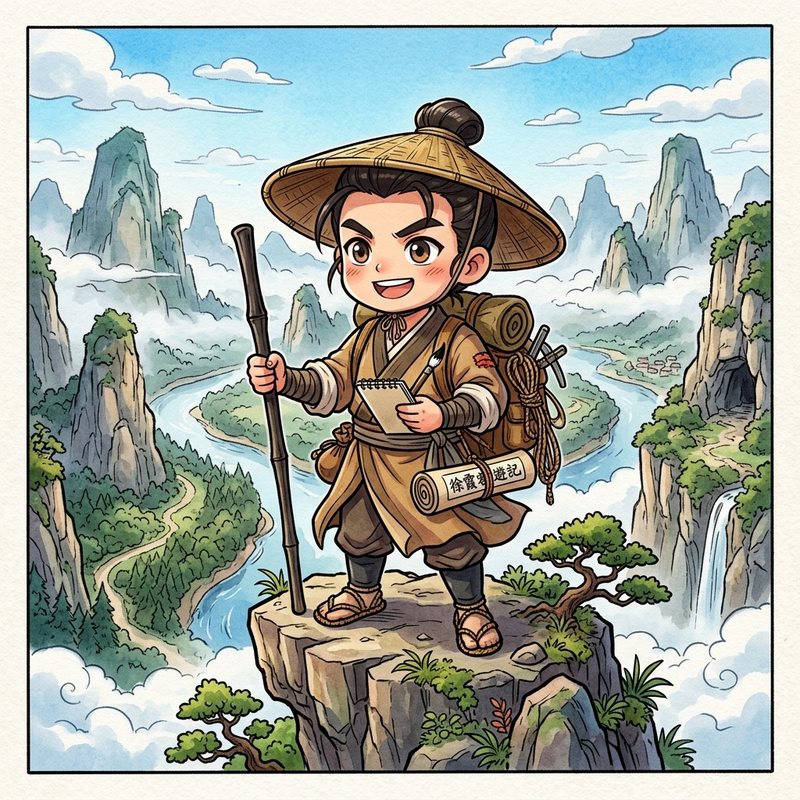
The 30-Year Solo Mountain & Cave ExplorerLate Ming Dynasty (1587-1641)名弘祖 · 字振之 · 霞客Audio Journey · 10 Stops
Explored uncharted caves and proved the true source of the Yangtze using only his feet and pen.
Father of Karst Geomorphology· Alexander von HumboldtThe Solitary Trailblazer of Wilderness· John Muir
Unfolding the Historical Landscape…
印
Daily Wisdom & Resilience Oracle
The Fearless Geographer
“大丈夫当朝碧海而暮苍梧,登高山以极目,览大川以抒怀。”
A true soul should greet the azure ocean at dawn and Cangwu mountain at dusk—climbing great peaks to stretch vision, and beholding grand rivers to unburden the heart.
💡 Donning a travel cap sewn by his mother, young Xu Xiake pledges to explore China's mountains and rivers on foot.
— Xu Xiake(The 30-Year Solo Mountain & Cave Explorer)
Historical Footprints & Narration Archive
10 Stations
1
Mazhen, Jiangyin (Jiangsu)
1607 CE · Age 20
Water-town home of Jiangyin on the Yangtze delta, Jiangsu
A Mother's Blessing: 'A Man's Ambition Belongs to the Four Horizons'
A true traveler should greet the blue ocean in the morning and reach mountain peaks at dusk; how could one spend life chained within four walls!
Station Narration Script
In 1607, twenty-year-old Xu Hongzu of Jiangyin refused the exam path. Wearing a travel cap sewn by his mother, he vowed: 'A true man should see blue seas at dawn and Cangwu at dusk—how can one live like clay and wood?'
Departure Transition Script
He first headed north to Mount Tai in Shandong, to pioneer on-the-ground geographic observation.
2
Mount Tai (Tai'an, Shandong)
1613 CE · Age 26
Chief of China's sacred peaks explored on his first grand excursion, Tai'an, Shandong
Climbing the Emperor of Mountains: Pioneering Observational Geology
The sun ascends from the east, ten thousand leagues pure and radiant, with every mountain peak bowing beneath.
Station Narration Script
Atop Mount Tai he logged rock strata and climate by hour, writing: 'The sun rises in the east—ten thousand li pure and radiant, every peak below.' Field science replaced vague lyrical tourism.
Departure Transition Script
From Tai he turned south to Anhui, twice assaulting Huangshan's icy granite spires.
3
Mount Huangshan (Anhui)
1616 CE · Age 29
Granite pinnacles and sea of clouds where Xu Xiake made pioneering ascents, Anhui
Conquering the Sea of Clouds: 'No Mountain Rivals Huangshan'
Across all the world within and beyond the seas, none rivals the Yellow Mountain; climbing Huangshan, no other mountain remains—it is the ultimate wonder!
Station Narration Script
Twice in blizzards he forced Lotus Peak and Tiandu Peak, concluding forever: 'Within and beyond the seas, none rivals Huangshan; climb it, and no other mountain remains—the ultimate wonder!'
Departure Transition Script
Next he entered northern Fujian, rafting Wuyi's Nine-Bend Stream among red sandstone and hanging coffins.
4
Mount Wuyi (Nanping, Fujian)
1630 CE · Age 43
Red sandstone karst landscape and bamboo raft river exploration, Fujian
Red Sandstone Canyons and Cliffside Hanging Coffins
“曲曲山回转,峰峰水抱流。”
Qū qū shān huí zhuǎn, fēng fēng shuǐ bào liú.
Around every bend the mountains turn; by every peak the emerald waters flow embrace.
Station Narration Script
Rafting the Nine-Bend Stream, he mapped Danxia sandstone weathering and cliff coffins, marveling: 'Around every bend the mountains turn; by every peak the waters flow in embrace.'
Departure Transition Script
From Wuyi he turned to Zhejiang's coast, to solve the source of Yandang's Great Dragon Waterfall.
5
Mount Yandang (Wenzhou, Zhejiang)
1632 CE · Age 45
Volcanic rock peaks and dramatic waterfalls surveyed by Xu Xiake, Zhejiang
Hanging from a Cliff to Solve the Mystery of the Great Dragon Waterfall
“溯瀑源而上,攀绝壁而行,奇峰环拱,造化神工。”
Sù pù yuán ér shàng, pān jué bì ér xíng, qí fēng huán gǒng, zào huà shén gōng.
Tracing the waterfall to its source, scaling vertical precipices; wondrous peaks embrace from all sides, a miracle of nature's craftsmanship.
Station Narration Script
At Yandang he lowered himself on wild vines to trace Dalongqiu Falls, recognizing an ancient volcanic caldera: 'Tracing the fall to its source, scaling precipices—wondrous peaks embrace, nature's craftsmanship.'
Departure Transition Script
At fifty he launched his greatest trek—ten thousand li into the southwest, toward Guilin's karst.
6
Guilin & Yangshuo (Guangxi)
1637 CE · Age 50
Karst landscape wonderland along the Li River, modern Guilin, Guangxi
Mapping Hundreds of Caverns: 150 Years Ahead of European Karst Science
Caves nested within caves, subterranean waters coursing through; forests of stalactites standing tall, miraculous elegance of creation.
Station Narration Script
Around Guilin he torch-mapped hundreds of limestone caves: 'Caves within caves, water threading through; forests of stalactites—miraculous elegance of creation,' pioneering karst science 150 years before Europe.
Departure Transition Script
Through bandit country and miasma he pushed on into the wild Guizhou plateau.
7
Huangguoshu Waterfall, Anshun (Guizhou)
1638 CE · Age 51
Magnificent waterfall whose geology and mist were scientifically surveyed, Guizhou
Thunder of White Water: The First Scientific Account of Huangguoshu Falls
Pounding pearls and shattering jade, mist surges upward like soaring smoke; its momentum is supremely majestic.
Station Narration Script
At Huangguoshu Falls he wrote: 'Pearls smashed, jade shattered; spray surges back like smoke into the sky—its force immensely fierce'—the earliest scientific description of the cataract.
Departure Transition Script
Westward into Yunnan, he made for Dali's Cangshan and Erhai along the Hengduan ranges.
8
Mount Cangshan & Erhai, Dali (Yunnan)
1639 CE · Age 52
Ancient Nanzhao/Dali kingdom nestled between Cangshan Mountain and Erhai Lake, Yunnan
Nineteen Snow Peaks and the Butterfly Spring of Dali
Upon the grand tree over the spring, butterflies gather in swarms, connecting head to tail, dangling in colorful strands down to the water surface.
Station Narration Script
At Dali he studied marble genesis and Erhai's fault zone, and recorded Butterfly Spring: 'On the great tree above the spring, butterflies gather head-to-tail, hanging in colorful chains down to the water.'
Departure Transition Script
Aided by Lijiang's Mu chieftain, he entered the Jinsha gorges for his greatest geographic proof.
9
Jinsha River, Lijiang (Yunnan)
1639 CE · Age 52
Pioneering geographic survey proving Jinsha River is the true source of the Yangtze, Yunnan
Correcting Two Millennia of Geography: The True Source of the Yangtze
“推江源者,必当以金沙江为首,不当以岷江为首也。”
Tuī jiāng yuán zhě, bì dāng yǐ Jīn shā jiāng wéi shǒu, bù dāng yǐ Mín jiāng wéi shǒu yě.
In determining the source of the Yangtze, one must take the Jinsha River as the true headwaters, and not the Min River.
Station Narration Script
Surveying both banks of the Jinsha, he concluded in On the River's Source: 'Whoever traces the Yangtze must take the Jinsha as chief, not the Min'—correcting two millennia of error from the Tribute of Yu.
Departure Transition Script
Both feet crippled by the trek, Naxi friends escorted him home with dozens of precious manuscript volumes.
10
Mazhen, Jiangyin (Jiangsu)
1641 CE · Age 54
Water-town home of Jiangyin on the Yangtze delta, Jiangsu
Walking until the Feet Could Walk No More: The 600,000-Word Monument
Zhang Qian, Xuanzang, and Yelü Chucai all traveled on imperial orders. Xu Xiake, as a humble commoner in cotton robes, explored the realm for thirty years—a truly peerless hero!
Station Narration Script
He died in Jiangyin in 1641 at fifty-four. Qian Qianyi wrote: 'Zhang Qian, Xuanzang... Xiake, a commoner, traveled the realm thirty years—a remarkable man!' His 600,000-character Travels still shine in world science.
Key Historical Inquiries & Context
· 核心史实公案与速览
Centuries before modern geology and outdoor backpacking, Xu Xiake spent thirty years walking across thousands of uncharted mountains, rivers, and caves. Relying solely on his feet, notebook, and fearless spirit, he pioneered karst geomorphology and proved the true source of the Yangtze River.
Centuries before modern geology and outdoor backpacking, Xu Xiake spent thirty years walking across thousands of uncharted mountains, rivers, and caves. Relying solely on his feet, notebook, and fearless spirit, he pioneered karst geomorphology and proved the true source of the Yangtze River.
QWhat was Xu Xiake (Xu Hongzu)'s primary cultural and historical legacy?
Xu Xiake (Xu Hongzu) is celebrated across world history as a pioneer of Father of Karst Geomorphology, The Solitary Trailblazer of Wilderness, leaving enduring philosophical insights, literature, and art.
QWhere does Xu Xiake (Xu Hongzu)'s historical life journey map lead?
This interactive GIS map retraces 10 chronological stops across Late Ming Dynasty China, originating from Mazhen, Jiangyin (Jiangsu) and spanning through Mazhen, Jiangyin (Jiangsu).
The Complete Life Journey & Biography of Xu Xiake (Geographer) (徐霞客)
Chronological travel & exile routes mapped to modern Chinese cities across Late Ming Dynasty (1587-1641) China — featuring bilingual scholar audio, classical poetry recitations, and historical cross-paths.
Mazhen, Jiangyin (Jiangsu) (江苏江阴 (辞亲远游立鸿鹄之志))
Age 20
Modern-day analog: Water-town home of Jiangyin on the Yangtze delta, Jiangsu
A Mother's Blessing: 'A Man's Ambition Belongs to the Four Horizons'
In 1607, twenty-year-old Xu Hongzu of Jiangyin refused the exam path. Wearing a travel cap sewn by his mother, he vowed: 'A true man should see blue seas at dawn and Cangwu at dusk—how can one live like clay and wood?'
He first headed north to Mount Tai in Shandong, to pioneer on-the-ground geographic observation.
“A true traveler should greet the blue ocean in the morning and reach mountain peaks at dusk; how could one spend life chained within four walls!”
Mount Tai (Tai'an, Shandong) (山东泰安 (登泰山极顶开创实地考察学风))
Age 26
Modern-day analog: Chief of China's sacred peaks explored on his first grand excursion, Tai'an, Shandong
Climbing the Emperor of Mountains: Pioneering Observational Geology
Atop Mount Tai he logged rock strata and climate by hour, writing: 'The sun rises in the east—ten thousand li pure and radiant, every peak below.' Field science replaced vague lyrical tourism.
From Tai he turned south to Anhui, twice assaulting Huangshan's icy granite spires.
“The sun ascends from the east, ten thousand leagues pure and radiant, with every mountain peak bowing beneath.”
Modern-day analog: Granite pinnacles and sea of clouds where Xu Xiake made pioneering ascents, Anhui
Conquering the Sea of Clouds: 'No Mountain Rivals Huangshan'
Twice in blizzards he forced Lotus Peak and Tiandu Peak, concluding forever: 'Within and beyond the seas, none rivals Huangshan; climb it, and no other mountain remains—the ultimate wonder!'
Next he entered northern Fujian, rafting Wuyi's Nine-Bend Stream among red sandstone and hanging coffins.
“Across all the world within and beyond the seas, none rivals the Yellow Mountain; climbing Huangshan, no other mountain remains—it is the ultimate wonder!”
Modern-day analog: Red sandstone karst landscape and bamboo raft river exploration, Fujian
Red Sandstone Canyons and Cliffside Hanging Coffins
Rafting the Nine-Bend Stream, he mapped Danxia sandstone weathering and cliff coffins, marveling: 'Around every bend the mountains turn; by every peak the waters flow in embrace.'
From Wuyi he turned to Zhejiang's coast, to solve the source of Yandang's Great Dragon Waterfall.
“Around every bend the mountains turn; by every peak the emerald waters flow embrace.”
Mount Yandang (Wenzhou, Zhejiang) (浙江温州 (攀绝壁探雁荡山大龙湫源流))
Age 45
Modern-day analog: Volcanic rock peaks and dramatic waterfalls surveyed by Xu Xiake, Zhejiang
Hanging from a Cliff to Solve the Mystery of the Great Dragon Waterfall
At Yandang he lowered himself on wild vines to trace Dalongqiu Falls, recognizing an ancient volcanic caldera: 'Tracing the fall to its source, scaling precipices—wondrous peaks embrace, nature's craftsmanship.'
At fifty he launched his greatest trek—ten thousand li into the southwest, toward Guilin's karst.
“Tracing the waterfall to its source, scaling vertical precipices; wondrous peaks embrace from all sides, a miracle of nature's craftsmanship.”
溯瀑源而上,攀绝壁而行,奇峰环拱,造化神工。 (Sù pù yuán ér shàng, pān jué bì ér xíng, qí fēng huán gǒng, zào huà shén gōng.)
Modern-day analog: Karst landscape wonderland along the Li River, modern Guilin, Guangxi
Mapping Hundreds of Caverns: 150 Years Ahead of European Karst Science
Around Guilin he torch-mapped hundreds of limestone caves: 'Caves within caves, water threading through; forests of stalactites—miraculous elegance of creation,' pioneering karst science 150 years before Europe.
Through bandit country and miasma he pushed on into the wild Guizhou plateau.
“Caves nested within caves, subterranean waters coursing through; forests of stalactites standing tall, miraculous elegance of creation.”
Modern-day analog: Magnificent waterfall whose geology and mist were scientifically surveyed, Guizhou
Thunder of White Water: The First Scientific Account of Huangguoshu Falls
At Huangguoshu Falls he wrote: 'Pearls smashed, jade shattered; spray surges back like smoke into the sky—its force immensely fierce'—the earliest scientific description of the cataract.
Westward into Yunnan, he made for Dali's Cangshan and Erhai along the Hengduan ranges.
“Pounding pearls and shattering jade, mist surges upward like soaring smoke; its momentum is supremely majestic.”
Mount Cangshan & Erhai, Dali (Yunnan) (云南大理 (登苍山十九峰考察蝴蝶泉奇观))
Age 52
Modern-day analog: Ancient Nanzhao/Dali kingdom nestled between Cangshan Mountain and Erhai Lake, Yunnan
Nineteen Snow Peaks and the Butterfly Spring of Dali
At Dali he studied marble genesis and Erhai's fault zone, and recorded Butterfly Spring: 'On the great tree above the spring, butterflies gather head-to-tail, hanging in colorful chains down to the water.'
Aided by Lijiang's Mu chieftain, he entered the Jinsha gorges for his greatest geographic proof.
“Upon the grand tree over the spring, butterflies gather in swarms, connecting head to tail, dangling in colorful strands down to the water surface.”
Jinsha River, Lijiang (Yunnan) (云南丽江 (确证金沙江为长江正源纠正千年谬误))
Age 52
Modern-day analog: Pioneering geographic survey proving Jinsha River is the true source of the Yangtze, Yunnan
Correcting Two Millennia of Geography: The True Source of the Yangtze
Surveying both banks of the Jinsha, he concluded in On the River's Source: 'Whoever traces the Yangtze must take the Jinsha as chief, not the Min'—correcting two millennia of error from the Tribute of Yu.
Both feet crippled by the trek, Naxi friends escorted him home with dozens of precious manuscript volumes.
“In determining the source of the Yangtze, one must take the Jinsha River as the true headwaters, and not the Min River.”
Modern-day analog: Water-town home of Jiangyin on the Yangtze delta, Jiangsu
Walking until the Feet Could Walk No More: The 600,000-Word Monument
He died in Jiangyin in 1641 at fifty-four. Qian Qianyi wrote: 'Zhang Qian, Xuanzang... Xiake, a commoner, traveled the realm thirty years—a remarkable man!' His 600,000-character Travels still shine in world science.
“Zhang Qian, Xuanzang, and Yelü Chucai all traveled on imperial orders. Xu Xiake, as a humble commoner in cotton robes, explored the realm for thirty years—a truly peerless hero!”