Chronological travel & exile routes mapped to modern Chinese cities across Southern Song Dynasty China — featuring bilingual scholar audio, classical poetry recitations, and historical cross-paths.
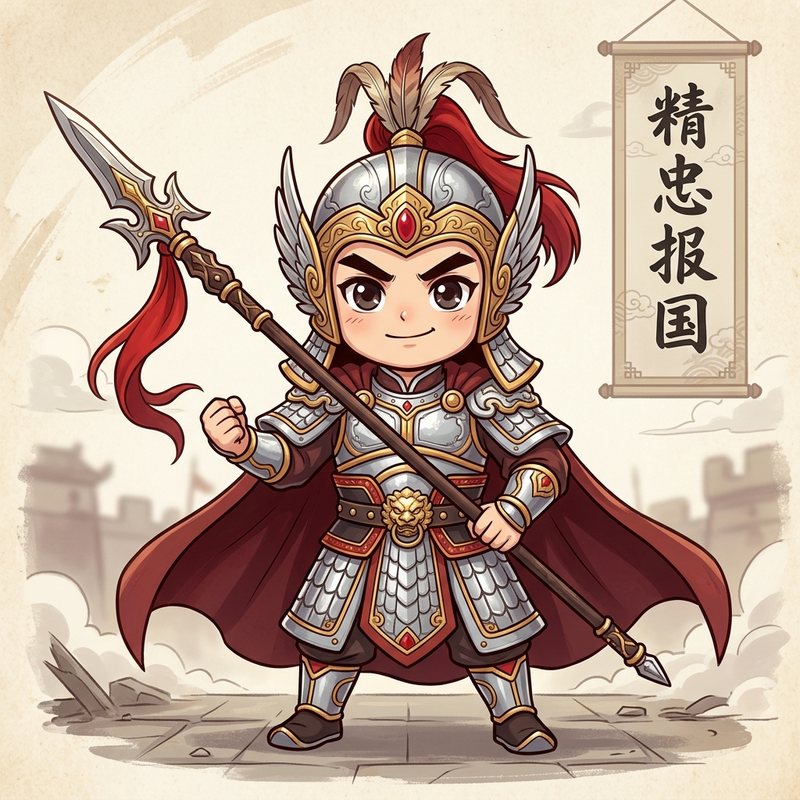
Tangyin (Birthplace & The Tattoo of Loyalty) (相州汤阴(母刺精忠报国))
Age 1Modern-day analog: Tangyin County, Anyang, Henan Province
Born in Tangyin, he mastered archery under master Zhou Tong, able to draw an immense 300-pound bow; his mother tattooed 'Serve Country with Utmost Loyalty' onto his back.
In a flood-scarred village of Tangyin, young Yue Fei grew up poor but resolute, farming by day and studying the art of war by night. Under master Zhou Tong he trained until he could draw a mighty three-hundred-pound bow. Then the Jin invaders swept south, and the northern capital fell. His mother, Yao Shi, took up an embroidery needle and pricked four characters into his back—'Serve the Country with Utmost Loyalty'—sealing them with vinegar ink so they would never fade. The sting of the needle burned into the boy's heart a vow that would never cool: serve the country with utmost loyalty, and swear to wash away the national disgrace.
The sting of that needle and its vow were etched into Yue Fei's very bones. When Jin cavalry trampled the capital and carried off the emperors, the twenty-three-year-old could no longer stand idle. He took up arms and rode for Kaifeng, joining the veteran commander Zong Ze on the road of resistance.
“Serve the country with utmost loyalty, and swear to wash away the national disgrace.”
尽忠报国,誓雪国耻。 (Jìn zhōng bào guó, shì xuě guó chǐ.)
Kaifeng (Under Veteran Commander Zong Ze) (开封府(从军抗战,宗泽麾下))
Age 23Modern-day analog: Modern Kaifeng, Henan Province
As northern China collapsed during the Jingkang Incident, Yue Fei fought under veteran loyalist Zong Ze, who hailed him as superior to ancient master generals.
The Jingkang Incident shattered the empire—both emperors were dragged into captivity. Grief and fury consumed Yue Fei, who petitioned the new court to counterattack and was stripped of his post for his audacity. He joined the aged loyalist Zong Ze in Kaifeng, leading a hundred horsemen straight into the Jin formations again and again. On his deathbed, Zong Ze gathered his last strength and cried three times: 'Cross the River! Cross the River! Cross the River!'—entrusting the liberation of the north to Yue Fei, who knelt and swore to carry that undying torch.
Zong Ze's dying cry became the unquenchable faith of Yue Fei's life. He led his army south across the rivers, sharpening his blade for the battles ahead. When Prince Wuzhu's hundred thousand troops swept into Jiangnan, the twenty-seven-year-old commander laid an ambush at Mount Niushou—and won the decisive victory that would change the war.
“Cross the River! Cross the River! Cross the River!”
过河!过河!过河! (Guò hé! Guò hé! Guò hé!)
Jiankang (Nanjing, Decisive Victory on the Yangtze) (建康府(收复金陵,重挫金兀术))
Age 27Modern-day analog: Niushoushan Scenic Area, Nanjing, Jiangsu
When Jin Prince Wuzhu invaded south across the Yangtze, Yue Fei laid an ambush at Mount Niushou, liberating Nanjing and turning the tide of the war.
In 1130, after pillaging the southern capital, Prince Wuzhu turned his armies northward. Yue Fei built stone ramparts on Mount Niushou and laid a devastating ambush, using foot soldiers to break the enemy's cavalry. At Qingshuiting he slew over a thousand foes, and Wuzhu fled across the Yangtze in disgrace. The ancient capital of Jiankang was returned to Song hands. From that day, the cry echoed across the land: 'It is easier to uproot a mountain than to shake the Yue Family Army!'—a name that would haunt the Jin forever.
The triumph at Jiankang made the Yue Family Army legendary, and the Jin trembled at the very sound of its name. In 1134, Yue Fei marched west to recover the six prefectures of Xiangyang in just three months, then established his great headquarters at Wuchang—forging the iron fortress from which he would launch his northern campaigns.
“It is easier to uproot a mountain than to shake the Yue Family Army!”
撼山易,撼岳家军难! (Hàn shān yì, hàn Yuè jiā jūn nán!)
Ezhou (Wuchang, Grand Army Headquarters) (鄂州武昌(岳家军大本营,收复襄汉))
Age 31Modern-day analog: Wuchang District, Wuhan, Hubei Province
Headquartered at Wuchang overseeing 100,000 elite troops, he restored the six strategic prefectures of Xiangyang with legendary military discipline.
In 1134, Yue Fei recovered the six strategic prefectures of Xiangyang in just three months, opening the gateway to the north. Headquartered at Wuchang, he farmed and drilled his troops, nursing sick soldiers with his own hands and adopting the orphans of the fallen. His iron rule was absolute: 'Starve rather than loot, freeze rather than tear down a villager's home.' Standing atop the ramparts, he spoke his lifelong creed: 'If civil officials love not money, and military officers fear not death, then shall all under Heaven dwell in enduring peace.'
At Wuchang, his army was strong and his granaries full—the trumpet of the northern campaign was about to sound. In 1140, as Prince Wuzhu invaded once more, Yue Fei launched his fourth great offensive, sweeping irresistibly through the Central Plains toward the old capital of Kaifeng, with the recovery of the homeland within his grasp.
“If civil officials love not money, and military officers fear not death—then shall all under Heaven dwell in enduring peace.”
文臣不爱钱,武臣不惜死,天下太平矣。 (Wén chén bù ài qián, wǔ chén bù xī sǐ, tiān xià tài píng yǐ.)
Yancheng & Zhuxian Town (Twelve Gold Plaques) (郾城与朱仙镇(大破铁浮屠,痛收金牌))
Age 37Modern-day analog: Luohe & Kaifeng (Zhuxian), Henan Province
Deploying heavy halberds to crush Jin's armored cavalry at Yancheng, he reached Zhuxian Town near Kaifeng, only to receive twelve gold imperial plaques ordering immediate retreat.
In 1140, Yue Fei launched his greatest offensive. At Yancheng and Yingchang, his son Yue Yun led the light cavalry in desperate charges while infantry wielded heavy cleavers to sever the legs of the enemy's armored warhorses, annihilating the invincible 'Iron Pagoda' cavalry. The army pushed to Zhuxian Town, just fifteen miles from the ancient capital, as elders wept with joy. But Emperor Gaozong and the traitor Qin Hui, fearing his rising fame, dispatched twelve golden plaques in a single day ordering instant retreat. Yue Fei roared to the heavens: 'Ten years of devotion, shattered in a single day!'
The golden plaques fell like snow, and ten years of blood were undone in a single day. With a long sigh to the heavens, a weeping Yue Fei led his army back to Lin'an. There he found not the glory of a triumphant return, but a deadly snare already laid by the treacherous court, waiting to close around him.
“Ten years of heroic effort, destroyed in a single day! The recovered prefectures abandoned in an hour! Our ancestral mountains and rivers can no longer be restored!”
十年之功,废于一旦!所得州郡,一朝全休!社稷江山,难以中兴!乾坤浩劫,罪在何人! (Shí nián zhī gōng, fèi yú yī dàn!)
West Lake (Fengbo Pavilion & Yue Mausoleum) (杭州西湖(风波亭莫须有,万古精忠))
Age 39Modern-day analog: Guanfu & Yue Fei Temple, West Lake, Hangzhou
Framed on the fabricated charge of 'Unnecessary to Prove' (Mo Xu You), he was murdered at Fengbo Pavilion; later exonerated and buried beside Hangzhou's West Lake.
On New Year's Eve of 1142, Qin Hui fabricated charges of treason against Yue Fei. When the general Han Shizhong demanded evidence, the chancellor sneered: 'Mo Xu You'—perhaps it is not necessary to prove. At thirty-nine, the greatest commander of his age was murdered with poison at Fengbo Pavilion, his final words only: 'Clear Heaven! Clear Heaven!' He who had once written 'Thirty years of service, mere dust and earth; eight thousand miles under clouds and moon' gave his all to China. Later exonerated and reburied beside West Lake, his loyal bones rest beneath the green hills, his spirit eternal.
“My hair bristles with fury, leaning against the balcony as drizzle halts. Looking upward, I roar to the vast heavens, a heroic passion surging within! Thirty years of service, mere dust and earth; eight thousand miles of campaigns under clouds and moon. Linger not, lest youth's dark hair turns white in vain regret!”
怒发冲冠,凭栏处、潇潇雨歇。抬望眼,仰天长啸,壮怀激烈。三十功名尘与土,八千里路云和月。莫等闲、白了少年头,空悲切! (Nù fà chōng guān, píng lán chù, xiāo xiāo yǔ xiē...)