Did Sun Tzu Really Exist? The 2,000-Year Mystery Solved
From Sima Qian's court chronicles to the sensational 1972 Yinqueshan bamboo slips: Separating the historical general from centuries of skepticism.
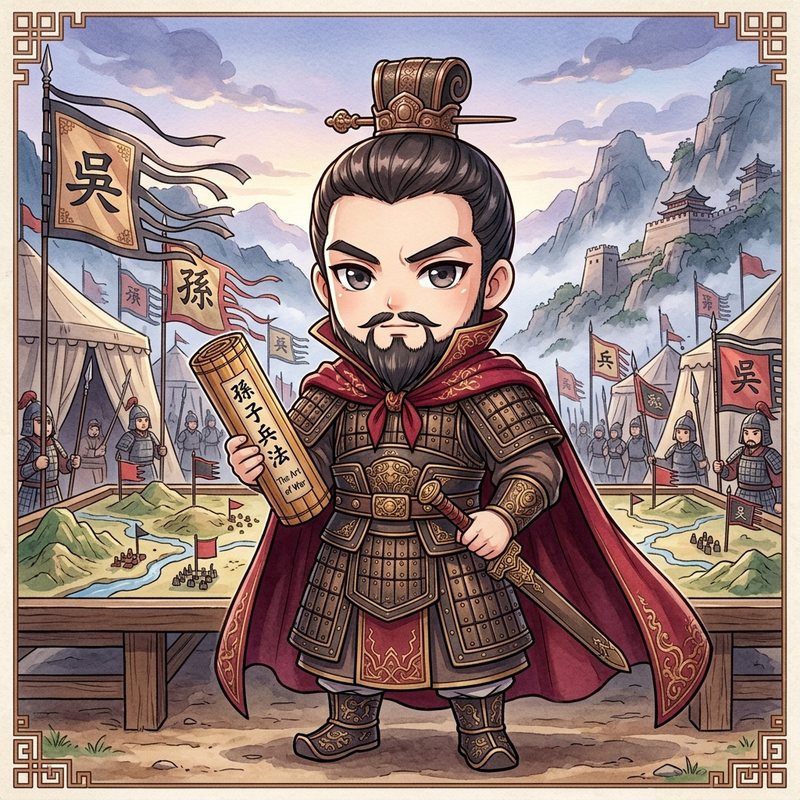
Sun Tzu (Sun Wu) (孙子 (孙武) · Sūn Zǐ)
字长卿 · 兵家至圣 · 百世兵家之师
The Supreme Strategist & Master of The Art of War
兵家鼻祖 · 不战而屈人之兵的东方战略哲学宗师
- The Traditional Record: Grand Historian Sima Qian documented Sun Wu (c. 544–496 BCE) as a native of Qi who served King Helü of Wu, orchestrating the conquest of the mighty Chu superpower at the Battle of Boju in 506 BCE.
- The Eight-Century Skeptical Crisis: Beginning in the Song Dynasty, prominent scholars questioned his existence because the authoritative historical chronicle Zuo Zhuan (左传) conspicuously omitted Sun Wu's personal name.
- The 1972 Yinqueshan Archaeological Triumph: Excavations at Silver Sparrow Mountain uncovered contemporaneous Han Dynasty bamboo slips containing both Sun Tzu's Art of War (13 chapters) and Sun Bin's Art of War (16 chapters), proving they were two separate individuals.
- Modern Academic Consensus: Sun Wu was a real historical military strategist in the late Spring and Autumn period, whose original 13 treatises formed the core masterwork passed down and edited by his disciples.
The Primary Source: Sima Qian's Biography in the Shiji
The earliest surviving systematic biographical record of Sun Tzu appears in Chapter 65 of Sima Qian’s Records of the Grand Historian (史记, compiled c. 94 BCE). According to Sima Qian, Sun Wu was a native of the northern state of Qi whose profound military treatises attracted the attention of King Helü of the southern state of Wu.
西汉司马迁在《史记·孙子吴起列传》中留下了关于孙武最早的系统记载:孙武本为齐国人,携兵法十三篇入吴,经重臣伍子胥七次举荐,得以面见吴王阖闾。
To test Sun Wu’s theories before commissioning him, King Helü famously asked if his military discipline could be applied to anyone—even court ladies. Sun Wu divided 180 palace concubines into two companies, placing the king’s favorite consorts in command. When the women repeatedly giggled and disobeyed drum signals, Sun Wu calmly stated: 'If words of command are not clear, it is the general's fault. But when orders are clear and not obeyed, it is the officers' crime.' He ordered both favorite concubines executed on the spot, transforming the remaining women into an elite, obedient drill unit.
吴王为试其才,命孙武在姑苏宫台演练宫女一百八十人。面对宫嫔嬉笑不遵军令,孙武正色言道:'约束既明而法不行者,吏士之罪也。'毅然斩杀吴王二位宠妃以申军律,令全军肃然。吴王知其大才,遂拜为大将。
Commanding the Wu army alongside minister Wu Zixu, Sun Wu launched a lightning campaign west in 506 BCE, marching 300 miles into the heartland of Chu and crushing a force five times larger at the Battle of Boju (柏举之战), capturing the Chu imperial capital of Ying.
公元前506年,孙武与伍子胥率吴军西破强楚,五战五捷攻入楚都郢,创造了中国古代军事史上以少胜多、奔袭千里的辉煌战例。
The Centuries of Doubt: Why Scholars Questioned His Existence
Despite Sima Qian’s vivid narrative, skepticism arose during the Southern Song dynasty. Scholars pointed out perplexing discrepancies in the historical record that led many to believe Sun Tzu was merely a myth:
尽管司马迁记载详实,但自南宋以来,疑古学派对孙武真实性的质疑愈演愈烈,主要论据集中在以下三个历史盲点:
Core historical arguments once raised against Sun Tzu's authenticity:
- The Silence of the Zuo Zhuan: The premier chronicle of the Spring and Autumn era (Zuo Zhuan) meticulously records the Battle of Boju and praises Wu Zixu, but never once mentions the name 'Sun Wu'.《左传》失载之谜:记述春秋史事最详尽的《左传》详细记载了柏举之战与伍子胥功绩,却对统帅‘孙武’一字未提。
- Anachronistic Warfare Descriptions: Scholars like Ye Shi (叶适) and later Liang Qichao (梁启超) argued that The Art of War describes massive conscript armies of 100,000 men and sophisticated crossbow deployments typical of the late Warring States period, not the aristocratic chariot duels of the Spring and Autumn era.作战规模与兵制时代差异:宋代叶适、清代姚鼐及近代梁启超认为,《孙子兵法》中提及的‘十万之师’、弩机运用与间谍网络,更符合战国中期总体战特征,而非春秋贵族车战模式。
- The 'One Man, Two Books' Hypothesis: Some historians theorized that 'Sun Wu' and 'Sun Bin' (a renowned mutilated strategist from the 4th century BCE) were the same person, with oral folklore splitting one master into two.孙武孙膑一人两分说:部分学者推测‘孙武’实为战国军事家‘孙膑’的神话投射,后世文人误将一人附会为祖孙二人。
The 1972 Yinqueshan Discovery: Archaeological Proof
The debate ended definitively in April 1972 in Linyi, Shandong Province. Construction workers grading ground on Silver Sparrow Mountain (Yinqueshan) uncovered two undisturbed Western Han Dynasty tombs (Tombs No. 1 and No. 2) dating back to 140–118 BCE.
1972年4月,山东临沂银雀山一号与二号西汉前期墓葬的发掘,彻底改写了这一学术僵局。考古队在墓中发掘出近五千枚珍贵竹简。
Among thousands of bamboo strips, archaeologists unearthed both texts buried side by side: the 13 classical chapters of Sun Tzu's Art of War (authored by Sun Wu) along with 16 distinct chapters of the long-lost Sun Bin's Art of War (孙膑兵法).
在这批汉简中,专家辨识出了失传已久的《孙子兵法》(孙武著)与《孙膑兵法》(孙膑著)两部截然不同的竹简古本。这一实物铁证无可辩驳地证明:孙武与孙膑各有其书、各有其人,《史记》关于祖孙二人的记载完全属实。
| Perspective 视角 | Dimension | Sun Wu (Sun Tzu / 孙武) vs. Sun Bin (孙膑) |
|---|---|---|
| Historical Era | Late Spring and Autumn Period (c. 544–496 BCE) | Mid-Warring States Period (c. 380–316 BCE) |
| State & Monarch Served | State of Wu (King Helü) | State of Qi (King Wei of Qi & General Tian Ji) |
| Signature Battle | Battle of Boju (506 BCE) — Rapid strike taking Chu capital | Battle of Guiling & Battle of Maling (Besiege Wei to Rescue Zhao) |
| Philosophical Treatise | The Art of War (13 Chapters) — Strategic philosophy & grand doctrine | Sun Bin's Art of War (16 Chapters) — Tactical formations & crossbow mechanics |
| 1972 Excavation Status | Confirmed authentic Western Han text of the 13 Chapters | Rediscovered after 1,000+ years of being lost to history |
Why Was Sun Wu Missing from the Zuo Zhuan?
With Sun Wu’s historical existence confirmed by archaeology, modern historiography has resolved why the Zuo Zhuan omitted his name. In ancient Spring and Autumn feudal protocol, court chronicles like Zuo Zhuan focused almost exclusively on hereditary aristocratic nobles (Dafu / Qing). Sun Wu was an un-titled tactical specialist and foreign military mercenary from Qi, meaning court scribes attributed overall victory directly to the sovereign and primary court minister (Wu Zixu).
现代史学家研究指出,《左传》记述重在周礼封爵与诸侯卿大夫世系。孙武作为齐国客卿流亡者,在吴国属于专职客籍将领,并非世袭卿相。加之其功成后隐退太湖烟波,春秋官修史官依据旧例往往将战功笼统归于君王阖闾与世卿伍子胥名下,故未留专篇。
Visit Sun Tzu's Historical Command Center on the 3D Map
Explore the ancient Kingdom of Wu and the historic Gusu royal terrace where Sun Tzu presented his 13 chapters and disciplined the army that conquered Chu.
Launch Sun Tzu's Strategic TrailFrequently Asked Questions
Was Sun Tzu his real name?
No. His real family name was Tian (田) or Sun (孙), and his personal given name was Wu (武), with the courtesy name Changqing (长卿). 'Sun Tzu' (孙子, Sunzi) is an honorary title of supreme respect meaning 'Master Sun'.
Did Sun Tzu fight in any actual battles, or was he only a philosopher?
Sun Wu was an active battlefield commander. Historical sources confirm he served as chief military commander alongside Wu Zixu during the Wu-Chu War of 506 BCE, directing five consecutive battlefield victories and orchestrating the capture of the Chu capital Ying.
What happened to Sun Tzu after his military victories?
According to historical traditions recorded in the Yuejueshu (越绝书) and local Jiangnan annals, after King Helü died and his son Fuchai became arrogant, Sun Wu recognized the dangers of court politics. He chose not to seek political office, quietly retreating into obscurity near Lake Tai (Taihu) to revise his military writings until his death around 496 BCE.
Walk with Sun Tzu (Sun Wu) Across China
随孙子 (孙武)漫步华夏河山 · 亲历命运逆境与精神涅槃