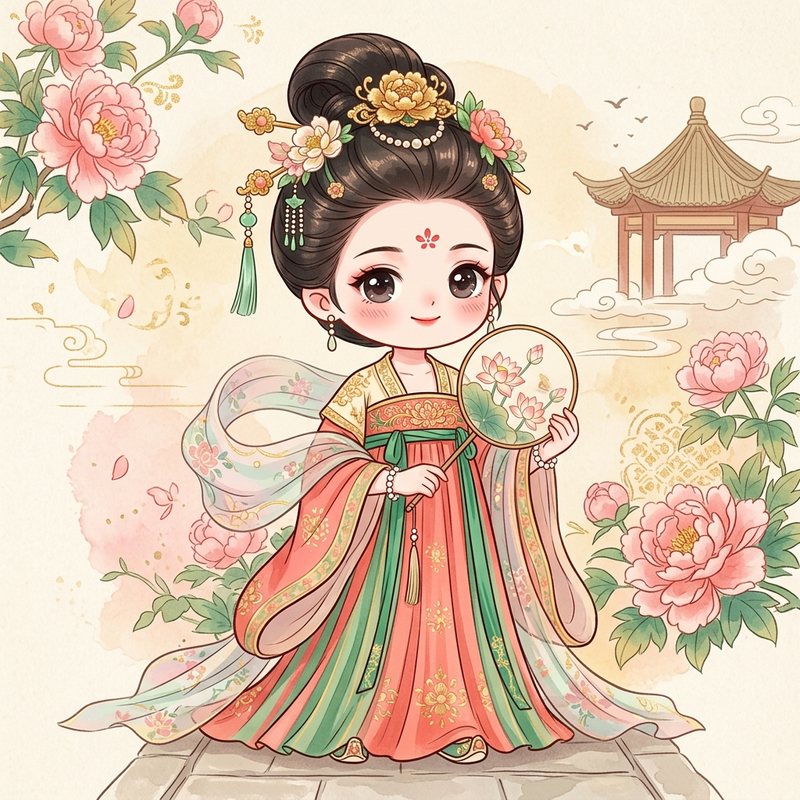
The Royal Peace-Weaver of Tibet: she crossed the snowbound plateau to forge an immortal bridge of peace, introducing agriculture, medicine, and Buddhism across forty devoted years.
Stops10
Traversed~2,170km
Audio Tour~12min
“知书达礼,深娴女德。”
Versed in classic literature and imperial decorum, deeply steeped in moral virtue.
The Royal Peace-Weaver of TibetTang Dynasty(623—680)吐蕃尊称甲木萨 · 汉妃神女 · 藏传佛教白度母化身Audio Journey · 10 Stops
The Royal Peace-Weaver of Tibet: she crossed the snowbound plateau to forge an immortal bridge of peace, introducing agriculture, medicine, and Buddhism across forty devoted years.
The Royal Peace-Weaver· Queen Bertha of KentThe Civilizing Queen· Catherine of BraganzaThe Sacred Patroness of Faith· Saint Helena
Unfolding the Historical Landscape…
印
Daily Wisdom & Resilience Oracle
The Resilient Optimist
“竹杖芒鞋轻胜马,谁怕?一蓑烟雨任平生。”
Holding a bamboo cane and wearing straw sandals, I stride faster than a horse. Who is afraid? A straw cloak in the mist and rain — I live my life with equanimity.
💡 In the 3rd year of exile in Huangzhou, caught in a sudden downpour, Su Shi embraced the storm with supreme resilience.
— Su Shi (Dongpo)(The Renaissance Foodie & Optimist)
Historical Footprints & Narration Archive
10 Stations
1
Chang'an Imperial Heritage
625 CE · Age 2
Imperial capital of the early Tang Dynasty, birthplace and upbringing of the princess, modern Xi'an, Shaanxi
Born into the Tang imperial clan, immersed from childhood in classics, poetry, and palace decorum.
“知书达礼,深娴女德。”
Zhī shū dá lǐ, shēn xián nǚ dé.
Versed in classic literature and imperial decorum, deeply steeped in moral virtue.
Station Narration Script
Beneath the palace willows of imperial Chang'an, young Princess Wencheng was raised amid literature, music, and courtly grace. Beyond the Confucian classics, she eagerly studied agricultural irrigation, herbal medicine, and astronomy. The cosmopolitan grandeur of the early Tang instilled in her an unshakeable cultural poise, quietly preparing her for a destiny that would bridge two immense worlds.
Departure Transition Script
In 640 CE, the Tibetan King dispatched royal envoys seeking marriage, calling the princess to a grand peacemaking mission.
2
Chang'an Betrothal & Mission
640 CE · Age 17
Imperial palace court of Emperor Taizong, commissioning center of the historic bridal alliance, modern Xi'an
Tibetan prime minister Gar Tongtsen brought gold to request marriage, and Emperor Taizong appointed Princess Wencheng.
“舅甥和好,社稷如一。”
Jiù shēng hé hǎo, shè jì rú yī.
Maternal uncle and royal nephew bound in harmonious fellowship, their sovereign states united as one harmonious commonwealth.
Station Narration Script
Before the banners of Taiji Palace, Gar Tongtsen presented radiant gold and exquisite treasures, sealing a royal alliance through razor-sharp intellect. Emperor Taizong formally invested seventeen-year-old Princess Wencheng with her historic title. Confronting the harsh unknowns of the remote plateau, the princess accepted the mantle with unwavering serenity, gathering sacred Buddhist statues, agricultural manuals, and silkworm breeds to bring the gifts of Chinese civilization west.
Departure Transition Script
In early 641 CE, Prince Li Daozong raised imperial banners, leading the grand royal bridal caravan westward.
3
Mount Riyue (Chiling Pass)
641 CE · Age 18
Historic continental divide and frontier mountain pass separating Tang China and the Tibetan Plateau, modern Mount Riyue, Qinghai
Standing at the border ridge, she shattered her looking glass against the rocks, dedicating her spirit wholly to Tibet.
“从长安到拉萨,走了一条金色的路。”
Cóng Cháng'ān dào Lāsà, zǒu le yì tiáo jīnsè de lù.
From Chang'an to Lhasa, she paved a golden road across the snow mountains.
Station Narration Script
At the wind-swept pass of Mount Chiling, the earth stretched vast and austere under a colossal sky. Standing upon the continental divide, east lay the blossoming orchards and cultured courts of Chang'an, while west rose the icy, perilous crags of the Tibetan plateau. Gazing outward, Princess Wencheng summoned invincible resolve, hurling her mirror upon the rocks. In that shattering moment, private nostalgia transformed into universal compassion, birthing a legendary peacemaker.
Departure Transition Script
Crossing the snowy ridge, the royal retinue descended toward the Yellow River's source to meet the Tibetan King.
4
Lake Baihai (Cypress Sea)
641 CE · Age 18
Pristine twin alpine lakes at the headwaters of the Yellow River, modern Lake Kyaring, Madoi, Qinghai
King Songtsen Gampo rode out to meet his bride at Lake Baihai, observing son-in-law etiquette with deep reverence.
The Tibetan King was overjoyed; upon meeting Prince Daozong, he observed the humble decorum of a son-in-law with utmost reverence.
Station Narration Script
Beside the sapphire waters of Lake Baihai, where the young Yellow River originates, white felt pavilions dotted the alpine meadows. King Songtsen Gampo arrived at the head of his royal cavaliers, having ridden across mountain passes to welcome his Tang bride. Meeting Prince Li Daozong, the king set aside his tribal armor, donned Tang robes, and bowed with the humility of a devoted son-in-law. Amid roaring campfires and joyous banquets, an enduring kinship between the two civilizations was born.
Departure Transition Script
With royal protocols concluded, the princess journeyed into the Kham valleys, scattering seeds of knowledge.
5
Yushu (Benda Valley)
641 CE · Age 18
Cultural gorge and mountain sanctuary along the Tang-Tibet Ancient Road in Kham, modern Yushu, Qinghai
Staying in Benda Gorge, she instructed local tribes in farming and masonry, leaving cliff carvings cherished for centuries.
Who claimed the high plateau could yield no grains? The Princess brought the fragrant harvest of barley, wheat, and rice.
Station Narration Script
In the sheltered greenery of Benda Gorge, Princess Wencheng set aside imperial pomp to walk the valley soil. She taught villagers how to judge soil fertility, build stone-lined irrigation canals, and cultivate hardy grains. Her craftsmen erected the highlands' first watermills to grind flour, while masons chiseled serene Buddhist figures into the cliffs of Lebagou. In a few industrious weeks, she turned a rugged mountain haven into a beacon of shared knowledge.
Departure Transition Script
Farewelling the grateful folk of Kham, the expedition crossed the final ranges to reach the sacred city of Lhasa.
6
Lhasa Nuptials & Sacred Temples
641 CE · Age 18
Spiritual heart of Tibet, site of the Jokhang Temple and Potala Palace, modern Lhasa
Arriving in Lhasa amid public jubilee, she wed the king, built the Potala, and geomantically founded Jokhang Temple.
“自从贵主和亲后,一半胡风似汉家。”
Zì cóng guì zhǔ hé qīn hòu, yí bàn hú fēng sì hàn jiā.
Ever since the noble imperial princess was wed in diplomatic peace, half of the frontier customs have resembled those of the Han homeland.
Station Narration Script
Beneath the red cliffs of Mount Marpori in Lhasa, conch trumpets resonated across the sunlit valley. The populace danced through the streets to welcome the Tang princess as queen. King Songtsen Gampo erected a soaring palace on the mountain for her residence. Climbing the heights with compass in hand, Wencheng analyzed the surrounding ridges, pinpointing the sacred coordinates for Jokhang and Ramoche temples. When the golden Jowo Shakyamuni was consecrated, Lhasa transformed from a warrior citadel into an eternal spiritual capital.
Departure Transition Script
Following the nuptials, the princess moved into the Yarlung Valley to revolutionize highland agrarian life.
7
Trandruk Temple (Yarlung Valley)
645 CE · Age 22
Ancient cradle of Tibetan agriculture and royalty in the fertile Yarlung Valley, modern Nedong, Shannan
Residing at Trandruk Temple, she cultivated Tibet's first measured farmland and embroidered the legendary Pearl Thangka.
A radiant golden bridge is arched across the snowy summits; Han and Tibetan are bound together as one beloved family.
Station Narration Script
In the sheltered warmth of the Yarlung Valley, historic cradle of Tibetan civilization, Princess Wencheng found a tranquil second home at Trandruk Temple. Walking the riverbanks in simple robes, she demonstrated the double-ox plow to local farmers, turning over ancient sod for golden barley crops. By lamplight at night, she threaded thousands of shimmering pearls into an iconic thangka of Guanyin. Her tireless hands brought not only celestial art, but also abundant grain and self-reliance to generations of highland families.
Departure Transition Script
After nine harmonious years, King Songtsen Gampo died suddenly, plunging the princess into a trial of supreme resilience.
8
Lhasa Fortitude & Peacekeeping
650 CE · Age 27
Himalayan imperial seat during royal succession and political turbulence, modern Lhasa, Tibet
When the king died young, she refused to return to Chang'an, staying thirty solitary years in Tibet to safeguard peace.
“柔肩担大义,孤胆守和平。”
Róujiān dān dàyì, gūdǎn shǒu hépíng.
With delicate shoulders she bore historic justice; with solitary courage she defended universal peace.
Station Narration Script
In 650 CE, sorrow enveloped Lhasa under somber skies as the great King Songtsen Gampo died young. Court intrigues stirred, and imperial emissaries offered to escort the twenty-seven-year-old princess back to the warmth of Chang'an. Yet gazing out over the people who called her 'Gyasa,' she refused to abandon them. Donning dark Tibetan mourning robes, she took her place in the council hall to stabilize the realm alongside minister Gar Tongtsen, burying personal sorrow to stand as an unbreakable guardian of peace.
Departure Transition Script
Twenty years marched by, yet through geopolitical storms Wencheng remained a welcoming beacon for travelers.
9
Lhasa Diplomatic Sanctuary
670 CE · Age 47
Continental crossroads of Silk Road diplomacy, shelter for pilgrims and envoys, modern Lhasa, Tibet
Navigating complex frontier geopolitics, she aided Tang envoy Wang Xuance and traveling pilgrims across the Himalayas.
“尊奉甲木萨,慈光照雪山。”
Zūnfèng Jiǎmùsà, cíguāng zhào xuěshān.
Venerated as Gyasa the compassionate queen, whose benevolent light shines across the snow mountains.
Station Narration Script
High clouds sailed above the stone battlements of Lhasa as age endowed Queen Wencheng with regal wisdom. Despite diplomatic storms along the borders, her palace gates remained wide open for official envoys and traveling pilgrim monks. When Tang ambassador Wang Xuance arrived on his Indian campaign, she arranged warm hospitality and essential transport; when freezing monks sought passage across the Himalayas, she provided fleece cloaks and imperial travel permits, transforming her home into an eternal haven.
Departure Transition Script
Decades passed, and after forty years of tireless devotion, the legendary queen approached her saintly farewell.
10
Lhasa White Tara Transcendence
680 CE · Age 57
Sacred resting sanctuary of Princess Wencheng beside Jokhang Temple, modern Lhasa, Tibet
Passing away after forty years in Tibet, honored with a state funeral, immortalized as the White Tara outside Jokhang.
Before the Jokhang Temple the Tang Willow flourishes green, spreading its gentle shade across the snowlands down to this day.
Station Narration Script
In 680 CE, temple bells echoed solemnly across Lhasa as Princess Wencheng closed her eyes after forty years of devotion. Tibet accorded her an unprecedented royal state funeral, while the Tang Emperor sent envoys across thousands of miles to mourn. Citizens lit countless butter lamps, honoring their beloved queen. Outside the Jokhang Temple, the sacred willow she planted spread green boughs in the alpine breeze. Deified as the White Tara, her spirit lives on as the eternal bridge uniting two great peoples.
Departure Transition Script
From Chang'an to the roof of the world, Princess Wencheng built a timeless monument of peace and love.
Key Historical Inquiries & Context
· 核心史实公案与速览
Princess Wencheng (c. 623–680 CE) was a noblewoman of the Tang imperial clan created an imperial princess by Emperor Taizong. In 641 CE, she journeyed to Tibet to marry King Songtsen Gampo, sealing a historic peace alliance. She brought the sacred Jowo Shakyamuni statue, agricultural seeds, medical treatises, and master craftsmen, geomantically founding the Jokhang and Ramoche temples and cultivating Tibet's first measured farmland. Remaining thirty years in Tibet after her husband's death, she guarded peace and was venerated by Tibetans as Gyasa and deified as the White Tara.
Princess Wencheng (c. 623–680 CE) was a noblewoman of the Tang imperial clan created an imperial princess by Emperor Taizong. In 641 CE, she journeyed to Tibet to marry King Songtsen Gampo, sealing a historic peace alliance. She brought the sacred Jowo Shakyamuni statue, agricultural seeds, medical treatises, and master craftsmen, geomantically founding the Jokhang and Ramoche temples and cultivating Tibet's first measured farmland. Remaining thirty years in Tibet after her husband's death, she guarded peace and was venerated by Tibetans as Gyasa and deified as the White Tara.
QWhat was Princess Wencheng's primary cultural and historical legacy?
Princess Wencheng is celebrated across world history as a pioneer of The Royal Peace-Weaver, The Civilizing Queen, The Sacred Patroness of Faith, leaving enduring philosophical insights, literature, and art.
QWhere does Princess Wencheng's historical life journey map lead?
This interactive GIS map retraces 10 chronological stops across Tang Dynasty China, originating from Chang'an Imperial Heritage and spanning through Lhasa White Tara Transcendence.
The Complete Life Journey & Biography of Princess Wencheng (Tibet) (文成公主)
Chronological travel & exile routes mapped to modern Chinese cities across Tang Dynasty China — featuring bilingual scholar audio, classical poetry recitations, and historical cross-paths.
Chang'an Imperial Heritage (长安宗室启蒙)
Age 2
Modern-day analog: Imperial capital of the early Tang Dynasty, birthplace and upbringing of the princess, modern Xi'an, Shaanxi
Born into the Tang imperial clan, immersed from childhood in classics, poetry, and palace decorum.
Beneath the palace willows of imperial Chang'an, young Princess Wencheng was raised amid literature, music, and courtly grace. Beyond the Confucian classics, she eagerly studied agricultural irrigation, herbal medicine, and astronomy. The cosmopolitan grandeur of the early Tang instilled in her an unshakeable cultural poise, quietly preparing her for a destiny that would bridge two immense worlds.
In 640 CE, the Tibetan King dispatched royal envoys seeking marriage, calling the princess to a grand peacemaking mission.
“Versed in classic literature and imperial decorum, deeply steeped in moral virtue.”
知书达礼,深娴女德。 (Zhī shū dá lǐ, shēn xián nǚ dé.)
Chang'an Betrothal & Mission (长安受册许婚)
Age 17
Modern-day analog: Imperial palace court of Emperor Taizong, commissioning center of the historic bridal alliance, modern Xi'an
Tibetan prime minister Gar Tongtsen brought gold to request marriage, and Emperor Taizong appointed Princess Wencheng.
Before the banners of Taiji Palace, Gar Tongtsen presented radiant gold and exquisite treasures, sealing a royal alliance through razor-sharp intellect. Emperor Taizong formally invested seventeen-year-old Princess Wencheng with her historic title. Confronting the harsh unknowns of the remote plateau, the princess accepted the mantle with unwavering serenity, gathering sacred Buddhist statues, agricultural manuals, and silkworm breeds to bring the gifts of Chinese civilization west.
In early 641 CE, Prince Li Daozong raised imperial banners, leading the grand royal bridal caravan westward.
“Maternal uncle and royal nephew bound in harmonious fellowship, their sovereign states united as one harmonious commonwealth.”
舅甥和好,社稷如一。 (Jiù shēng hé hǎo, shè jì rú yī.)
Mount Riyue (Chiling Pass) (赤岭日月山绝念)
Age 18
Modern-day analog: Historic continental divide and frontier mountain pass separating Tang China and the Tibetan Plateau, modern Mount Riyue, Qinghai
Standing at the border ridge, she shattered her looking glass against the rocks, dedicating her spirit wholly to Tibet.
At the wind-swept pass of Mount Chiling, the earth stretched vast and austere under a colossal sky. Standing upon the continental divide, east lay the blossoming orchards and cultured courts of Chang'an, while west rose the icy, perilous crags of the Tibetan plateau. Gazing outward, Princess Wencheng summoned invincible resolve, hurling her mirror upon the rocks. In that shattering moment, private nostalgia transformed into universal compassion, birthing a legendary peacemaker.
Crossing the snowy ridge, the royal retinue descended toward the Yellow River's source to meet the Tibetan King.
“From Chang'an to Lhasa, she paved a golden road across the snow mountains.”
从长安到拉萨,走了一条金色的路。 (Cóng Cháng'ān dào Lāsà, zǒu le yì tiáo jīnsè de lù.)
Lake Baihai (Cypress Sea) (柏海赞普亲迎)
Age 18
Modern-day analog: Pristine twin alpine lakes at the headwaters of the Yellow River, modern Lake Kyaring, Madoi, Qinghai
King Songtsen Gampo rode out to meet his bride at Lake Baihai, observing son-in-law etiquette with deep reverence.
Beside the sapphire waters of Lake Baihai, where the young Yellow River originates, white felt pavilions dotted the alpine meadows. King Songtsen Gampo arrived at the head of his royal cavaliers, having ridden across mountain passes to welcome his Tang bride. Meeting Prince Li Daozong, the king set aside his tribal armor, donned Tang robes, and bowed with the humility of a devoted son-in-law. Amid roaring campfires and joyous banquets, an enduring kinship between the two civilizations was born.
With royal protocols concluded, the princess journeyed into the Kham valleys, scattering seeds of knowledge.
“The Tibetan King was overjoyed; upon meeting Prince Daozong, he observed the humble decorum of a son-in-law with utmost reverence.”
Modern-day analog: Cultural gorge and mountain sanctuary along the Tang-Tibet Ancient Road in Kham, modern Yushu, Qinghai
Staying in Benda Gorge, she instructed local tribes in farming and masonry, leaving cliff carvings cherished for centuries.
In the sheltered greenery of Benda Gorge, Princess Wencheng set aside imperial pomp to walk the valley soil. She taught villagers how to judge soil fertility, build stone-lined irrigation canals, and cultivate hardy grains. Her craftsmen erected the highlands' first watermills to grind flour, while masons chiseled serene Buddhist figures into the cliffs of Lebagou. In a few industrious weeks, she turned a rugged mountain haven into a beacon of shared knowledge.
Farewelling the grateful folk of Kham, the expedition crossed the final ranges to reach the sacred city of Lhasa.
“Who claimed the high plateau could yield no grains? The Princess brought the fragrant harvest of barley, wheat, and rice.”
Modern-day analog: Spiritual heart of Tibet, site of the Jokhang Temple and Potala Palace, modern Lhasa
Arriving in Lhasa amid public jubilee, she wed the king, built the Potala, and geomantically founded Jokhang Temple.
Beneath the red cliffs of Mount Marpori in Lhasa, conch trumpets resonated across the sunlit valley. The populace danced through the streets to welcome the Tang princess as queen. King Songtsen Gampo erected a soaring palace on the mountain for her residence. Climbing the heights with compass in hand, Wencheng analyzed the surrounding ridges, pinpointing the sacred coordinates for Jokhang and Ramoche temples. When the golden Jowo Shakyamuni was consecrated, Lhasa transformed from a warrior citadel into an eternal spiritual capital.
Following the nuptials, the princess moved into the Yarlung Valley to revolutionize highland agrarian life.
“Ever since the noble imperial princess was wed in diplomatic peace, half of the frontier customs have resembled those of the Han homeland.”
自从贵主和亲后,一半胡风似汉家。 (Zì cóng guì zhǔ hé qīn hòu, yí bàn hú fēng sì hàn jiā.)
Modern-day analog: Ancient cradle of Tibetan agriculture and royalty in the fertile Yarlung Valley, modern Nedong, Shannan
Residing at Trandruk Temple, she cultivated Tibet's first measured farmland and embroidered the legendary Pearl Thangka.
In the sheltered warmth of the Yarlung Valley, historic cradle of Tibetan civilization, Princess Wencheng found a tranquil second home at Trandruk Temple. Walking the riverbanks in simple robes, she demonstrated the double-ox plow to local farmers, turning over ancient sod for golden barley crops. By lamplight at night, she threaded thousands of shimmering pearls into an iconic thangka of Guanyin. Her tireless hands brought not only celestial art, but also abundant grain and self-reliance to generations of highland families.
After nine harmonious years, King Songtsen Gampo died suddenly, plunging the princess into a trial of supreme resilience.
“A radiant golden bridge is arched across the snowy summits; Han and Tibetan are bound together as one beloved family.”
Modern-day analog: Himalayan imperial seat during royal succession and political turbulence, modern Lhasa, Tibet
When the king died young, she refused to return to Chang'an, staying thirty solitary years in Tibet to safeguard peace.
In 650 CE, sorrow enveloped Lhasa under somber skies as the great King Songtsen Gampo died young. Court intrigues stirred, and imperial emissaries offered to escort the twenty-seven-year-old princess back to the warmth of Chang'an. Yet gazing out over the people who called her 'Gyasa,' she refused to abandon them. Donning dark Tibetan mourning robes, she took her place in the council hall to stabilize the realm alongside minister Gar Tongtsen, burying personal sorrow to stand as an unbreakable guardian of peace.
Twenty years marched by, yet through geopolitical storms Wencheng remained a welcoming beacon for travelers.
“With delicate shoulders she bore historic justice; with solitary courage she defended universal peace.”
Modern-day analog: Continental crossroads of Silk Road diplomacy, shelter for pilgrims and envoys, modern Lhasa, Tibet
Navigating complex frontier geopolitics, she aided Tang envoy Wang Xuance and traveling pilgrims across the Himalayas.
High clouds sailed above the stone battlements of Lhasa as age endowed Queen Wencheng with regal wisdom. Despite diplomatic storms along the borders, her palace gates remained wide open for official envoys and traveling pilgrim monks. When Tang ambassador Wang Xuance arrived on his Indian campaign, she arranged warm hospitality and essential transport; when freezing monks sought passage across the Himalayas, she provided fleece cloaks and imperial travel permits, transforming her home into an eternal haven.
Decades passed, and after forty years of tireless devotion, the legendary queen approached her saintly farewell.
“Venerated as Gyasa the compassionate queen, whose benevolent light shines across the snow mountains.”
Modern-day analog: Sacred resting sanctuary of Princess Wencheng beside Jokhang Temple, modern Lhasa, Tibet
Passing away after forty years in Tibet, honored with a state funeral, immortalized as the White Tara outside Jokhang.
In 680 CE, temple bells echoed solemnly across Lhasa as Princess Wencheng closed her eyes after forty years of devotion. Tibet accorded her an unprecedented royal state funeral, while the Tang Emperor sent envoys across thousands of miles to mourn. Citizens lit countless butter lamps, honoring their beloved queen. Outside the Jokhang Temple, the sacred willow she planted spread green boughs in the alpine breeze. Deified as the White Tara, her spirit lives on as the eternal bridge uniting two great peoples.
From Chang'an to the roof of the world, Princess Wencheng built a timeless monument of peace and love.
“Before the Jokhang Temple the Tang Willow flourishes green, spreading its gentle shade across the snowlands down to this day.”