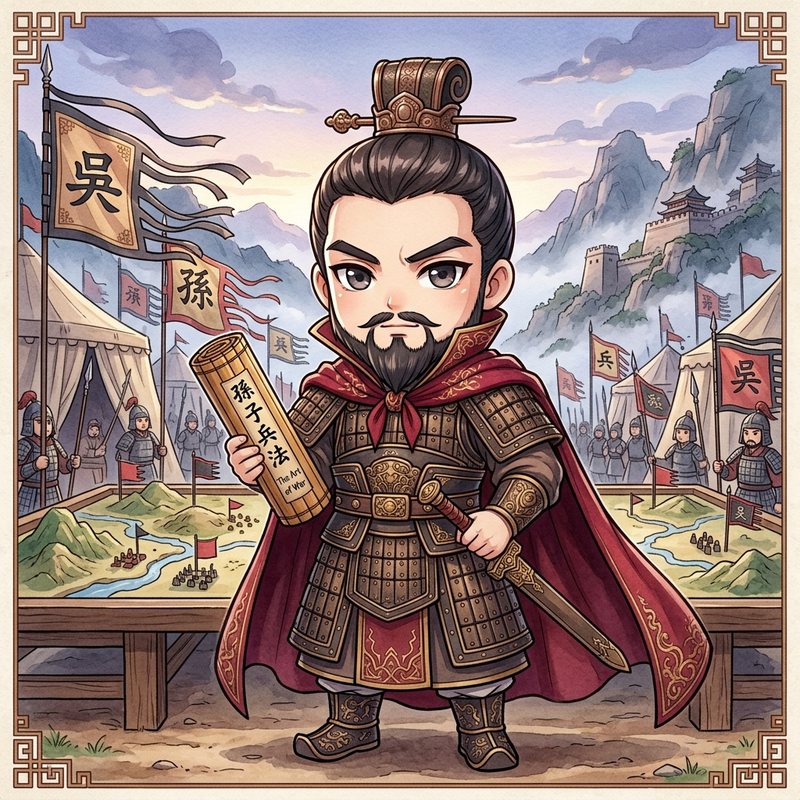
The Supreme Strategist & Master of The Art of War · -544 – -470
The Supreme Strategist & Master of The Art of War
Stops8
Traversed~2,449km
Audio Tour~12min
“兵者,国之大事,死生之地,存亡之道,不可不察也。”
Military action is of vital importance to the State; it is a matter of life and death, a road either to safety or to ruin. Hence it is a subject of inquiry which can on no account be neglected.
The Supreme Strategist & Master of The Art of WarSpring & Autumn (c. 544 - 470 BCE)字长卿 · 兵家至圣 · 百世兵家之师Audio Journey · 8 Stops
Transformed warfare into an immortal philosophy of psychology and effortless victory.
The Father of Strategic Warfare· Carl von Clausewitz & Sun TzuArchitect of Asymmetric Strategy· Niccolò Machiavelli & John Boyd
Unfolding the Historical Landscape…
印
Daily Wisdom & Resilience Oracle
The Supreme Strategist
“知彼知己,百战不殆;不知彼而知己,一胜一负;不知彼不知己,每战必殆。”
If you know the enemy and know yourself, you need not fear the result of a hundred battles. If you know yourself but not the enemy, for every victory gained you will also suffer a defeat. If you know neither the enemy nor yourself, you will succumb in every battle.
💡 Sun Tzu wrote his 13 chapters in seclusion near Suzhou, establishing the supreme strategic law of information and self-awareness.
— Sun Tzu(The Supreme Strategist & Master of The Art of War)
Historical Footprints & Narration Archive
8 Stations
1
Le'an, Qi State (Huimin, Shandong)
-525 CE · Age 19
Sun Tzu's ancestral homeland on the Yellow River, Binzhou, Shandong
Born into an Aristocratic Clan of Military Thinkers
Military action is of vital importance to the State; it is a matter of life and death, a road either to safety or to ruin. Hence it is a subject of inquiry which can on no account be neglected.
Station Narration Script
Born in 544 BCE into a military clan in Qi, young Sun Wu studied statecraft and warfare, taking to heart: 'War is a matter of vital importance to the state—the ground of life and death.' He resolved to master victory without needless slaughter.
Departure Transition Script
As Qi descended into clan strife, young Sun Wu crossed the Yangtze south to the kingdom of Wu, seeking a stage worthy of his strategic vision.
2
Mount Qionglong, Wu State (Suzhou, Jiangsu)
-518 CE · Age 26
Tranquil mountain retreat where Sun Tzu authored the thirteen chapters of The Art of War, Suzhou
Retreating to a Mountain Hut to Pen the Thirteen Chapters
If you know the enemy and know yourself, you need not fear the result of a hundred battles.
Station Narration Script
In a thatched retreat on Mount Qionglong near Suzhou, Sun Wu refined years of study into the thirteen chapters of The Art of War, forging the immortal rule: 'Know the enemy and know yourself, and you need not fear a hundred battles.'
Departure Transition Script
Wu Zixu recommended him seven times. Sun Wu entered King Helü's court with his treatise, ready for a decisive test of his doctrine.
3
Wu Royal Palace, Gusu (Suzhou, Jiangsu)
-512 CE · Age 32
Wu royal court in Suzhou where Sun Tzu demonstrated military discipline
Drilling Royal Concubines to Prove Iron Discipline
To fight and conquer in all your battles is not supreme excellence; supreme excellence consists in breaking the enemy's resistance without fighting.
Station Narration Script
King Helü tested him with one hundred eighty palace women. Sun Wu enforced discipline without fear of royal favoritism, proving that 'to subdue the enemy without fighting is the acme of skill,' and won command of Wu's armies.
Departure Transition Script
Appointed commander, Sun Wu led Wu's forces inland on a daring long-range strike toward Chu's heartland—the Battle of Boju loomed.
4
Baiju Battlefield, Hubei (Macheng)
-506 CE · Age 38
Fabled battlefield where Wu defeated Chu with asymmetric warfare, modern Macheng, Hubei
Five Battles, Five Victories: The Masterclass of Asymmetric Blitz
Let your rapidity be that of the wind, your compactness that of the forest. In raiding and plundering be like fire, in immovability like a mountain.
Station Narration Script
At Boju in 506 BCE, outnumbered by Chu, Sun Wu struck voids and avoided strengths—'swift as the wind, orderly as the forest, ravaging like fire, immovable as a mountain'—winning five successive victories.
Departure Transition Script
Chu's lines collapsed. Sun Wu pursued to the gates of Ying, the Chu capital.
5
Yingdu Capital, Chu State (Jingzhou, Hubei)
-506 CE · Age 38
Capital of Chu state on the middle Yangtze captured by Sun Tzu, modern Jingzhou, Hubei
Entering the Capital of the Southern Superpower
“夫兵形象水,水之形,避高而趋下;兵之形,避实而击虚。”
Fū bīng xíng xiàng shuǐ, shuǐ zhī xíng, bì gāo ér qū xià; bīng zhī xíng, bì shí ér jī xū.
Military tactics are like unto water; for water in its natural course runs away from high places and hastens downwards. So in war, the way is to avoid what is strong and to strike at what is weak.
Station Narration Script
Wu seized Ying. Sun Wu kept iron discipline and spared civilians, embodying 'military form is like water—avoid the solid and strike the void,' elevating Wu among the great powers.
Departure Transition Script
With Chu broken, Sun Wu led the triumphant army home to the Wu capital at Gusu.
6
Gusu Capital (Suzhou, Jiangsu)
-496 CE · Age 48
Ancient Wu capital & canal city of water gardens, modern Suzhou, Jiangsu
Designing the Great City of Gusu and Securing Hegemony
The skillful tactician positions himself where he cannot easily suffer defeat, and misses no opportunity to defeat the enemy.
Station Narration Script
Back in Gusu, Sun Wu helped redesign the capital's defenses and reorganize the army, holding that 'the skillful fighter puts himself beyond defeat, then awaits the enemy's moment of vulnerability.' Wu reached its zenith.
Departure Transition Script
After Helü's death, King Fuchai grew arrogant; Wu Zixu was forced to suicide. Sun Wu saw the danger and chose to retire at the height of success.
7
Dongting Mountain, Lake Tai (Suzhou, Jiangsu)
-484 CE · Age 60
Misty hermitage slopes near Lake Taihu where Sun Tzu retired from politics, Suzhou
Walking Away from Power: The Ultimate Wisdom of Self-Preservation
O divine art of subtlety and secrecy! Through you we learn to be invisible, through you inaudible; and hence we're the directors of the enemy's fate.
Station Narration Script
At sixty, Sun Wu retired among the islands of Lake Tai, refining his writings toward the highest mastery—'so subtle as to be formless, so mysterious as to be silent'—beyond glory and defeat.
Departure Transition Script
In time Sun Wu passed away in Wu. The thirteen chapters he left behind were destined to travel the world for millennia.
8
Wuzhong, Suzhou (Jiangsu)
-470 CE · Age 74
Historic southern Jiangsu sanctuary where the legacy of The Art of War became immortal
The Thirteen Chapters that Conquered Two and a Half Millennia
“投之亡地然后存,陷之死地然后生。”
Tóu zhī wáng dì rán hòu cún, xiàn zhī sǐ dì rán hòu shēng.
Place your army in deadly peril, and it will survive; plunge it into desperate straits, and it will come off in safety.
Station Narration Script
Around 470 BCE Sun Wu died in Wu. The Art of War, translated into dozens of languages, still lights strategy worldwide—with hard-won wisdom such as 'place them in death ground, and they will live.'
Key Historical Inquiries & Context
· 核心史实公案与速览
Sun Tzu (c. 544–496 BCE), or Sun Wu, was the legendary military general and strategist from the state of Wu, renowned worldwide as the author of The Art of War (Sunzi Bingfa). His strategy prioritizes psychological foresight and winning without battle.
QWhat is the supreme principle in Sun Tzu's Art of War?
'To subdue the enemy without fighting is the acme of skill' (不战而屈人之兵). He considered bloody siege and attrition the costliest failures of statecraft.
QWas Sun Tzu a real historical figure?
Yes. Sima Qian's Shiji documents Sun Wu's military service under King Helü of Wu, orchestrating the historic defeat of Chu in the Battle of Boju (506 BCE).
QHow is Sun Tzu's strategy applied today?
Modern leaders apply his principles of asymmetric information, competitive positioning, and emotional discipline to business, diplomacy, and crisis management.
The Complete Life Journey & Biography of Sun Tzu (Art of War) (孙子)
Chronological travel & exile routes mapped to modern Chinese cities across Spring & Autumn (c. 544 - 470 BCE) China — featuring bilingual scholar audio, classical poetry recitations, and historical cross-paths.
Le'an, Qi State (Huimin, Shandong) (山东惠民 (齐国乐安))
Age 19
Modern-day analog: Sun Tzu's ancestral homeland on the Yellow River, Binzhou, Shandong
Born into an Aristocratic Clan of Military Thinkers
Born in 544 BCE into a military clan in Qi, young Sun Wu studied statecraft and warfare, taking to heart: 'War is a matter of vital importance to the state—the ground of life and death.' He resolved to master victory without needless slaughter.
As Qi descended into clan strife, young Sun Wu crossed the Yangtze south to the kingdom of Wu, seeking a stage worthy of his strategic vision.
“Military action is of vital importance to the State; it is a matter of life and death, a road either to safety or to ruin. Hence it is a subject of inquiry which can on no account be neglected.”
Mount Qionglong, Wu State (Suzhou, Jiangsu) (江苏苏州 (穹窿山隐居著书))
Age 26
Modern-day analog: Tranquil mountain retreat where Sun Tzu authored the thirteen chapters of The Art of War, Suzhou
Retreating to a Mountain Hut to Pen the Thirteen Chapters
In a thatched retreat on Mount Qionglong near Suzhou, Sun Wu refined years of study into the thirteen chapters of The Art of War, forging the immortal rule: 'Know the enemy and know yourself, and you need not fear a hundred battles.'
Wu Zixu recommended him seven times. Sun Wu entered King Helü's court with his treatise, ready for a decisive test of his doctrine.
“If you know the enemy and know yourself, you need not fear the result of a hundred battles.”
Wu Royal Palace, Gusu (Suzhou, Jiangsu) (江苏苏州 (吴宫演兵与拜大将))
Age 32
Modern-day analog: Wu royal court in Suzhou where Sun Tzu demonstrated military discipline
Drilling Royal Concubines to Prove Iron Discipline
King Helü tested him with one hundred eighty palace women. Sun Wu enforced discipline without fear of royal favoritism, proving that 'to subdue the enemy without fighting is the acme of skill,' and won command of Wu's armies.
Appointed commander, Sun Wu led Wu's forces inland on a daring long-range strike toward Chu's heartland—the Battle of Boju loomed.
“To fight and conquer in all your battles is not supreme excellence; supreme excellence consists in breaking the enemy's resistance without fighting.”
Modern-day analog: Fabled battlefield where Wu defeated Chu with asymmetric warfare, modern Macheng, Hubei
Five Battles, Five Victories: The Masterclass of Asymmetric Blitz
At Boju in 506 BCE, outnumbered by Chu, Sun Wu struck voids and avoided strengths—'swift as the wind, orderly as the forest, ravaging like fire, immovable as a mountain'—winning five successive victories.
Chu's lines collapsed. Sun Wu pursued to the gates of Ying, the Chu capital.
“Let your rapidity be that of the wind, your compactness that of the forest. In raiding and plundering be like fire, in immovability like a mountain.”
Yingdu Capital, Chu State (Jingzhou, Hubei) (湖北荆州 (攻入楚国都城郢都))
Age 38
Modern-day analog: Capital of Chu state on the middle Yangtze captured by Sun Tzu, modern Jingzhou, Hubei
Entering the Capital of the Southern Superpower
Wu seized Ying. Sun Wu kept iron discipline and spared civilians, embodying 'military form is like water—avoid the solid and strike the void,' elevating Wu among the great powers.
With Chu broken, Sun Wu led the triumphant army home to the Wu capital at Gusu.
“Military tactics are like unto water; for water in its natural course runs away from high places and hastens downwards. So in war, the way is to avoid what is strong and to strike at what is weak.”
夫兵形象水,水之形,避高而趋下;兵之形,避实而击虚。 (Fū bīng xíng xiàng shuǐ, shuǐ zhī xíng, bì gāo ér qū xià; bīng zhī xíng, bì shí ér jī xū.)
Gusu Capital (Suzhou, Jiangsu) (江苏苏州 (筑城强国与称霸诸侯))
Age 48
Modern-day analog: Ancient Wu capital & canal city of water gardens, modern Suzhou, Jiangsu
Designing the Great City of Gusu and Securing Hegemony
Back in Gusu, Sun Wu helped redesign the capital's defenses and reorganize the army, holding that 'the skillful fighter puts himself beyond defeat, then awaits the enemy's moment of vulnerability.' Wu reached its zenith.
After Helü's death, King Fuchai grew arrogant; Wu Zixu was forced to suicide. Sun Wu saw the danger and chose to retire at the height of success.
“The skillful tactician positions himself where he cannot easily suffer defeat, and misses no opportunity to defeat the enemy.”
Dongting Mountain, Lake Tai (Suzhou, Jiangsu) (江苏太湖 (洞庭山超然隐退))
Age 60
Modern-day analog: Misty hermitage slopes near Lake Taihu where Sun Tzu retired from politics, Suzhou
Walking Away from Power: The Ultimate Wisdom of Self-Preservation
At sixty, Sun Wu retired among the islands of Lake Tai, refining his writings toward the highest mastery—'so subtle as to be formless, so mysterious as to be silent'—beyond glory and defeat.
In time Sun Wu passed away in Wu. The thirteen chapters he left behind were destined to travel the world for millennia.
“O divine art of subtlety and secrecy! Through you we learn to be invisible, through you inaudible; and hence we're the directors of the enemy's fate.”
Modern-day analog: Historic southern Jiangsu sanctuary where the legacy of The Art of War became immortal
The Thirteen Chapters that Conquered Two and a Half Millennia
Around 470 BCE Sun Wu died in Wu. The Art of War, translated into dozens of languages, still lights strategy worldwide—with hard-won wisdom such as 'place them in death ground, and they will live.'
“Place your army in deadly peril, and it will survive; plunge it into desperate straits, and it will come off in safety.”
投之亡地然后存,陷之死地然后生。 (Tóu zhī wáng dì rán hòu cún, xiàn zhī sǐ dì rán hòu shēng.)
In-Depth Essays & Philosophical Inquiries on Sun Tzu
Deep dives, myth-busting, and modern lessons from Sun Tzu's life and philosophy.