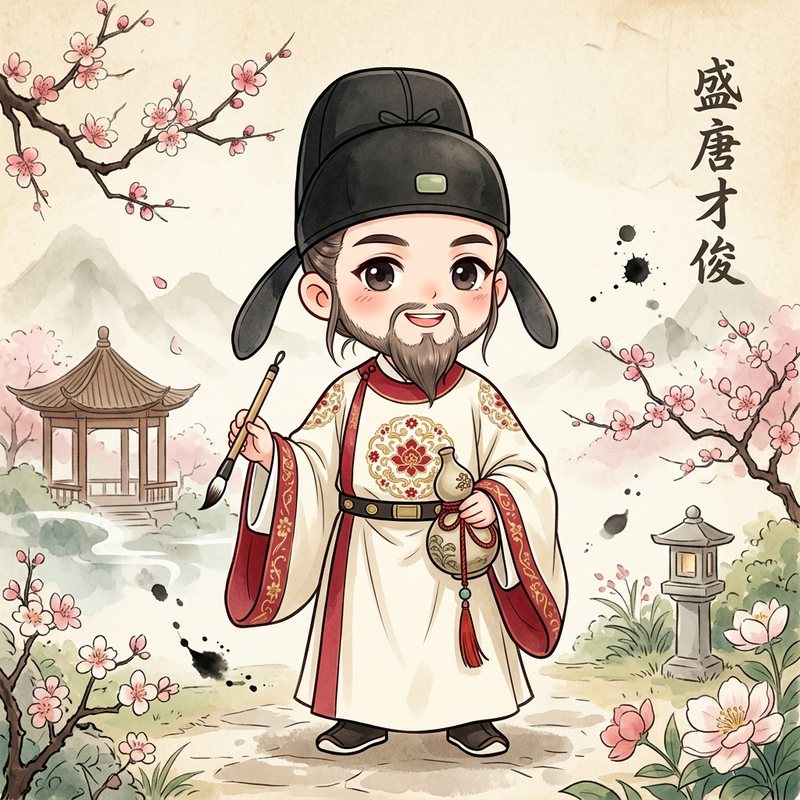
The Poet Buddha of Tang DynastyTang Dynasty(701—761)字摩诘 · 世称王右丞/诗佛Audio Journey · 9 Stops
The Poet Buddha: master of Zen nature poetry and founding father of Southern School ink painting.
The Impressionist of Chinese Poetry· Claude MonetThe Hermit of Wangchuan Valley· Henry David ThoreauThe Poet Buddha of Serenity· A Master of Zen and Mindfulness
Unfolding the Historical Landscape…
印
Daily Wisdom & Resilience Oracle
The Resilient Optimist
“竹杖芒鞋轻胜马,谁怕?一蓑烟雨任平生。”
Holding a bamboo cane and wearing straw sandals, I stride faster than a horse. Who is afraid? A straw cloak in the mist and rain — I live my life with equanimity.
💡 In the 3rd year of exile in Huangzhou, caught in a sudden downpour, Su Shi embraced the storm with supreme resilience.
— Su Shi (Dongpo)(The Renaissance Foodie & Optimist)
Historical Footprints & Narration Archive
9 Stations
1
Puzhou Birthplace
701 CE · Age 0
Ancient Hedong cultural cradle near the Yellow River, modern Yongji, Shanxi
Born into the noble Hedong Wang clan, named after Vimalakirti by his mother, immersed in poetry, lute music, and Chan stillness.
All alone in a strange land as a lonely guest, at every festive holiday my longing for kin doubles.
Station Narration Script
Along the historic banks of the Yellow River in ancient Puzhou, young Wang Wei came into the world. His mother, a devoted Chan Buddhist, named him after the enlightened layman Vimalakirti, planting the seeds of lifelong serenity. Here the child prodigy practiced ink calligraphy and mastered the five-stringed lute in bamboo courtyards, creating a spiritual foundation that would weather every future storm.
Departure Transition Script
Around 715 CE, the fifteen-year-old scholar packed his scrolls and lute, journeying westward toward Chang'an, the glittering capital of the Tang Empire.
2
Chang'an Imperial Examination Triumph
721 CE · Age 20
Tang imperial capital and metropolitan examination center, modern Xi'an, Shaanxi
Captivating imperial salons with his lute masterpiece 'The Feather Robe', he passed the imperial examinations at twenty-one to direct royal music.
Who pities the Yue maiden with a face pure as jade, washing silk in poverty by the riverbank alone?
Station Narration Script
In the imperial capital of Chang'an, blooming with unprecedented wealth and culture, young Wang Wei arrived with his five-stringed lute. At royal salons, his performance of 'The Feather Robe' held nobles spellbound with ethereal acoustic purity. Passing the prestigious Jinshi examinations at twenty-one, he was awarded directorship of imperial music—a young genius shining at the very zenith of the High Tang.
Departure Transition Script
Yet court splendor proved fleeting: when palace dancers under his authority performed a forbidden royal lion dance, Wang Wei was demoted and exiled to Jizhou.
3
Jizhou Demotion
721 CE · Age 20
Provincial canal crossroad and imperial grain granary center, modern Jining, Shandong
Demoted to grain supply officer in Jizhou over an unauthorized court lion dance, enduring his first plunge into bureaucratic obscurity.
“微官易得罪,谪去济川阴。”
Wēi guān yì dé zuì, zhé qù Jì chuān yīn.
A minor official easily incurs blame, cast away south into the shadows of the Ji River.
Station Narration Script
From the grand palaces of Chang'an to the dusty grain silos of Jizhou in Shandong, twenty-year-old Wang Wei confronted the harsh unpredictability of imperial power. Yet he did not wallow in despair. Diligently balancing ledgers and inspecting public granaries, he walked among reeds along the Ji River, shedding youthful vanity and cultivating a quiet, enduring fortitude.
Departure Transition Script
In 726 CE, his term completed, Wang Wei resigned from his post, turning his back on official bureaucracy to seek pastoral quiet along the Qi River.
4
Qishang Hermitage
726 CE · Age 25
Scenic river basin known for bamboo groves and Taoist retreats, modern Hebi, Henan
Resigning to till fields and meditate along the Qi River, following Tao Yuanming to establish his lifelong pastoral aesthetic.
“屏居冠栗里,清夜坐虚堂。”
Píng jū guān Lì lǐ, qīng yè zuò xū táng.
Living in seclusion I follow the ways of Tao Qian; in the tranquil night I sit meditating in an empty hall.
Station Narration Script
Along the Qi River in Henan, dense bamboo groves swayed beside pristine waters. Here the young poet tasted the unburdened life of a hermit-farmer. Hoeing wild weeds at dawn, steering skiffs at sunset, and reading Buddhist sutras in empty halls by night, he found harmony with the voice of the wind. This pastoral interlude nurtured the gentle, lucid aesthetics that would crown him master of landscape verse.
Departure Transition Script
In 734 CE, as the righteous chancellor Zhang Jiuling assumed power, Wang Wei felt the call of public duty and journeyed back to the capital.
5
Chang'an Court Return
734 CE · Age 33
Tang imperial chancery and Daming Palace counseling chambers, modern Xi'an, Shaanxi
Promoted to Right Reminder by Chancellor Zhang Jiuling, offering courageous court counsel during Kaiyuan's golden twilight.
“贱子跪自陈,可为帐下不?”
Jiàn zǐ guì zì chén, kě wéi zhàng xià fǒu?
Humbly kneeling I present myself: may I serve faithfully beneath your banner?
Station Narration Script
Returning to the halls of Daming Palace, thirty-something Wang Wei earned the deep trust of Chancellor Zhang Jiuling. As Right Reminder, he spoke candidly on public welfare, seeking to reform governance. Yet as unscrupulous rivals marginalized loyal statesmen, Wang Wei refused compromise, guarding his moral center through inner meditation.
Departure Transition Script
In the spring of 737 CE, appointed Imperial Censor to the frontier, Wang Wei galloped westward across the passes into the boundless Gobi desert.
6
Liangzhou Frontier Expedition
737 CE · Age 36
Hexi Corridor military garrison and Silk Road gateway, modern Wuwei, Gansu
Serving as military inspector in the Hexi Corridor, capturing the desert's straight smoke and round setting sun in immortal verse.
“大漠孤烟直,长河落日圆。”
Dà mò gū yān zhí, cháng hé luò rì yuán.
In the boundless desert a lone smoke rises straight; along the endless river the setting sun hangs round.
Station Narration Script
With Qilian snow peaks looming above arid plains, Wang Wei rode through the whistling winds of the Hexi Corridor as imperial commissioner. A solitary beacon smoke rose arrow-straight into the heavens; an immense crimson sun dipped gently beside the Yellow River. This minimalist geometric majesty permanently redefined Chinese landscape aesthetics and expanded his spirit to the horizon itself.
Departure Transition Script
Having served three rigorous years along the frontier, Wang Wei returned to Chang'an in 741 CE to establish a hermitage beneath the Zhongnan Mountains.
7
Zhongnan Mountain Hermitage
741 CE · Age 40
Legendary mountain sanctuary for Daoist and Buddhist hermits, southern Xi'an, Shaanxi
Pioneering the 'half-official, half-hermit' lifestyle, discovering boundless freedom where outward waters end and clouds rise.
“行到水穷处,坐看云起时。”
Xíng dào shuǐ qióng chù, zuò kàn yún qǐ shí.
I stroll to where the water ends, and sit to watch the rising clouds.
Station Narration Script
Beneath the soaring crags of the Zhongnan range, middle-aged Wang Wei discovered perfect equilibrium. On days of leave, he wandered solitary trails with no agenda. Reaching the rocky headwaters where the stream vanished into mist, he simply sat on the stones and watched clouds blossom above the peaks—an immortal testament to inner composure beyond worldly ambition.
Departure Transition Script
In 744 CE, Wang Wei purchased the country estate of early Tang poet Song Zhiwen at Wangchuan, preparing his ultimate mountain sanctuary.
8
Wangchuan Villa Retreat
744 CE · Age 44
Fabled poet-painter estate and Zen nature sanctuary in Lantian Valley, modern Xi'an, Shaanxi
Crafting the twenty scenic sights of Wangchuan with companion Pei Di, fusing poetry, painting, and Chan into timeless serenity.
Empty mountain, no one seen, yet the echo of voices drifts on the air. Returning sunlight enters the deep grove, shining once more upon green moss.
Station Narration Script
Wangchuan Stream wound like a jade ribbon through the emerald defiles of Lantian. Here Wang Wei established Chinese literature's purest artistic sanctuary. Plucking the zither inside quiet bamboo thickets, only the autumn moon kept him company; in empty ravines, rays of dying sunlight illuminated patches of green moss. In duet with his friend Pei Di, he distilled life into pure ink and verse, attaining the pinnacle of the Poet Buddha.
Departure Transition Script
In the winter of 755 CE, the catastrophic An Lushan Rebellion erupted, dragging the empire into blood and fire and tearing Wang Wei from his paradise.
9
Chang'an Shangshu Youcheng & Final Transcendence
761 CE · Age 60
Tang imperial chancery and high state council, modern Xi'an, Shaanxi
Enduring captivity with his covert loyalist poem, pardoned and elevated to Vice Prime Minister before departing in tranquil meditation.
From myriad households sorrow rises like wild smoke; when will the hundred officials attend the Son of Heaven again? In empty courtyards autumn locust leaves cascade, while pipes and strings play on beside Ningbi Pond.
Station Narration Script
Surviving the tragic fall of the twin capitals and captive interrogation, Wang Wei endured through moral integrity and Buddhist equanimity. Elevated to Vice Prime Minister, he lived without pride, maintaining simple vegetarian habits and daily meditation. In 761 CE, sensing his journey's end, the sixty-one-year-old master calmly brushed farewell letters to his brother and lifelong friends, laid down his ink-brush, and passed into eternity with complete serenity.
Departure Transition Script
Wang Wei's legacy harmonized verse, painting, music, and Zen. Like moonlight over Wangchuan's pines, his serene landscapes shine forever across world literature.
Key Historical Inquiries & Context
· 核心史实公案与速览
Wang Wei (701–761), styled Mojie, was an illustrious Tang Dynasty poet, painter, musician, and statesman from Hedong (modern Yongji, Shanxi), hailed across East Asian history as the 'Poet Buddha' (Shi Fo). A celebrated prodigy who passed the imperial examinations at twenty-one and held posts from court musician to Vice Prime Minister (Shangshu Youcheng), he harmonized deep Chan Buddhist meditation with landscape art. At his beloved Wangchuan Villa in Lantian, he created the twenty-poem Wangchuan Collection and pioneering ink-wash scrolls, celebrated by Su Shi as possessing 'painting in his poetry and poetry in his painting.'
Wang Wei (701–761), styled Mojie, was an illustrious Tang Dynasty poet, painter, musician, and statesman from Hedong (modern Yongji, Shanxi), hailed across East Asian history as the 'Poet Buddha' (Shi Fo). A celebrated prodigy who passed the imperial examinations at twenty-one and held posts from court musician to Vice Prime Minister (Shangshu Youcheng), he harmonized deep Chan Buddhist meditation with landscape art. At his beloved Wangchuan Villa in Lantian, he created the twenty-poem Wangchuan Collection and pioneering ink-wash scrolls, celebrated by Su Shi as possessing 'painting in his poetry and poetry in his painting.'
QWhat was Wang Wei's primary cultural and historical legacy?
Wang Wei is celebrated across world history as a pioneer of The Impressionist of Chinese Poetry, The Hermit of Wangchuan Valley, The Poet Buddha of Serenity, leaving enduring philosophical insights, literature, and art.
QWhere does Wang Wei's historical life journey map lead?
This interactive GIS map retraces 9 chronological stops across Tang Dynasty China, originating from Puzhou Birthplace and spanning through Chang'an Shangshu Youcheng & Final Transcendence.
The Complete Life Journey & Biography of Wang Wei (王维)
Chronological travel & exile routes mapped to modern Chinese cities across Tang Dynasty China — featuring bilingual scholar audio, classical poetry recitations, and historical cross-paths.
Puzhou Birthplace (蒲州出生)
Age 0
Modern-day analog: Ancient Hedong cultural cradle near the Yellow River, modern Yongji, Shanxi
Born into the noble Hedong Wang clan, named after Vimalakirti by his mother, immersed in poetry, lute music, and Chan stillness.
Along the historic banks of the Yellow River in ancient Puzhou, young Wang Wei came into the world. His mother, a devoted Chan Buddhist, named him after the enlightened layman Vimalakirti, planting the seeds of lifelong serenity. Here the child prodigy practiced ink calligraphy and mastered the five-stringed lute in bamboo courtyards, creating a spiritual foundation that would weather every future storm.
Around 715 CE, the fifteen-year-old scholar packed his scrolls and lute, journeying westward toward Chang'an, the glittering capital of the Tang Empire.
“All alone in a strange land as a lonely guest, at every festive holiday my longing for kin doubles.”
Modern-day analog: Tang imperial capital and metropolitan examination center, modern Xi'an, Shaanxi
Captivating imperial salons with his lute masterpiece 'The Feather Robe', he passed the imperial examinations at twenty-one to direct royal music.
In the imperial capital of Chang'an, blooming with unprecedented wealth and culture, young Wang Wei arrived with his five-stringed lute. At royal salons, his performance of 'The Feather Robe' held nobles spellbound with ethereal acoustic purity. Passing the prestigious Jinshi examinations at twenty-one, he was awarded directorship of imperial music—a young genius shining at the very zenith of the High Tang.
Yet court splendor proved fleeting: when palace dancers under his authority performed a forbidden royal lion dance, Wang Wei was demoted and exiled to Jizhou.
“Who pities the Yue maiden with a face pure as jade, washing silk in poverty by the riverbank alone?”
Modern-day analog: Provincial canal crossroad and imperial grain granary center, modern Jining, Shandong
Demoted to grain supply officer in Jizhou over an unauthorized court lion dance, enduring his first plunge into bureaucratic obscurity.
From the grand palaces of Chang'an to the dusty grain silos of Jizhou in Shandong, twenty-year-old Wang Wei confronted the harsh unpredictability of imperial power. Yet he did not wallow in despair. Diligently balancing ledgers and inspecting public granaries, he walked among reeds along the Ji River, shedding youthful vanity and cultivating a quiet, enduring fortitude.
In 726 CE, his term completed, Wang Wei resigned from his post, turning his back on official bureaucracy to seek pastoral quiet along the Qi River.
“A minor official easily incurs blame, cast away south into the shadows of the Ji River.”
Modern-day analog: Scenic river basin known for bamboo groves and Taoist retreats, modern Hebi, Henan
Resigning to till fields and meditate along the Qi River, following Tao Yuanming to establish his lifelong pastoral aesthetic.
Along the Qi River in Henan, dense bamboo groves swayed beside pristine waters. Here the young poet tasted the unburdened life of a hermit-farmer. Hoeing wild weeds at dawn, steering skiffs at sunset, and reading Buddhist sutras in empty halls by night, he found harmony with the voice of the wind. This pastoral interlude nurtured the gentle, lucid aesthetics that would crown him master of landscape verse.
In 734 CE, as the righteous chancellor Zhang Jiuling assumed power, Wang Wei felt the call of public duty and journeyed back to the capital.
“Living in seclusion I follow the ways of Tao Qian; in the tranquil night I sit meditating in an empty hall.”
Modern-day analog: Tang imperial chancery and Daming Palace counseling chambers, modern Xi'an, Shaanxi
Promoted to Right Reminder by Chancellor Zhang Jiuling, offering courageous court counsel during Kaiyuan's golden twilight.
Returning to the halls of Daming Palace, thirty-something Wang Wei earned the deep trust of Chancellor Zhang Jiuling. As Right Reminder, he spoke candidly on public welfare, seeking to reform governance. Yet as unscrupulous rivals marginalized loyal statesmen, Wang Wei refused compromise, guarding his moral center through inner meditation.
In the spring of 737 CE, appointed Imperial Censor to the frontier, Wang Wei galloped westward across the passes into the boundless Gobi desert.
“Humbly kneeling I present myself: may I serve faithfully beneath your banner?”
Modern-day analog: Hexi Corridor military garrison and Silk Road gateway, modern Wuwei, Gansu
Serving as military inspector in the Hexi Corridor, capturing the desert's straight smoke and round setting sun in immortal verse.
With Qilian snow peaks looming above arid plains, Wang Wei rode through the whistling winds of the Hexi Corridor as imperial commissioner. A solitary beacon smoke rose arrow-straight into the heavens; an immense crimson sun dipped gently beside the Yellow River. This minimalist geometric majesty permanently redefined Chinese landscape aesthetics and expanded his spirit to the horizon itself.
Having served three rigorous years along the frontier, Wang Wei returned to Chang'an in 741 CE to establish a hermitage beneath the Zhongnan Mountains.
“In the boundless desert a lone smoke rises straight; along the endless river the setting sun hangs round.”
Modern-day analog: Legendary mountain sanctuary for Daoist and Buddhist hermits, southern Xi'an, Shaanxi
Pioneering the 'half-official, half-hermit' lifestyle, discovering boundless freedom where outward waters end and clouds rise.
Beneath the soaring crags of the Zhongnan range, middle-aged Wang Wei discovered perfect equilibrium. On days of leave, he wandered solitary trails with no agenda. Reaching the rocky headwaters where the stream vanished into mist, he simply sat on the stones and watched clouds blossom above the peaks—an immortal testament to inner composure beyond worldly ambition.
In 744 CE, Wang Wei purchased the country estate of early Tang poet Song Zhiwen at Wangchuan, preparing his ultimate mountain sanctuary.
“I stroll to where the water ends, and sit to watch the rising clouds.”
Modern-day analog: Fabled poet-painter estate and Zen nature sanctuary in Lantian Valley, modern Xi'an, Shaanxi
Crafting the twenty scenic sights of Wangchuan with companion Pei Di, fusing poetry, painting, and Chan into timeless serenity.
Wangchuan Stream wound like a jade ribbon through the emerald defiles of Lantian. Here Wang Wei established Chinese literature's purest artistic sanctuary. Plucking the zither inside quiet bamboo thickets, only the autumn moon kept him company; in empty ravines, rays of dying sunlight illuminated patches of green moss. In duet with his friend Pei Di, he distilled life into pure ink and verse, attaining the pinnacle of the Poet Buddha.
In the winter of 755 CE, the catastrophic An Lushan Rebellion erupted, dragging the empire into blood and fire and tearing Wang Wei from his paradise.
“Empty mountain, no one seen, yet the echo of voices drifts on the air. Returning sunlight enters the deep grove, shining once more upon green moss.”
Chang'an Shangshu Youcheng & Final Transcendence (长安右丞)
Age 60
Modern-day analog: Tang imperial chancery and high state council, modern Xi'an, Shaanxi
Enduring captivity with his covert loyalist poem, pardoned and elevated to Vice Prime Minister before departing in tranquil meditation.
Surviving the tragic fall of the twin capitals and captive interrogation, Wang Wei endured through moral integrity and Buddhist equanimity. Elevated to Vice Prime Minister, he lived without pride, maintaining simple vegetarian habits and daily meditation. In 761 CE, sensing his journey's end, the sixty-one-year-old master calmly brushed farewell letters to his brother and lifelong friends, laid down his ink-brush, and passed into eternity with complete serenity.
Wang Wei's legacy harmonized verse, painting, music, and Zen. Like moonlight over Wangchuan's pines, his serene landscapes shine forever across world literature.
“From myriad households sorrow rises like wild smoke; when will the hundred officials attend the Son of Heaven again? In empty courtyards autumn locust leaves cascade, while pipes and strings play on beside Ningbi Pond.”