Zheng He vs Columbus: Ship Size Comparison & Fleet Facts
Zheng He vs Columbus: Ship Size Comparison & Fleet Facts
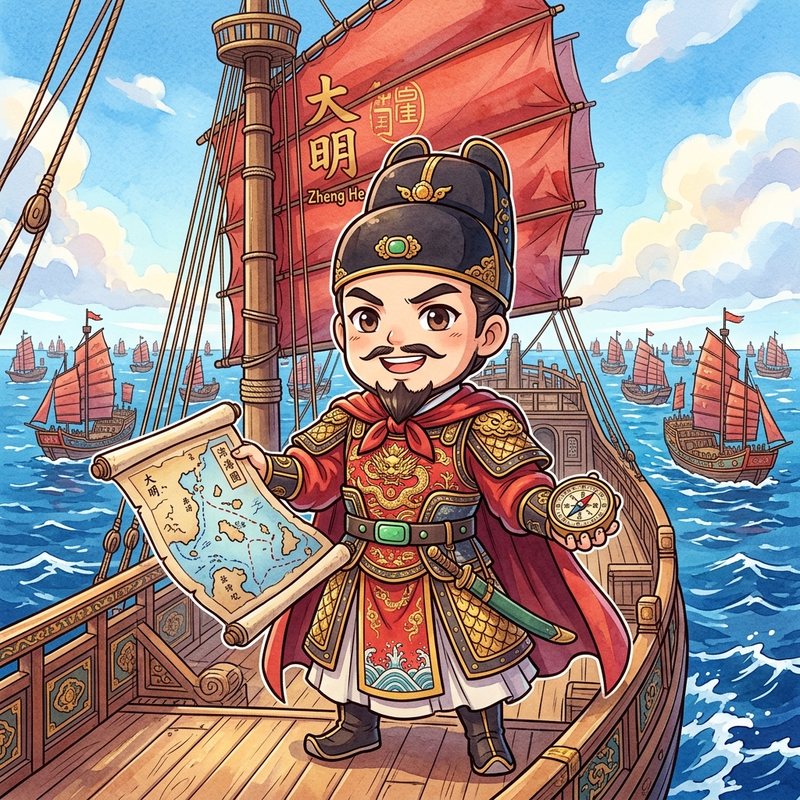
Zheng He (Cheng Ho) (郑和 (三宝太监) · Zhèng Hé)
本姓马 · 小字三保 · 三宝太监
The Supreme Maritime Admiral & World Explorer of the Ming Empire
大明七下西洋统帅 · 跨大洋和平外交与大航海史诗先驱
- Astounding Scale: Zheng He's fleet numbered over 200 ships with 27,800 men, compared to Columbus's 3 small ships and 90 crew members.
- Divergent Missions: Columbus sailed for gold, commercial spices, and territorial conquest; Zheng He sailed for diplomatic tribute, security, and prestige.
- Technological Superiority: Ming vessels featured watertight bulkheads, balanced rudders, magnetic compass navigation, and battened lug sails centuries ahead of Europe.
- The Confucian Retraction: Following Mongol border threats and the exorbitant cost of building fleets, conservative court mandarins burned the naval logs and dismantled ocean ships.
Zheng He Ship vs Columbus: Size, Crew, and Engineering
The disparity in ship engineering between the two expeditions is one of the most astonishing contrasts in naval history. Columbus's flagship, the Santa Maria, was approximately 19 meters long. By contrast, historical Ming records describe Zheng He's flagship Treasure Ships (Baochuan) as measuring up to 130 meters long with nine masts.
两支船队的工程技术对比令世界海事界震惊:哥伦布的旗舰‘圣玛利亚号’仅长约十九米;而《明史·郑和传》与龙江船厂出土巨型舵杆证实,大明主力宝船长逾百米、设九桅十二帆,底部分设十余个水密隔舱,即使触礁漏水亦不致沉没。
| Perspective 视角 | Zheng He's Treasure Fleet (1405) | Columbus (1492) |
|---|---|---|
| Fleet Strength | 250+ ocean vessels, including massive 9-masted Treasure Ships; 27,800 crew | 3 small caravels (Santa Maria, Pinta, Niña); approximately 90 sailors |
| Primary Objective | Projecting imperial Pax Ming, demanding symbolic tribute, securing spice sea routes | Discovering a direct sea route to India, extracting gold, silver, and claiming colonies |
| Naval Technology | Watertight bulkheads, balanced rudders, star-compass navigation, carrier pigeons | Square and lateen-rigged wooden caravels, dead reckoning, early astrolabes |
| Ultimate Outcome | Fleet burned by Confucian court bureaucrats; China turned inward to fortify borders | Sparked centuries of European transatlantic conquest, colonialism, and global trade |
The 1421 Myth: Did Zheng He Reach America Before Columbus?
In 2002, British amateur author Gavin Menzies popularized the claim that Zheng He circumnavigated the globe and discovered America in 1421—seven decades before Columbus. While sensational, professional historians and maritime archaeologists universally dismiss this theory as pseudo-history. Extensive archaeological excavations across North and South America have yielded zero authentic Ming porcelain, coins, or shipwrecks from the 1420s.
2002年,英国业余历史爱好者孟席斯提出‘1421假说’,声称郑和早在哥伦布之前70年便已发现美洲大陆。这一说法虽轰动一时,但被国际历史与海事学界一致定性为伪史。美洲大陆考古从未发掘出任何永乐年间的青花瓷、铜钱或明代沉船;而在印尼、印度乃至东非肯尼亚等真实航线上,郑和船队留下的明代文物与石碑却数不胜数。
Furthermore, the so-called 1418/1763 world map cited by Menzies features European-style dual-hemisphere projections, modern longitude lines, and internal African river systems unknown to 15th-century cartographers. Zheng He's true historical legacy did not require an imaginary American landing: his Treasure Fleet mastered the Indian Ocean basin—connecting Nanjing with Southeast Asia, India, the Persian Gulf, and the Swahili Coast of East Africa in peaceful trade and diplomacy.
不仅如此,孟席斯所引用的所谓‘1418年地图’带有明显的近代欧洲制图学特征(如双半球投影与经纬网)。郑和真正的历史功绩无需依赖‘发现美洲’的虚妄传说:他的宝船队横跨印度洋,建立起东起南京、西抵波斯湾与东非海岸的庞大和平贸易网络,这本身就是人类前近代航海史的绝顶奇迹。
Why Did China Burn the Fleet? The Great Reversal
Why didn't China colonize the world? The answer lies in political economics. To the Ming court, the voyages were an expensive tribute mission running on imperial tax revenues rather than capitalist profit. When northern Mongol raids threatened Beijing, Confucian scholar-officials argued that treasure voyages squandered silver that was desperately needed to rebuild the Great Wall.
为何大明没有走向殖民扩张?根源在于体制经济学。郑和下西洋本质是‘厚往薄来’的朝贡外交,耗费巨额国帑而缺乏重商主义的资本回流。当蒙古骑兵屡屡进逼北方边境时,士大夫集团力劝停废宝船,将有限赋税全力转投于修筑万里长城与巩固北境防线。
Stand at Taicang: Where Zheng He's 200 Ships Assembled
Experience the historic gathering at Liuhe Harbor in Taicang, where 27,800 soldiers and sailors offered sacrifices to the Sea Goddess Tianfei before sailing out to the world.
Launch Zheng He's Taicang MapFrequently Asked Questions (People Also Ask)
Zheng He ship vs Columbus — who had the bigger fleet?
Zheng He. The Ming treasure fleet sailed with 200+ ships and about 27,800 men. Columbus crossed in 1492 with three caravels and about 90 sailors. Flagship length: Ming baochuan on the order of 70–120 meters versus Santa Maria at about 19 meters.
How did Zheng He's ships compare to Columbus's fleet in size?
Zheng He's largest treasure ships were estimated between 70 to 120 meters long, roughly five to six times the length of Columbus's 19-meter flagship Santa Maria.
Did Zheng He discover America before Christopher Columbus?
No. Mainstream historians and archaeologists universally reject the claim that Zheng He reached the Americas. Extensive archaeological digs across North and South America have found zero Ming artifacts from the 1420s, whereas authentic Ming porcelain, coins, and steles have been found abundantly along his genuine Indian Ocean routes from Southeast Asia to East Africa.
Why did China stop sea exploration after Zheng He?
The Ming court faced growing military threats from nomadic invaders in the north, leading scholar-officials to redirect massive imperial funds toward the Great Wall and domestic defense.
Did Zheng He colonize any territories during his seven voyages?
No. Unlike European colonizers who seized lands and enslaved populations, Zheng He's mission focused on the tributary system — establishing peace, eliminating pirates, and trading gifts.
Walk with Zheng He (Cheng Ho) Across China
随郑和 (三宝太监)漫步华夏河山 · 亲历命运逆境与精神涅槃