Chronological travel & exile routes mapped to modern Chinese cities across Eastern Han & Three Kingdoms China — featuring bilingual scholar audio, classical poetry recitations, and historical cross-paths.
Qiao County (Ancestral Homeland) (沛国谯县(少年英发))
Age 1Modern-day analog: Modern Bozhou, Anhui Province
Born into an influential family in ancient Qiao, his youth was marked by spirited adventurousness, tactical cunning, and profound literary talent.
In the ancestral halls of Qiao County, the young Cao Cao rode wild horses and flew falcons, a restless spirit who seemed the very image of a carefree noble. Yet behind his roguish air burned a mind that could read the coming storm. The sage Qiao Xuan praised him as the one destined to pacify a collapsing empire, while the critic Xu Shao sealed his fate in a single phrase: an able minister in times of peace, an audacious hero in times of chaos. Deep in his hometown's military classics and histories, he nurtured an ambition to sweep the realm clean. He sensed that the Han dynasty was about to be engulfed by towering waves.
The sharp edge of youth would soon be tempered in the halls of power. Carrying his hometown ambition, young Cao Cao entered the eastern capital Luoyang, where before a rotting court ruled by eunuchs he was about to reveal the first cold gleam of his iron-fisted justice—a justice that would shake the very foundations of the imperial city.
“An able minister in times of peace; an audacious hero in times of chaos.”
治世之能臣,乱世之奸雄。 (Zhì shì zhī néng chén, luàn shì zhī jiān xióng.)
Luoyang (Northern Gate Captain) (洛阳(北部尉设五色棒))
Age 19Modern-day analog: Modern Luoyang, Henan Province
Appointed Northern Commandant of Luoyang, he crafted multicolored clubs to enforce the law fearlessly against corrupt imperial courtiers.
In the night shadows of Luoyang's northern gate, young Commandant Cao Cao forged five-colored clubs and hung them at the gate as a warning to the mighty. When the uncle of the emperor's favorite eunuch broke the curfew, Cao Cao showed no mercy—he executed him on the spot. That single blow shattered the arrogance of the eunuch faction and made the entire capital's officials shrink back. At barely twenty, he declared in the most absolute way that before the law, noble and commoner stand equal. This fearless integrity became the first cornerstone of his rise through a world in chaos.
His fearless enforcement of the law inevitably enraged the entrenched aristocratic powers, forcing Cao Cao out of Luoyang into years of wandering and obscurity. Yet the gathering storm of a collapsing age was already pushing him, step by step, toward a far greater stage where his destiny would be forged.
“Whosoever violates the law, regardless of birth, shall face the club.”
有犯禁者,皆棒杀之。 (Yǒu fàn jìn zhě, jiē bàng shā zhī.)
Chenliu (Call to Arms Against Dong Zhuo) (陈留(散家财起兵讨董))
Age 34Modern-day analog: Modern Kaifeng (Chenliu Town), Henan Province
When warlord Dong Zhuo usurped the Han throne, Cao Cao liquidated his family fortune in Chenliu to raise a coalition army.
When Dong Zhuo deposed the emperor and seized power, the realm trembled. Refusing the tyrant's bribes, Cao Cao liquidated his family fortune and raised the banner of loyalty in Chenliu. Clan warriors—Cao Ren, Cao Hong, Xiahou Dun—gathered beneath it, and he issued the empire-wide manifesto against Dong Zhuo, becoming the anchor of the eastern warlords. Gazing across a ravaged land, he wrote in 'Song of the Haoli': white bones bleach in the wilderness; for a thousand miles no rooster crows. The horror of chaos carved deep into his heart, igniting an obsession to sweep the warlords away and restore peace.
The anti-Dong Zhuo alliance crumbled as each warlord pursued his own ambition, plunging the realm into deeper chaos. Cao Cao came to understand that to save the people he must first seize legitimacy and establish a firm base—and he was steadily approaching the decisive choice that would reshape the entire landscape.
“White bones lie bleaching in the wilderness; for a thousand miles no rooster crows. Barely one in a hundred survives—the thought tears my heart in two.”
白骨露于野,千里无鸡鸣。生民百遗一,念之断人肠。 (Bái gǔ lù yú yě, qiān lǐ wú jī míng. Shēng mín bǎi yí yī, niàn zhī duàn rén cháng.)
Xuchang (Imperial Seat & Agricultural Colonies) (许昌(奉迎天子,兴修屯田))
Age 41Modern-day analog: Modern Xuchang, Henan Province
Welcoming the Han Emperor to Xuchang, he instituted the revolutionary Tuntian system—transforming famine-stricken plains into a bountiful powerhouse.
Amidst warlord chaos and mass starvation, Cao Cao heeded strategist Xun Yu's counsel, welcoming the fugitive Emperor Xian to Xuchang and gaining the legitimacy to command all under heaven. He then instituted the Tuntian system, settling refugees on state farmland until granaries overflowed within a few years. 'The art of stabilizing a nation rests upon a robust army and abundant food,' he declared. Rising from the war-torn central plains through a blend of iron will and benevolent governance, he laid the firmest foundation for unifying the north—and offered a starving world a glimmer of hope.
With his foundation secured and the central plains initially pacified, Cao Cao turned his gaze toward his mightiest rival in the north, Yuan Shao. A life-and-death showdown that would decide the fate of the entire realm was quietly closing in upon the plains of Guandu, testing every ounce of his strategy and courage.
“The art of stabilizing a nation rests upon a robust army and abundant food.”
夫定国之术,在于强兵足食。 (Fū dìng guó zhī shù, zài yú qiáng bīng zú shí.)
Guandu (Triumph of Strategy Over Superior Numbers) (官渡(奇袭乌巢,以弱胜强))
Age 45Modern-day analog: Northeast of modern Zhongmu, Henan Province
Facing Yuan Shao's overwhelming 100,000-strong army, Cao Cao led a daring night raid on Wuchao to burn enemy supply depots, achieving a classic tactical masterpiece.
At Guandu, the siege dragged on for months until Cao Cao's army ran desperately low on rations. In the decisive hour, strategist Xu You defected—and Cao Cao ran out barefoot to welcome him. Acting on his counsel, he led five thousand elite riders disguised as the enemy to torch Yuan Shao's grain depots at Wuchao. One great fire consumed a million bushels of provisions, and Yuan's army collapsed overnight. Outnumbered, Cao Cao won the north in a single stroke. Gazing at the talents now turning to him, he sang in 'Short Song Style': mountains never tire of rising high, the sea never tires of plunging deep—like the Duke of Zhou, may all under heaven turn their hearts to me.
With the great victory at Guandu, the fate of the north was sealed. Yet Cao Cao did not pause—he marched north to crush the Wuhuan tribes and settle the frontier. On the journey home, he climbed Mount Jieshi and faced the boundless sea, his heart swelling with the ambition to swallow the universe itself.
“Mountains never tire of rising high, the sea never tires of plunging deep. Like the Duke of Zhou cherishing wise talents, may all under Heaven turn their hearts to me.”
山不厌高,海不厌深。周公吐哺,天下归心。 (Shān bù yàn gāo, hǎi bù yàn shēn. Zhōu gōng tǔ bǔ, tiān xià guī xīn.)
Mount Jieshi (Ode to the Bohai Sea) (碣石山(东临碣石,以观沧海))
Age 52Modern-day analog: Coastal Bohai Bay, modern Qinhuangdao / Changli, Hebei
Returning victorious from the northern frontier, he scaled Mount Jieshi overlooking the vast Bohai Sea to pen 'Gazing at the Ocean', pioneering Chinese landscape verse.
Having crushed the Wuhuan through a thousand-mile forced march, Cao Cao returned along the Bohai coast and climbed Mount Jieshi. Before him the waves shimmered and the isles stood towering, as if the sun, moon, and stars all rose from the sea's depths. He wrote 'Gazing at the Ocean': the travels of sun and moon seem to rise from its depths; the splendor of the Milky Way seems born of its heart. It was the first panoramic landscape poem in Chinese literature—and a portrait of a soul vast enough to hold the universe. At fifty-two, Cao Cao stood between sea and sky as a monument uniting towering poet and towering sovereign.
The sea wind of Jieshi had barely faded when Cao Cao turned south, determined to conquer the Yangtze and unify the realm. In 208, his mighty host sailed down the river—and in the flames of Red Cliffs, a battle that would decide the division of the Three Kingdoms was brewing.
“The travels of sun and moon seem to rise from its depths; the splendor of the Milky Way seems born of its heart. Blessed is this fortune, I sing to voice my soul's intent.”
日月之行,若出其中;星汉灿烂,若出其里。幸甚至哉,歌以咏志。 (Rì yuè zhī xíng, ruò chū qí zhōng; Xīng hàn càn làn, ruò chū qí lǐ. Xìng shèn zhì zāi, gē yǐ yǒng zhì.)
Red Cliffs (Chibi on the Yangtze) (赤壁(赤壁鏖兵,对酒当歌))
Age 53Modern-day analog: Yangtze River bend near modern Chibi, Hubei Province
Sweeping south with grand ambitions, he composed the immortal 'Short Song Style' on the river; yet a surprise fire attack sealed the Three Kingdoms division.
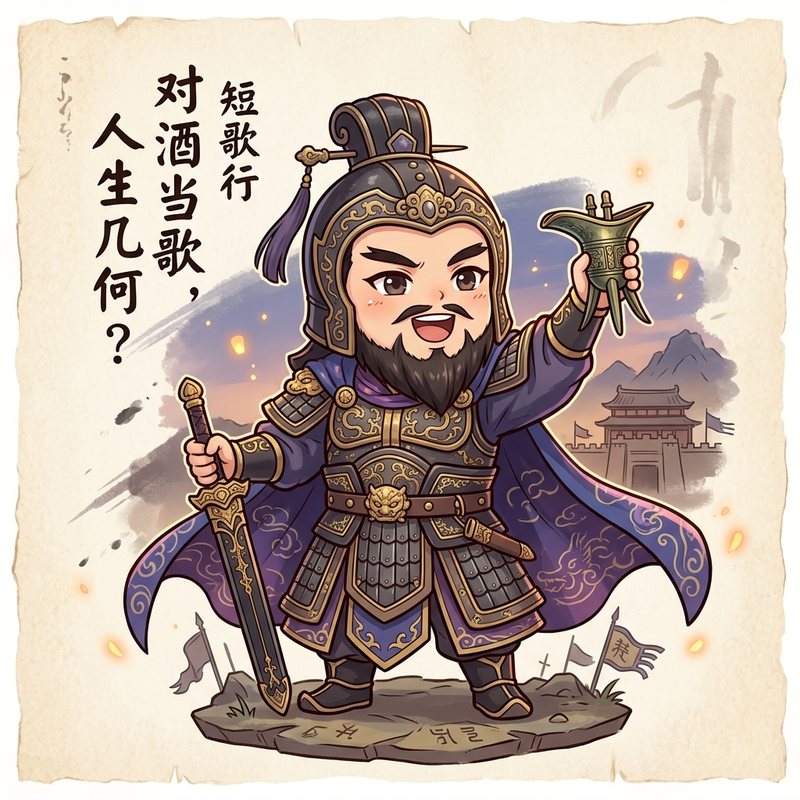
In 208, beneath a bright moon, Cao Cao held a banquet aboard his warships and, resting his spear, sang 'Short Song Style': sing along as wine we pour, for how long does life endure? Like morning dew that fades away, days gone by are hard to stay. Yet Zhou Yu and Huang Gai launched their fire-ship assault; the wind fed the flames, his fleet burned, and he was forced to retreat through Huarong. Losing his chance to swiftly conquer the south, he sealed the Three Kingdoms division. Still, Cao Cao bore the defeat with unshaken composure, steadying his northern realm—even in loss, his spirit could swallow heaven and earth.
The embers of Red Cliffs had barely cooled when Cao Cao withdrew north to rebuild his realm. For over a decade he stabilized the central plains and gathered strength. In 220, the audacious hero who had bestridden the world for a lifetime reached the end of his road in Luoyang.
“Sing along as wine we pour, for how long does life endure? Like morning dew that fades away, days gone by are hard to stay. What can dissolve this heroic grief? None but Du Kang's mellow cup.”
对酒当歌,人生几何!譬如朝露,去日苦多。慨当以慷,忧思难忘。何以解忧?唯有杜康。 (Duì jiǔ dāng gē, rén shēng jǐ hé! Pì rú zhāo lù, qù rì kǔ duō. Kǎi dāng yǐ kāng, yōu sī nán wàng. Hé yǐ jiě yōu? Wéi yǒu Dù Kāng.)
Luoyang (Final Decree & Gaoling Mausoleum) (洛阳(分香卖履,一代枭雄落幕))
Age 65Modern-day analog: Modern Luoyang, Henan Province & Anyang, Henan
Passing away in Luoyang, his final testament ordered a modest unadorned burial and tenderly instructed his concubines to learn craftwork to support themselves.
In 220, Cao Cao passed away in Luoyang. His final testament boasted nothing of his conquests—only tender, practical words: 'The world is not yet at peace; bury me simply, without gold or jades. When the burial is done, lay aside mourning. Let my attendants make shoe-ribbons to earn their living.' The iron hero showed his gentlest heart. Looking back on a lifetime, he had written in 'Though the Tortoise Lives Long': the old steed in the stable still longs to gallop a thousand miles; an ambitious soul in its twilight never loses its heart. From the restless youth of Qiao County to the audacious sovereign of an age, Cao Cao left an immortal monument of strategy and verse.
“The old steed in the stable still longs to gallop a thousand miles; an ambitious soul in its twilight never loses its heart. Longevity depends not solely on Heaven; nurture your spirit in serenity, and enduring years are yours.”
老骥伏枥,志在千里;烈士暮年,壮心不已。盈缩之期,不但在天;养怡之福,可得永年。 (Lǎo jì fú lì, zhì zài qiān lǐ; Liè shì mù nián, zhuàng xīn bù yǐ.)