Chronological travel & exile routes mapped to modern Chinese cities across Western Han Dynasty China — featuring bilingual scholar audio, classical poetry recitations, and historical cross-paths.
Pei County (Zhongyangli, Fengyi) (沛县丰邑(好酒及色,豁达任侠))
Age 1Modern-day analog: Feng County, Xuzhou, Jiangsu Province
Born to rural peasants in Pei County, the unconventional young Liu Bang despised farming chores, serving as patrol master while befriending heroes with effortless charisma.
In the twilight of the Warring States, in the village of Fengyi in Pei County, a farmer's son who loathed tilling the fields possessed a heart of extraordinary generosity. Serving as master of the Sishui Postal Pavilion, he won the fierce loyalty of magistrates Xiao He and Cao Shen and the butcher Fan Kuai with his open-handed charm. One day, escorting conscripts to Xianyang, he witnessed the First Emperor's magnificent imperial procession. His heart surged, and he blurted out: 'Ah, this is truly how a great man ought to live!' In that moment, a lowly pavilion master had secretly planted the spark of an empire.
But the chaotic age allowed no one to sit still. Under the Qin's brutal rule, conscription, flight, and execution came one after another. This open-hearted pavilion master would soon be swept onto the tide of rebellion, heading toward the marshlands and legends of Mount Mangdang.
“Ah, this is truly how a great man ought to live!”
嗟乎,大丈夫当如此也! (Jiē hū, dà zhàng fū dāng rú cǐ yě!)
Mount Mangdang (Rebellion in the Marshes) (芒砀山(斩白蛇起义,隐匿沼泽))
Age 47Modern-day analog: Dangshan / Yongcheng, modern Shangqiu, Henan
Escorting conscripts to Mount Li, he liberated the captives when many escaped, famously slaying a giant serpent blocking the trail to launch the uprising.
When Chen Sheng and Wu Guang raised the banner of revolt, chaos engulfed the land. Liu Bang was ordered to escort conscripts to build the First Emperor's tomb, but by the time they reached the marsh west of Feng, more than half had fled. He simply untied their bonds and set them free: 'Go your ways, all of you; I too shall depart forever from this day!' Dozens of heroes chose to follow him into hiding at Mount Mangdang. Drunk one night, he found a giant white serpent blocking the path and cut it in two. The myth of the Red Emperor slaying the White Emperor spread, and he gathered followers, declaring himself the Duke of Pei.
The spark of the serpent-slaying uprising soon blazed into a prairie fire. Liu Bang led the young men of Pei westward, conquering city after city. Amid a generation of heroes, his gaze already crossed the mountain passes toward the towering palaces of the Qin capital, Xianyang.
“Go your ways, all of you; I too shall depart forever from this day!”
公等皆去,吾亦从此逝矣! (Gōng děng jiē qù, wú yì cóng cǐ shì yǐ!)
Xianyang & Bashang (Pacifying Guanzhong) (咸阳与霸上(先入咸阳,约法三章))
Age 50Modern-day analog: Modern Xianyang & Xi'an, Shaanxi Province
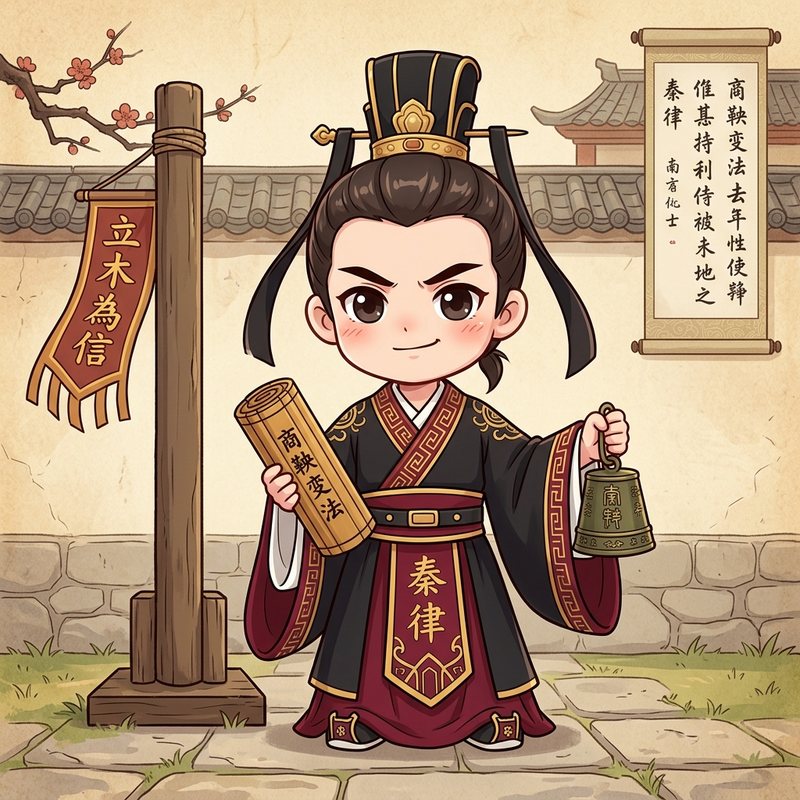
First among the warlords to take the Qin capital, he sealed the palaces, withdrew to Bashang, and abolished harsh laws with the simple 'Three Codes of Restraint'.
In 206 BCE, Liu Bang's light cavalry was first through the Wu Pass, and the last Qin ruler surrendered his imperial seal. Refusing to plunder, Liu Bang sealed the vaults and withdrew to Bashang. He summoned the elders of Guanzhong and proclaimed: 'I contract with you elders three laws only: murderers shall die, those who injure or steal shall be punished. All other harsh Qin laws are wiped away.' The brutal Qin statutes vanished overnight, and the people rejoiced, desperately hoping he would rule them. With mercy and restraint, he won the hearts of the realm and laid the foundation of the Han.
Yet his popularity roused the jealousy of the Hegemon King. Enraged that Liu Bang had taken Guanzhong first, Xiang Yu camped 400,000 troops at Hongmen. A feast dripping with deadly intent awaited Liu Bang as he stepped through its gates.
“I contract with you elders three laws only: murderers shall die, those who injure or steal shall be punished. All other harsh Qin laws are wiped away.”
与父老约,法三章耳:杀人者死,伤人及盗抵罪。余悉除去秦法。 (Yǔ fù lǎo yuē, fǎ sān zhāng ěr: shā rén zhě sǐ, shāng rén jí dào dǐ zuì.)
Hongmen Banquet (Perilous Sword Dance) (鸿门(鸿门宴脱险,剑拔弩张))
Age 50Modern-day analog: Lintong District, modern Xi'an, Shaanxi Province
Confronting Xiang Yu's 400,000-strong army, Liu Bang rode to Hongmen with 100 guards, surviving Xiang Zhuang's assassination sword dance through razor-sharp diplomacy.
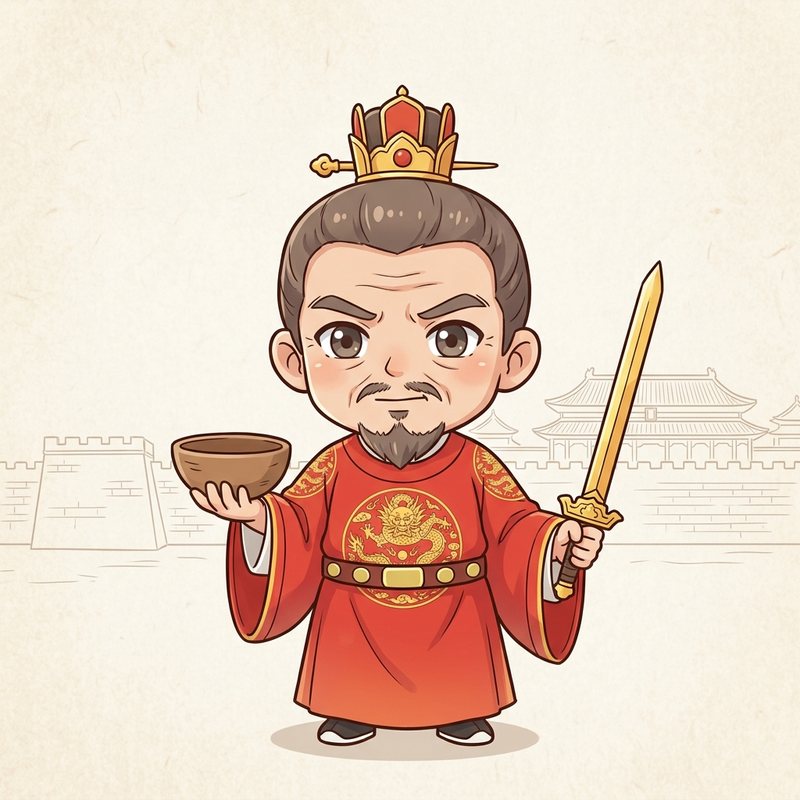
At the Hongmen Banquet, Xiang Yu's 400,000-strong army bristled with menace while Liu Bang arrived with only a hundred guards. He offered humble apologies in measured words, yet the danger was unmistakable. Fan Zeng raised his jade ring as a signal; Xiang Zhuang danced with his sword, its blade aimed at the Duke of Pei. At the critical moment, Fan Kuai stormed the tent, roaring in defense of his lord. Seizing an excuse to visit the latrine, Liu Bang slipped away through a back path. 'Great enterprises do not quibble over minor courtesies'—he understood that between cleaver and meat, survival was the greatest victory.
Escaping Hongmen alive, Liu Bang was nonetheless outmatched and was enfeoffed to the remote, mountainous region of Hanzhong. His troops longed for home and morale crumbled. Just then, Xiao He chased down the deserter Han Xin through the moonlight, bringing Liu Bang a turning point.
“Great enterprises do not quibble over minor courtesies! When others are the cleaver and we are the meat, why bother bidding farewell?”
大行不顾细谨,大礼不辞小让。如今人方为刀俎,我为鱼肉,何辞为! (Dà xíng bù gù xì jǐn, dà lǐ bù cí xiǎo ràng.)
Hanzhong (Appointing Han Xin Commander) (汉中南郑(拜将韩信,明修栈道暗度陈仓))
Age 50Modern-day analog: Modern Hanzhong, Shaanxi Province
Exiled to mountainous Hanzhong as King of Han, he built an altar to appoint Han Xin as supreme general, launching the legendary march to reclaim China.
Relegated to Hanzhong, Liu Bang's army grew restless. Chancellor Xiao He pursued the fleeing general Han Xin through the night and urged him: 'If you wish to contest the empire, no one but Han Xin can achieve it.' Liu Bang chose an auspicious day, built a high altar, and after fasting and bathing, solemnly appointed Han Xin Supreme Commander. Han Xin openly repaired the broken trestle roads while secretly marching through Chencang, seizing Guanzhong within weeks. From Hanzhong to Chang'an, from despair to revival, Liu Bang's gift for recognizing talent had reclaimed the throat of the empire.
With Guanzhong secured, the Chu-Han contention reached its climax. Unyielding through repeated defeats, Liu Bang finally marshaled the allied armies of Han Xin and Peng Yue, encircling Xiang Yu at Gaixia for the decisive final battle.
“Openly repair the wooden trestle plankways; secretly cross through Chencang.”
明修栈道,暗度陈仓。 (Míng xiū zhàn dào, àn dù Chén cāng.)
Gaixia (Songs of Chu in the Night) (垓下(十面埋伏,四面楚歌))
Age 54Modern-day analog: Lingbi County, Suzhou, Anhui Province
Uniting with allied commanders to envelop Xiang Yu at Gaixia, Han troops sang the songs of Chu in the midnight fog, breaking the warlord's army.
In the winter of 202 BCE, Han Xin's 300,000 troops sealed Xiang Yu's 100,000 Chu soldiers in a concentric trap at Gaixia. Deep in the night, Han soldiers sang native Chu folk ballads across the trenches—songs of Chu on every side. Xiang Yu was struck with dismay: 'Has Han already taken all of Chu? Why are there so many Chu people here?' The Hegemon King parted from his beloved, wept through the long night, broke out with eight hundred riders, and died by his own sword at the Wujiang River. After four years of bloody war, Liu Bang's openness and mercy had finally won the realm.
With the victory at Gaixia, all hearts turned to Liu Bang. He ascended the throne and founded the Han Dynasty. Yet the work was unfinished and the realm unsettled. In his later years, returning from putting down a rebellion, he came home to Pei County, where a grand banquet awaited the peasant-born emperor.
“Xiang Yu's army was besieged at Gaixia, their food exhausted. In the night they heard songs of Chu on every side, and the Hegemon King was struck with dismay.”
项王军壁垓下,兵少食尽,汉军及诸侯兵围之数重。夜闻汉军四面皆楚歌,项王乃大惊。 (Xiàng wáng jūn bì Gāi xià, bīng shǎo shí jìn.)
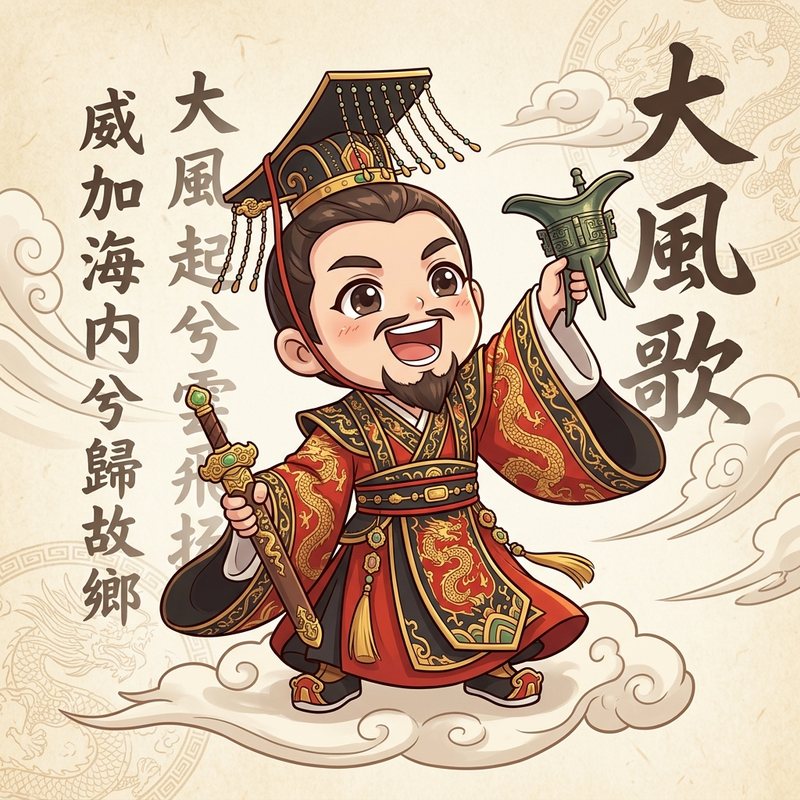
Pei Hometown (Song of the Great Wind) (沛县与长乐宫(大风起兮,威加海内))
Age 61Modern-day analog: Pei County, Jiangsu & Modern Xi'an, Shaanxi
Returning to his home village of Pei, the Emperor held an open banquet, struck the zither, and sang the immortal 'Song of the Great Wind'.
After pacifying a rebellion, the aging Emperor paused at his ancestral home of Pei. He gathered 120 childhood friends and elders for a grand feast and exempted the town from taxes forever. Deep in his cups, this founding emperor who had risen from a humble pavilion master struck the zither himself, rose to dance, and sang with fierce melancholy: 'A great wind rises, clouds fly high! My majesty sweeps across the seas as I return to my hometown; where shall I find brave warriors to guard the four corners of the realm?' Tears streamed down his face. That same year he passed away in Chang'an's Changle Palace, yet he had founded four hundred years of Han glory, giving the Han people their eternal name.
“A great wind rises, clouds fly high! My majesty sweeps across the seas as I return to my hometown; where shall I find brave warriors to guard the four corners of the realm?”
大风起兮云飞扬,威加海内兮归故乡,安得猛士兮守四方! (Dà fēng qǐ xī yún fēi yáng, wēi jiā hǎi nèi xī guī gù xiāng, ān dé měng shì xī shǒu sì fāng!)