Chronological travel & exile routes mapped to modern Chinese cities across Warring States Period China — featuring bilingual scholar audio, classical poetry recitations, and historical cross-paths.
State of Wey & Wei (Legalist Tutelage) (卫国与魏国(研读刑名,求真思变))
Age 1Modern-day analog: Puyang, Henan & Xia County, Yuncheng, Shanxi
Born into the nobility of the small State of Wey, he immersed himself in legal codices and studied under Chancellor Gongshu Zuo in powerful Wei.
In the pale dawn of the small State of Wey, young Gongsun Yang pored over legal codices, his fingers tracing the cold statutes on bamboo slips while ambition burned in his eyes. Journeying to powerful Wei, he witnessed Li Kui's reforms and Wu Qi's military discipline transform the state into a hegemon—governance, he realized, could be breathtakingly bold. On his deathbed, Chancellor Gongshu Zuo urged King Hui to either appoint this youth prime minister or execute him so he could never serve another state. But the King, dismissive, let him go. Shang Yang watched the royal carriage recede and smiled coldly: "Since the King cannot recognize my worth to employ me, how could he possess the wisdom to kill me?" Calmly, he turned away, waiting for a sovereign worthy of his grand designs.
The King of Wei's arrogance only served Shang Yang's purpose. He knew a grand cause demanded a worthy sovereign. When Duke Xiao of Qin's decree seeking talent echoed across the realm—"whoever can devise bold strategies to strengthen Qin shall be honored with high office and share in the land"—it struck him like thunder. Packing his scrolls and the Canon of Laws, he rode west through the passes, bound for Qin.
“Since the King cannot recognize my worth to employ me, how could he possess the wisdom to kill me?”
彼王不能用,安能杀我! (Bǐ wáng bù néng yòng, ān néng shā wǒ!)
Yueyang (Ancient Qin Capital & The Trust Pole) (秦国栎阳(徙木立信,初次变法))
Age 29Modern-day analog: Yanliang District, Xi'an, Shaanxi Province
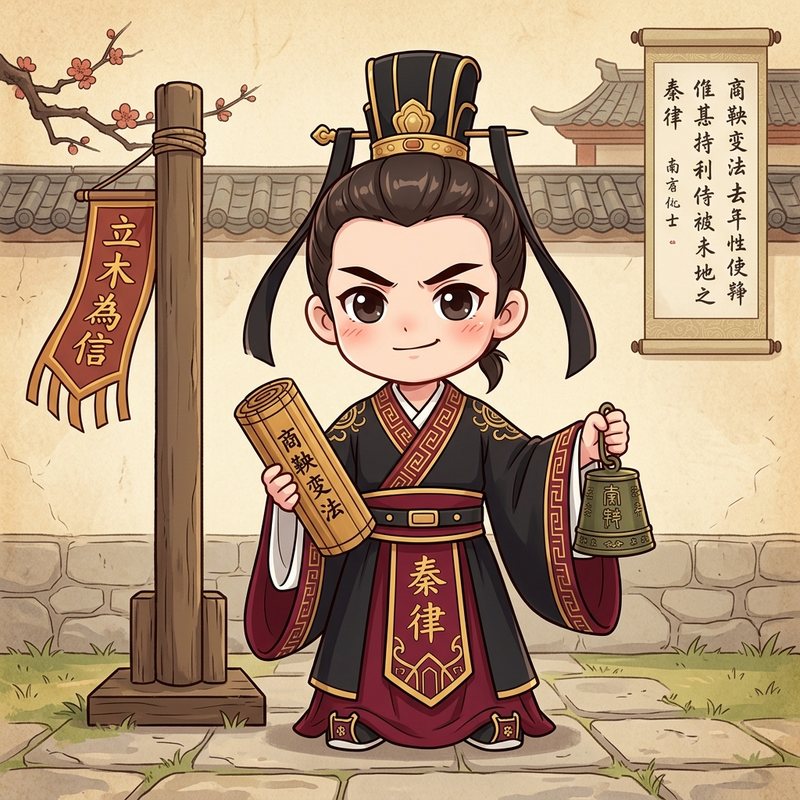
Responding to Duke Xiao's edict for talent, he erected a heavy wooden pole at the city gate offering gold to anyone who moved it, cementing the credibility of the law.
At the south gate of Yueyang, a massive timber pole stood tall while the crowd murmured in doubt—no one dared touch it. Shang Yang watched from the ramparts, his gaze hard as iron. If the people did not trust the court, its laws were mere scraps of paper. He offered a lavish reward; at last one man stepped forward and carried the pole to the north gate. Shang Yang paid the fifty gold pieces on the spot, and the whole state trembled. He knew then: "The common people cannot deliberate upon beginnings, but they may rejoice in final success." The great reform had begun—mutual-responsibility registers, rewards for military merit and farming—and the law stood as firm as a mountain across Qin.
The first reforms transformed Qin's spirit. But Shang Yang knew this was only the beginning. He sought not repair but total reinvention. As the reforms deepened, he resolved to build a brand-new capital, carrying the law and the nation's destiny to a grander stage—Xianyang, north of the Wei River.
“The common people cannot deliberate upon beginnings, but they may rejoice in final success. Those who cultivate supreme virtue heed not petty conventions; those who achieve monumental deeds seek not consensus among the crowd.”
民不可与虑始,而可与乐成。论至德者不和于俗,成大功者不谋于众。 (Mín bù kě yǔ lǜ shǐ, ér kě yǔ lè chéng.)
Xianyang (New Imperial Capital) (秦都咸阳(废井田开阡陌,推行郡县))
Age 40Modern-day analog: Weicheng District, Xianyang, Shaanxi Province
Masterminding the construction of new capital Xianyang, his Second Reform abolished archaic clan estates, standardized measures, and created nationwide county governance.
On the northern bank of the Wei River, the palace of Xianyang rose from the earth as Shang Yang stood upon its walls, gazing at the embryonic empire he had forged. The Second Reform struck like thunder: the well-field system abolished, private land ownership recognized; the state reorganized into forty-one counties ruled by officials directly appointed by the Duke; the "Shang Yang Bronze Sheng" standardized weights and measures; and a twenty-rank system tied all nobility to military and agricultural merit. The privileges of old aristocrats were torn out by the roots. Qin became a land where nothing was left on the roads, no bandits in the hills, and every household prospered. He declared: "There is no single way to govern the realm; to benefit the state, one need not emulate antiquity."
After two decades of reform, the law had sunk into the very marrow of Qin. Shang Yang was no longer content with internal strength alone. He knew the world would bow only to a power proven on the battlefield. Donning his armor, he led this reborn army toward the mighty Wei across the Yellow River's western banks.
“There is no single way to govern the realm; to benefit the state, one need not emulate antiquity. Kings Tang and Wu followed not past customs yet became true monarchs; the Xia and Yin dynasties refused to reform and met ruin.”
治世不一道,便国不法古。故汤武不循古而王,夏殷不易礼而亡。 (Zhì shì bù yī dào, biàn guó bù fǎ gǔ.)
Hexi Corridor (Yellow River Border) (河西要津(大战魏军,受封商君))
Age 50Modern-day analog: Heyang & Dali, Weinan, Shaanxi Province
Commanding the revamped Qin army, he shattered the forces of Wei, forcing them to cede the vital Hexi corridor; Duke Xiao ennobled him with fifteen fiefs as 'Lord Shang'.
The Yellow River roared and war drums thundered. Leading his reborn army straight at Wei's capital Anyi, Shang Yang captured the Wei commander Prince Ang. The once-mighty Wei collapsed in total defeat, ceding all lands west of the river and relocating its capital to Daliang. It was the most glorious vindication of two decades of reform. Overjoyed, Duke Xiao enfeoffed him with fifteen cities in Shang and Yu. From then on, Gongsun Yang shook the realm and was honored as "Lord Shang." The histories record: "The people of Qin grew affluent and mighty; the Zhou Son of Heaven sent sacrificial meats in honor of Duke Xiao, and all feudal lords came to congratulate." The youth once dismissed by the King of Wei now stood at the summit of his age.
Even at the summit, shadows were gathering. Shang Yang's iron reforms had enraged countless old aristocrats. When he punished the crown prince's tutor Lord Qian by cutting off his nose, that hatred coiled like a serpent in Xianyang's dark corners. While Duke Xiao lived, he was protected; but once his patron died, the storm would surely break.
“The people of Qin grew affluent and mighty; the Zhou Son of Heaven sent sacrificial meats in honor of Duke Xiao, and all feudal lords came to congratulate.”
秦人富强,天子致胙于孝公,诸侯毕贺。 (Qín rén fù qiáng, tiān zǐ zhì zuò yú Xiào Gōng, zhū hóu bì hè.)
Mianchi & Xianyang (The Law Outlives the Man) (咸阳与渑池(遭嫉车裂,秦法未败))
Age 52Modern-day analog: Modern Xianyang, Shaanxi & Mianchi, Henan
Upon Duke Xiao's death, vindictive aristocrats framed him for treason. He died as a martyr to his own legal code, but the laws survived unchanged to unify China.
In 338 BCE, Duke Xiao died and King Huiwen ascended the throne. Lord Qian and the old aristocrats, whose noses Shang Yang had once punished under the law, immediately framed him for rebellion. Fleeing by night, Shang Yang sought lodging at an inn by the pass, but the innkeeper refused him: "Under Lord Shang's law, we are punished if we take guests without identification." He looked up and sighed: "Alas, the stringency of the law has reached even me!" Calmly he accepted his fate and was executed by dismemberment. Yet King Huiwen retained all his laws. "Though Lord Shang is dead, the laws of Qin have never been defeated." He died to erect the most tragic monument to the rule of law—the law endures beyond any man, and became the foundation on which the First Emperor unified all under Heaven.
“Though Lord Shang is dead, the laws of Qin have never been defeated.”
商君虽死,秦法未败。 (Shāng Jūn suī sǐ, Qín fǎ wèi bài.)