Without detachment from desire, one cannot clarify one's ambition; without inner tranquility, one cannot reach far horizons.
Station Narration Script
Born in 181 CE to a Langya noble house, Zhuge Liang fled south amid civil war. The creed he would later write—'without simplicity, no clarity of aim; without calm, no far-reaching vision'—already shaped the boy.
Departure Transition Script
After his uncle's death, young Zhuge Liang settled at Longzhong for a decade of study.
2
Longzhong, Xiangyang (Hubei)
206 CE · Age 25
Rural retreat near modern Xiangyang, Hubei (where the Three Kingdoms began)
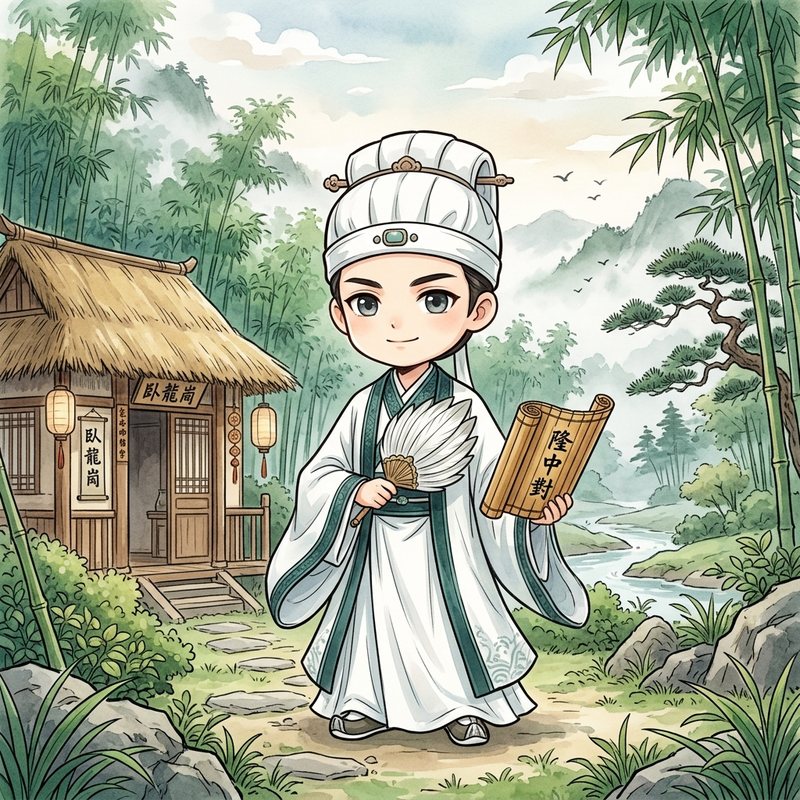
Farming by Day, Reading the Cosmos by Night: The Crouching Dragon
The phoenix soars high into the clouds, resting only upon the sacred tree; the true scholar waits in seclusion, serving only the worthy leader.
Station Narration Script
For ten years at Longzhong he farmed by day and studied strategy by night, comparing himself to ancient chancellors. Scholars called him the Crouching Dragon—a phoenix that would perch only on a true paulownia.
Departure Transition Script
Liu Bei, camped at Xinye, braved winter storms to visit the cottage three times—history's most famous solicitation of talent.
3
Thatched Cottage, Longzhong (Xiangyang, Hubei)
207 CE · Age 27
Rustic retreat where Zhuge Liang planned the Three Kingdoms, modern Xiangyang
Three Visits to the Thatched Cottage: The Geopolitical Masterplan
Since Dong Zhuo, warlords have risen everywhere. That Cao Cao overcame Yuan Shao was not merely good fortune, but superior strategic calculation.
Station Narration Script
Moved by Liu Bei's sincerity, Zhuge Liang unveiled the Longzhong Plan: since Dong Zhuo's chaos, heroes had risen—'Cao Cao defeated Yuan Shao by planning, not heaven alone.' He mapped the three-way split and the Sun–Liu alliance.
Departure Transition Script
Soon Cao Cao marched south. Zhuge Liang sailed alone to Chaisang in Wu to forge an alliance that would decide survival.
4
Red Cliffs / Chibi (Xianning, Hubei)
208 CE · Age 28
Yangtze River cliffs near modern Chibi/Xianning, Hubei
Flames upon the Yangtze: The Historic Battle of Red Cliffs
If Your Lordship appoints fierce generals to lead tens of thousands and coordinates with the Lord of Yu Province, Cao Cao's army will surely be broken.
Station Narration Script
At Chaisang, Zhuge Liang urged Sun Quan: appoint fierce generals, coordinate with Liu Bei, and Cao Cao can be broken. The Sun–Liu alliance then burned Cao's fleet at Red Cliffs, locking in the Three Kingdoms.
Departure Transition Script
After Red Cliffs, Zhuge Liang led forces up the Yangtze Gorges westward to secure the Sichuan basin.
5
Chengdu (Sichuan)
214 CE · Age 34
Imperial capital of Shu Han & southwest economic center, modern Chengdu, Sichuan
Transforming the Land of Abundance into an Economic Powerhouse
When laws are upheld and discipline is clear, rewards and punishments strictly trustworthy, all deceit and corruption naturally vanish.
Station Narration Script
As Chancellor in Chengdu, he codified Shu law, restored Dujiangyan irrigation, and nurtured silk trade—until 'decrees ran, discipline was clear, rewards and punishments were trusted, and deceit was leveled.'
Departure Transition Script
After the Yiling disaster, ailing Liu Bei summoned Zhuge Liang to Baidi Castle for their final charge.
6
Baidi City, Fengjie (Chongqing)
223 CE · Age 43
High cliff fortress overlooking the Yangtze Gorges where Liu Bei entrusted the realm, Chongqing
The Emperor's Final Plea: 'If My Son Is Unfit, Take the Throne Yourself'
Your servant dares only to exhaust every ounce of strength, maintaining utmost loyalty and integrity until death!
Station Narration Script
At Baidi, Liu Bei entrusted his heir and realm. Weeping, Zhuge Liang pledged to 'bend himself to the task and exhaust his strength until death,' vowing to pour out every sinew in loyal service.
Departure Transition Script
To secure the rear, he led an expedition south across the Lu River into the frontier.
7
Dali & Baoshan (Yunnan / Nanzhong)
225 CE · Age 45
Rugged southwestern highlands of Yunnan and Guizhou pacified with psychological wisdom
Conquering the Heart, Not the Land: Seven Captures of Meng Huo
“夫用兵之道,攻心为上,攻城为下;心战为上,兵战为下。”
Fū yòng bīng zhī dào, gōng xīn wéi shàng, gōng chéng wéi xià; xīn zhàn wéi shàng, bīng zhàn wéi xià.
In the art of war, attacking the mind is supreme, attacking cities is secondary; psychological victory is supreme, armed conflict is secondary.
Station Narration Script
In the south he held: 'Attack the mind before the walls; win hearts before winning battles.' Capturing and releasing Meng Huo seven times, he won lasting loyalty for the northern campaigns ahead.
Departure Transition Script
With the south pacified, 47-year-old Zhuge Liang submitted the Former Memorial and moved north to Hanzhong.
8
Mianxian, Hanzhong (Shaanxi)
227 CE · Age 47
Strategic northern military headquarters gateway to the Qinling Mountains, Shaanxi
The Memorial of Tears: Penning the Immortal 'Former Memorial on the Expedition'
I received my commission amidst defeat, and accepted my command in times of deadly crisis—twenty and one years have passed since then.
Station Narration Script
From the Hanzhong camp he wrote the Former Memorial: 'I received my charge amid a defeated army, was sent forth in a time of peril—one and twenty years have passed.' Duty to the late emperor burns on every line.
Departure Transition Script
The army crossed the Qinling toward Qishan. To solve the eternal supply problem, Zhuge Liang devised ingenious transport machines.
9
Mount Qi / Qishan Fort (Lixian, Gansu)
231 CE · Age 51
Strategic northern mountain fort in southern Gansu leading toward the Central Plains
Mechanical Marvels: The Wooden Oxen and Gliding Horses on Precipices
“鞠躬尽瘁,死而后已。”
Jū gōng jìn cuì, sǐ ér hòu yǐ.
Bending my body and exhausting my utmost energy until the very day I die.
Station Narration Script
On the Qishan front he fielded wooden oxen and flowing horses for supply, repeating crossbows, and the Eight Formations—living his vow to exhaust himself unto death, while Wei's Sima Yi hesitated to engage.
Departure Transition Script
In Jianxing 12 he marched north a sixth time, camping at Wuzhang Plains—his final field.
10
Wuzhang Plains, Qishan (Baoji, Shaanxi)
234 CE · Age 54
High strategic plateau overlooking the Wei River where Zhuge Liang met his destiny, Shaanxi
A Star Falls on the Wuzhang Plains: The Immortal Conscience
Before the expedition could triumph, his life came to an end; forever leaving future heroes with tears soaking their robes.
Station Narration Script
In autumn 234, Zhuge Liang died of exhaustion at Wuzhang Plains, aged fifty-four. Du Fu later mourned: 'The campaign unfinished, he died first—forever making heroes wet their sleeves with tears.'
Key Historical Inquiries & Context
· 核心史实公案与速览
Zhuge Liang (181–234), courtesy name Kongming, was the supreme chancellor and strategist of Shu Han during the Three Kingdoms period. Revered for unyielding loyalty, logistical innovation, and strategic foresight, he embodies the highest Confucian ideal of statesman-scholar.
Yes. He was a real statesman of the Three Kingdoms, documented in Chen Shou's Records of the Three Kingdoms (Sanguozhi). While folklore embellished his deeds, his diplomatic alliance and Northern Expeditions are verified history.
QWhat made Zhuge Liang so famous in history?
The Longzhong Plan partitioning China into three realms, the Red Cliffs alliance, mechanical inventions like the Wooden Ox, and his Northern Expeditions.
QIs Zhuge Liang the same as Kongming?
Yes. Kongming is his courtesy name (zi). Chinese and Asian historical literature frequently uses Kongming interchangeably with Zhuge Liang.
The Complete Life Journey & Biography of Zhuge Liang (Kongming) (诸葛亮)
Chronological travel & exile routes mapped to modern Chinese cities across Three Kingdoms (181-234) China — featuring bilingual scholar audio, classical poetry recitations, and historical cross-paths.
Modern-day analog: Ancient cultural haven of eastern Shandong, modern Linyi
A Scholarly Prodigy Fleeing the Cataclysmic Wars of the Han Dynasty
Born in 181 CE to a Langya noble house, Zhuge Liang fled south amid civil war. The creed he would later write—'without simplicity, no clarity of aim; without calm, no far-reaching vision'—already shaped the boy.
After his uncle's death, young Zhuge Liang settled at Longzhong for a decade of study.
“Without detachment from desire, one cannot clarify one's ambition; without inner tranquility, one cannot reach far horizons.”
Modern-day analog: Rural retreat near modern Xiangyang, Hubei (where the Three Kingdoms began)
Farming by Day, Reading the Cosmos by Night: The Crouching Dragon
For ten years at Longzhong he farmed by day and studied strategy by night, comparing himself to ancient chancellors. Scholars called him the Crouching Dragon—a phoenix that would perch only on a true paulownia.
Liu Bei, camped at Xinye, braved winter storms to visit the cottage three times—history's most famous solicitation of talent.
“The phoenix soars high into the clouds, resting only upon the sacred tree; the true scholar waits in seclusion, serving only the worthy leader.”
Modern-day analog: Rustic retreat where Zhuge Liang planned the Three Kingdoms, modern Xiangyang
Three Visits to the Thatched Cottage: The Geopolitical Masterplan
Moved by Liu Bei's sincerity, Zhuge Liang unveiled the Longzhong Plan: since Dong Zhuo's chaos, heroes had risen—'Cao Cao defeated Yuan Shao by planning, not heaven alone.' He mapped the three-way split and the Sun–Liu alliance.
Soon Cao Cao marched south. Zhuge Liang sailed alone to Chaisang in Wu to forge an alliance that would decide survival.
“Since Dong Zhuo, warlords have risen everywhere. That Cao Cao overcame Yuan Shao was not merely good fortune, but superior strategic calculation.”
Red Cliffs / Chibi (Xianning, Hubei) (湖北赤壁 (舌战群儒联吴与火烧赤壁))
Age 28
Modern-day analog: Yangtze River cliffs near modern Chibi/Xianning, Hubei
Flames upon the Yangtze: The Historic Battle of Red Cliffs
At Chaisang, Zhuge Liang urged Sun Quan: appoint fierce generals, coordinate with Liu Bei, and Cao Cao can be broken. The Sun–Liu alliance then burned Cao's fleet at Red Cliffs, locking in the Three Kingdoms.
After Red Cliffs, Zhuge Liang led forces up the Yangtze Gorges westward to secure the Sichuan basin.
“If Your Lordship appoints fierce generals to lead tens of thousands and coordinates with the Lord of Yu Province, Cao Cao's army will surely be broken.”
Modern-day analog: Imperial capital of Shu Han & southwest economic center, modern Chengdu, Sichuan
Transforming the Land of Abundance into an Economic Powerhouse
As Chancellor in Chengdu, he codified Shu law, restored Dujiangyan irrigation, and nurtured silk trade—until 'decrees ran, discipline was clear, rewards and punishments were trusted, and deceit was leveled.'
After the Yiling disaster, ailing Liu Bei summoned Zhuge Liang to Baidi Castle for their final charge.
“When laws are upheld and discipline is clear, rewards and punishments strictly trustworthy, all deceit and corruption naturally vanish.”
Baidi City, Fengjie (Chongqing) (重庆奉节 (白帝城刘备托孤重托))
Age 43
Modern-day analog: High cliff fortress overlooking the Yangtze Gorges where Liu Bei entrusted the realm, Chongqing
The Emperor's Final Plea: 'If My Son Is Unfit, Take the Throne Yourself'
At Baidi, Liu Bei entrusted his heir and realm. Weeping, Zhuge Liang pledged to 'bend himself to the task and exhaust his strength until death,' vowing to pour out every sinew in loyal service.
To secure the rear, he led an expedition south across the Lu River into the frontier.
“Your servant dares only to exhaust every ounce of strength, maintaining utmost loyalty and integrity until death!”
Dali & Baoshan (Yunnan / Nanzhong) (云南大理 (五月渡泸与七擒孟获))
Age 45
Modern-day analog: Rugged southwestern highlands of Yunnan and Guizhou pacified with psychological wisdom
Conquering the Heart, Not the Land: Seven Captures of Meng Huo
In the south he held: 'Attack the mind before the walls; win hearts before winning battles.' Capturing and releasing Meng Huo seven times, he won lasting loyalty for the northern campaigns ahead.
With the south pacified, 47-year-old Zhuge Liang submitted the Former Memorial and moved north to Hanzhong.
“In the art of war, attacking the mind is supreme, attacking cities is secondary; psychological victory is supreme, armed conflict is secondary.”
夫用兵之道,攻心为上,攻城为下;心战为上,兵战为下。 (Fū yòng bīng zhī dào, gōng xīn wéi shàng, gōng chéng wéi xià; xīn zhàn wéi shàng, bīng zhàn wéi xià.)
Mianxian, Hanzhong (Shaanxi) (陕西汉中 (出师表临表涕零屯兵北伐))
Age 47
Modern-day analog: Strategic northern military headquarters gateway to the Qinling Mountains, Shaanxi
The Memorial of Tears: Penning the Immortal 'Former Memorial on the Expedition'
From the Hanzhong camp he wrote the Former Memorial: 'I received my charge amid a defeated army, was sent forth in a time of peril—one and twenty years have passed.' Duty to the late emperor burns on every line.
The army crossed the Qinling toward Qishan. To solve the eternal supply problem, Zhuge Liang devised ingenious transport machines.
“I received my commission amidst defeat, and accepted my command in times of deadly crisis—twenty and one years have passed since then.”
Mount Qi / Qishan Fort (Lixian, Gansu) (甘肃陇南 (六出祁山木牛流马转运天险))
Age 51
Modern-day analog: Strategic northern mountain fort in southern Gansu leading toward the Central Plains
Mechanical Marvels: The Wooden Oxen and Gliding Horses on Precipices
On the Qishan front he fielded wooden oxen and flowing horses for supply, repeating crossbows, and the Eight Formations—living his vow to exhaust himself unto death, while Wei's Sima Yi hesitated to engage.
In Jianxing 12 he marched north a sixth time, camping at Wuzhang Plains—his final field.
“Bending my body and exhausting my utmost energy until the very day I die.”
Modern-day analog: High strategic plateau overlooking the Wei River where Zhuge Liang met his destiny, Shaanxi
A Star Falls on the Wuzhang Plains: The Immortal Conscience
In autumn 234, Zhuge Liang died of exhaustion at Wuzhang Plains, aged fifty-four. Du Fu later mourned: 'The campaign unfinished, he died first—forever making heroes wet their sleeves with tears.'
“Before the expedition could triumph, his life came to an end; forever leaving future heroes with tears soaking their robes.”