Chronological travel & exile routes mapped to modern Chinese cities across Tang & Zhou Dynasties China — featuring bilingual scholar audio, classical poetry recitations, and historical cross-paths.
Lizhou (Disputed Birthplace) (利州(出生地存疑))
Age 1Modern-day analog: Near modern Guangyuan, northern Sichuan Province
Born into the aristocratic Wu clan in northern Sichuan, her early childhood was steeped in courage, literacy, and boundless curiosity.
On the banks of the Jialing River, the town of Lizhou was the first world of the Wu family's young daughter. Her father, a timber magnate who helped found the Tang, served as its governor; her mother came from the noble Sui imperial line and schooled her strictly in the classics. While other girls practiced needlework, she buried herself in chronicles and strategy, her eyes holding a boldness rare for women of her age. The mountains and rivers of Sichuan nurtured her courage and boundless curiosity—forging the unflinching mind that would one day face the treacherous imperial court without fear.
At fourteen, an imperial decree arrived from Chang'an, summoning her to serve Emperor Taizong as a consort. Bidding farewell to the rivers of Sichuan, she set out north along the official road. The girl who had nourished her ambition with books was about to enter the empire's most forbidding labyrinth of power—and her destiny had only just begun to turn.
“Seeing crimson turn to azure amidst swirling thoughts, haggard and worn with longing for you.”
看朱成碧思纷纷,憔悴支离为忆君。 (Kàn zhū chéng bì sī fēn fēn, qiáo cuì zhī lí wèi yì jūn.)
Chang'an (Imperial Capital of Tang) (长安(唐都城))
Age 13Modern-day analog: Modern Xi'an, Shaanxi Province
Entering the Forbidden City at fourteen, she evolved from a humble consort to co-ruling alongside Emperor Gaozong as the 'Two Sages'.
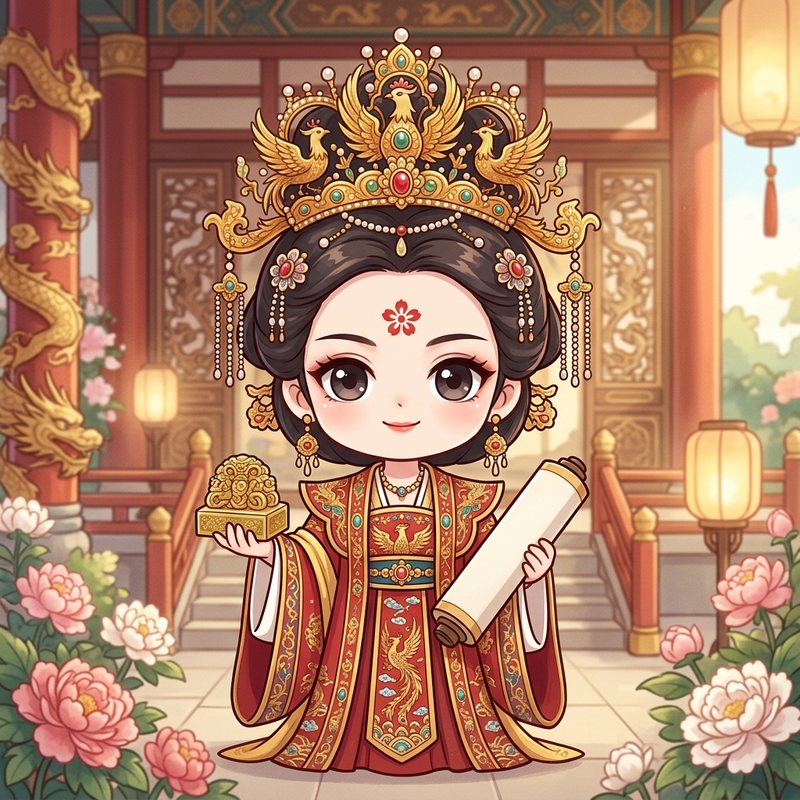
Beneath the golden tiles of the Daming Palace, the young consort Wu Mei nursed a towering ambition. Legend holds that she offered to tame a wild imperial steed with a whip, a hammer, and a dagger—revealing her unflinching resolve even in youth. After Emperor Gaozong took the throne, she weathered the storms of the harem to become Empress. As Gaozong's chronic headaches worsened, she governed behind the curtain for thirty years, revered with him as the 'Two Sages.' She promoted talents like Li Qiao and Luo Binwang, and enacted the 'Twelve Memorials' to lighten taxes and ease the people's burden, winning the hearts of the realm.
Yet beneath the splendor of the age, dark currents swirled. When Emperor Taizong died, childless consorts were by law condemned to the convent. The woman who had once stood beside the throne was cast into the abyss overnight. Shaving her hair, she walked toward the long, bitter silence of Ganye Temple.
“Tomorrow I shall tour the imperial park; herald spring with haste! Let all flowers blossom overnight, wait not for the morning breeze.”
明朝游上苑,火急报春知。花须连夜发,莫待晓风吹。 (Míng zhāo yóu shàng yuàn, huǒ jí bào chūn zhī. Huā xū lián yè fā, mò dài xiǎo fēng chuī.)
Ganye Buddhist Temple (感业寺(幽居削发))
Age 25Modern-day analog: Within historical Chang'an (modern Xi'an, Shaanxi)
Exiled to a Buddhist convent upon Emperor Taizong's death, she endured the darkness with poetic grace until destiny reopened its doors.
The dim lamp of Ganye Temple fell upon the gaunt face of the nun Wu. When Emperor Taizong died, childless consorts were condemned by law to spend their lives as Buddhist nuns—yet she refused to bow to fate. In the long bitterness, she exchanged secret verses with Emperor Gaozong, awakening their old love with the tear-stained 'Ru Yi Niang': 'If you believe not in the tears shed in sorrowful exile, open the chest and examine my pomegranate-dyed silk gown.' With tenderness she overcame hardness, using a single poem to pry open destiny. When they met in tears at the anniversary rite, the chance to return to the Tang court—and to supreme power—finally arrived.
Back in Chang'an, she was no longer the nun of the lamp. From consort to Empress, from Empress to the 'Two Sages' ruling behind the curtain, she climbed step by step to the summit of power. In 690 CE, she ascended the throne at the Ze Tian Gate in Luoyang, founding the Zhou Dynasty and becoming the only legitimate female emperor in Chinese history.
“If you believe not in the tears shed in sorrowful exile, open the chest and examine my pomegranate-dyed silk gown.”
不信比来常下泪,开箱验取石榴裙。 (Bù xìn bǐ lái cháng xià lèi, kāi xiāng yàn qǔ shí liu qún.)
Luoyang (Divine Capital of Zhou) (洛阳(东都 / 神都))
Age 60Modern-day analog: Modern Luoyang, Henan Province
Proclaiming Luoyang as the Divine Capital, she founded the Great Zhou Empire—shattering millennia of patriarchal tradition to rule as Emperor.
Beneath the Ze Tian Gate in Luoyang, the sixty-seven-year-old Wu Zetian ascended the throne, founding the Zhou Dynasty and proclaiming Luoyang the 'Divine Capital.' With an iron hand she shattered millennia of patriarchal rule, personally creating the palace examination (Dianshi) and military exams so that commoner talents could bypass aristocratic monopolies. She promoted such pillars as Di Renjie and Zhang Jianzhi, rewarded agriculture, and secured the frontiers, bringing sustained prosperity to the realm. When Luo Binwang's famous indictment against her swept the empire, she did not rage—she lamented that the chancellery had lost such genius. 'Great radiance fills the world, universal harmony embraces the seas': as a female emperor, she had carved out her own golden age.
Having taken the throne, she performed the supreme Feng Shan rites to consecrate her dynasty before Heaven and Earth. In 696 CE, the aged empress led her ministers up the Central Sacred Peak of Mount Song to offer sacrifice and cast a golden prayer tablet, beseeching peace across the seas.
“Great radiance fills the world, universal harmony embraces the seas. High Heaven looks down with grace to establish our imperial foundation.”
天下光宅,海内雍熙。上玄降鉴,方建隆基。 (Tiān xià guāng zhái, hǎi nèi yōng xī. Shàng xuán jiàng jiàn, fāng jiàn lóng jī.)
Mount Song (Central Sacred Peak) (嵩山(封禅天册))
Age 72Modern-day analog: Modern Dengfeng, Henan Province
Ascending the Central Sacred Peak to perform the ancient Feng Shan rituals, she consecrated her imperial authority between Heaven and Earth.
In the first year of the Wansui Dengfeng era, mist swirled over the summit of Mount Song. The Feng Shan ceremony had long been the supreme rite of legendary male emperors—yet now the seventy-two-year-old empress led her princes and ministers up Mount Taishi to sacrifice to Heaven and Earth. She assumed the title 'Heavenly-Patterned Golden-Wheel Great Sage Emperor,' granted a general amnesty, and changed the reign name to Dengfeng. Solemnly she cast a golden prayer tablet, beseeching divine protection and universal peace. 'Right and wrong, triumphs and faults—Heaven and Earth bear witness.' That tablet, the only surviving artifact in Wu Zetian's own hand, testifies to how a female sovereign consecrated her supreme legitimacy through sacred rites.
The drums of the Feng Shan ceremony faded, and the empress's golden age drew to a close. In 705 CE, the Shenlong Coup erupted as Chancellor Zhang Jianzhi marched on the palace. The eighty-one-year-old Wu Zetian accepted reality with calm dignity, abdicating to Emperor Zhongzong and retiring to Shangyang Palace.
“Right and wrong, triumphs and faults—Heaven and Earth bear witness to all.”
是非功过,天地昭然。 (Shì fēi gōng guò, tiān dì zhāo rán.)
Shangyang Palace (Luoyang) (洛阳上阳宫(仙居归宁))
Age 81Modern-day analog: Imperial gardens in modern Luoyang, Henan Province
Relinquishing power with calm dignity after the Shenlong Coup, she retired to Shangyang Palace, bringing a peaceful conclusion to her dynasty.
Beside the Luo River at Shangyang Palace, the eighty-one-year-old empress lay gravely ill. Facing the Shenlong Coup, she accepted the transition with astonishing clarity, abdicating to Emperor Zhongzong. Her final decree relinquished the title of Emperor, asked to be addressed as 'Empress Zetian Dasheng,' requested burial beside Gaozong at Qianling, and spared her Wu kinsmen from execution. This transcendent decision secured a peaceful passage from Zhou back to the Tang. From the nun of Ganye Temple to the sovereign of the realm, and now to the serene surrender of supreme power, she closed the legend of a female emperor with magnanimity and political wisdom.
The following year, her coffin was laid to rest at Qianling beside Emperor Gaozong. Before the tomb rises a colossal stele over seven meters tall, carved with eight coiling dragons but bearing not a single character. In her deliberate silence, she left her triumphs and faults for posterity to judge.
“Relinquish the imperial title of Emperor, address me as Empress Zetian Dasheng, and bury me alongside Emperor Gaozong at Qianling.”
去帝号,称则天大圣皇后,祔葬乾陵。 (Qù dì hào, chēng Zé Tiān Dà Shèng Huáng Hòu, fù zàng Qián Líng.)
Qianling Imperial Mausoleum (乾陵(无字碑前,天地自知))
Age 82Modern-day analog: Modern Qian County, Xianyang, Shaanxi Province
Laid to rest at Qianling, she erected the iconic Wordless Stele—leaving her monumental legacy for future generations to evaluate without vanity.
Atop Mount Liang at Qianling, the Wordless Stele stands in silent majesty. Seven and a half meters tall and weighing a hundred tons, it is adorned with eight coiling dragons yet bears not a single inscribed character. In a culture saturated with hyperbolic eulogies, her deliberate silence is the ultimate declaration of self-confidence. 'My triumphs and errors, gains and losses—leave them unwritten, that future generations may freely judge.' From the girl of Lizhou to the nun of Ganye Temple, from the consort of Chang'an to the empress of Luoyang, she forged with brilliance the legend of China's only legitimate female sovereign. In wordlessness lies the capacity to hold a thousand years of merit and fault—and to smile at the verdicts of history.
“My triumphs and errors, gains and losses—leave them unwritten, that future generations may freely judge.”
己之功过,是非得失,不着一字,留待后人。 (Jǐ zhī gōng guò, shì fēi dé shī, bù zhuó yí zì, liú dài hòu rén.)